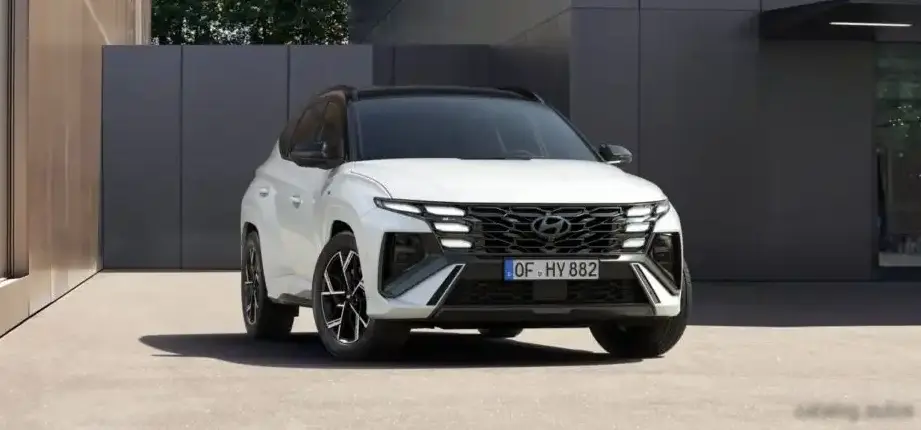
The Hyundai Tucson IV facelift, introduced in May 2024, represents a significant update to Hyundai’s popular compact SUV. Among the various powertrain options available, the 1.6T (215 Hp) Full Hybrid 4WD Automatic variant occupies a prominent position, offering a balance of performance, efficiency, and all-weather capability. This model, produced through September 2025, is built on the 1HX0 platform and caters to buyers seeking a technologically advanced and versatile SUV. It’s positioned as a mid-to-upper trim level within the Tucson IV range, offering more power and features than the base engine options while remaining more accessible than the top-tier trims.
Technical Specifications
| Brand | Hyundai |
| Model | Tucson |
| Generation | Tucson IV (facelift 2024) |
| Type (Engine) | 1.6T (215 Hp) Full Hybrid 4WD Automatic |
| Start of production | May, 2024 |
| End of production | September, 2025 |
| Powertrain Architecture | FHEV (Full Hybrid Electric Vehicle) |
| Body type | SUV |
| Seats | 5 |
| Doors | 5 |
| Fuel consumption at Low speed (WLTP) | 4.7-6.5 l/100 km (50 – 36.2 US mpg, 60.1 – 43.5 UK mpg, 21.3 – 15.4 km/l) |
| Fuel consumption at Medium speed (WLTP) | 3.8-5.6 l/100 km (61.9 – 42 US mpg, 74.3 – 50.4 UK mpg, 26.3 – 17.9 km/l) |
| Fuel consumption at high speed (WLTP) | 5.2-5.5 l/100 km (45.2 – 42.8 US mpg, 54.3 – 51.4 UK mpg, 19.2 – 18.2 km/l) |
| Fuel consumption at very high speed (WLTP) | 7.5-8.0 l/100 km (31.4 – 29.4 US mpg, 37.7 – 35.3 UK mpg, 13.3 – 12.5 km/l) |
| Combined fuel consumption (WLTP) | 5.7-6.6 l/100 km (41.3 – 35.6 US mpg, 49.6 – 42.8 UK mpg, 17.5 – 15.2 km/l) |
| CO2 emissions (WLTP) | 129-149 g/km |
| Fuel Type | Petrol (Gasoline) |
| Acceleration 0 – 100 km/h | 8.5 sec |
| Acceleration 0 – 62 mph | 8.5 sec |
| Acceleration 0 – 60 mph | 8.1 sec |
| Maximum speed | 187 km/h (116.2 mph) |
| Emission standard | Euro 6e |
| Weight-to-power ratio | 8.2 kg/Hp, 121.4 Hp/tonne |
| Weight-to-torque ratio | 6.7 kg/Nm, 149.1 Nm/tonne |
| Battery technology | Lithium-polymer (LiPo) |
| Battery location | Below the floor, under the rear seats |
| Electric motor power | 60 Hp |
| Electric motor Torque | 265 Nm (195.45 lb.-ft.) |
| Electric motor type | Synchronous |
| System power | 215 Hp @ 5500 rpm |
| System torque | 264 Nm @ 1500-4500 rpm (194.72 lb.-ft. @ 1500-4500 rpm) |
| Engine layout | Front, Transverse |
| Engine Model/Code | G4FT |
| Engine displacement | 1598 cm3 (97.52 cu. in.) |
| Number of cylinders | 4 |
| Engine configuration | Inline |
| Cylinder Bore | 75.6 mm (2.98 in.) |
| Piston Stroke | 89 mm (3.5 in.) |
| Compression ratio | 10.5:1 |
| Number of valves per cylinder | 4 |
| Fuel injection system | Direct injection |
| Engine aspiration | Turbocharger, Intercooler |
| Valvetrain | DOHC |
| Engine oil capacity | 4.8 l (5.07 US qt | 4.22 UK qt) |
| Coolant | 7.8 l (8.24 US qt | 6.86 UK qt) |
| Kerb Weight | 1771 kg (3904.39 lbs.) |
| Max. weight | 2250 kg (4960.4 lbs.) |
| Max load | 479 kg (1056.01 lbs.) |
| Trunk (boot) space – minimum | 616 l (21.75 cu. ft.) |
| Trunk (boot) space – maximum | 1795 l (63.39 cu. ft.) |
| Fuel tank capacity | 52 l (13.74 US gal | 11.44 UK gal) |
| Max. roof load | 100 kg (220.46 lbs.) |
| Permitted trailer load with brakes (12%) | 1360 kg (2998.29 lbs.) |
| Permitted trailer load without brakes | 750 kg (1653.47 lbs.) |
| Length | 4510 mm (177.56 in.) |
| Width | 1865 mm (73.43 in.) |
| Height | 1650-1653 mm (64.96 – 65.08 in.) |
| Wheelbase | 2680 mm (105.51 in.) |
| Front track | 1615-1630 mm (63.58 – 64.17 in.) |
| Rear (Back) track | 1622-1637 mm (63.86 – 64.45 in.) |
| Minimum turning circle (turning diameter) | 11 m (36.09 ft.) |
| Drivetrain Architecture | The Internal combustion engine (ICE) and the electric motor permanently drive the front wheels of the vehicle, capable of running in full electric or mixed mode, and if necessary through the electrically or mechanically controlled clutch, the rear wheels are driven. |
| Drive wheel | All wheel drive (4×4) |
| Number of gears and type of gearbox | 6 gears, automatic transmission |
| Front suspension | Independent type McPherson |
| Rear suspension | Independent multi-link suspension |
| Front brakes | Disc |
| Rear brakes | Disc |
| Assisting systems | ABS (Anti-lock braking system) |
| Steering type | Steering rack and pinion |
| Power steering | Electric Steering |
| Tires size | 215/65 R17; 235/55 R18; 235/50 R19 |
| Wheel rims size | 7.0J x 17; 7.5J x 18; 7.5J x 19 |
INTRODUCTION
The Hyundai Tucson IV facelift, launched in 2024, builds upon the success of the fourth-generation Tucson, offering refreshed styling, enhanced technology, and updated powertrain options. The 1.6T Full Hybrid 4WD Automatic variant is a key component of this update, designed to appeal to a broad range of buyers seeking a practical, efficient, and well-equipped SUV. This version combines a turbocharged gasoline engine with an electric motor and a lithium-polymer battery pack, delivering a combined output of 215 horsepower. The inclusion of all-wheel drive further enhances its versatility, making it suitable for various driving conditions. This powertrain option is a significant step up from the base engine choices, offering improved acceleration and overall performance.
Powertrain & Engine Architecture
At the heart of the 1.6T Hybrid is Hyundai’s G4FT engine, a 1.6-liter turbocharged inline-four cylinder gasoline engine. This engine utilizes direct fuel injection and a sophisticated turbocharging system to deliver a balance of power and efficiency. The engine produces 150 hp on its own. Coupled with the 60 hp electric motor, the total system output reaches 215 hp at 5500 rpm and 264 Nm (194.72 lb-ft) of torque between 1500-4500 rpm. The engine features a DOHC valvetrain and a compression ratio of 10.5:1. The hybrid system employs a lithium-polymer battery pack located under the rear seats, providing energy to the electric motor. The power is then sent to all four wheels via a six-speed automatic transmission. This transmission is specifically tuned to work seamlessly with the hybrid system, optimizing fuel efficiency and providing smooth gear changes.
Driving Characteristics
The 1.6T Full Hybrid 4WD Automatic Tucson offers a refined and comfortable driving experience. The combined output of the gasoline engine and electric motor provides ample power for everyday driving situations, with a 0-60 mph acceleration time of around 8.1 seconds. The electric motor provides instant torque, resulting in brisk acceleration from a standstill. The six-speed automatic transmission shifts smoothly and efficiently, contributing to a relaxed driving experience. The all-wheel-drive system provides enhanced traction and stability, particularly in inclement weather conditions. Compared to the base engine options, the 1.6T Hybrid offers a noticeable improvement in performance. While not as sporty as some competitors, it provides a well-rounded driving experience that prioritizes comfort and efficiency.
Equipment & Trim Levels
The 1.6T Full Hybrid 4WD Automatic trim typically includes a comprehensive suite of standard features. These often include automatic climate control, a touchscreen infotainment system with Apple CarPlay and Android Auto compatibility, a rearview camera, and a suite of advanced driver-assistance systems (ADAS) such as lane-keeping assist, forward collision warning, and automatic emergency braking. Higher trim levels may add features such as leather upholstery, a panoramic sunroof, a premium sound system, and adaptive cruise control. Interior upholstery is typically a combination of cloth and leatherette, with options for full leather available on higher trims. The dashboard layout is modern and user-friendly, with a focus on intuitive controls and a clean design.
Chassis & Braking
The Tucson IV utilizes an independent suspension system, with McPherson struts at the front and a multi-link setup at the rear. This suspension configuration provides a comfortable ride quality and good handling characteristics. The chassis is designed to be rigid and lightweight, contributing to improved handling and fuel efficiency. The 1.6T Hybrid variant is equipped with disc brakes on all four wheels, providing ample stopping power. Anti-lock braking system (ABS) is standard, along with electronic stability control and traction control. The steering is electrically assisted, providing a light and responsive feel.
Market Reception & Comparison
The Hyundai Tucson IV facelift, and particularly the 1.6T Full Hybrid 4WD Automatic variant, has been well-received by automotive critics. Reviewers have praised its stylish design, spacious interior, and comprehensive feature set. The hybrid powertrain has been lauded for its fuel efficiency and smooth operation. Compared to other trims in the Tucson lineup, the 1.6T Hybrid offers a compelling balance of performance and economy. It provides more power than the base engine options while delivering better fuel economy than the traditional gasoline engines. In terms of reliability, Hyundai has a strong reputation for building durable and dependable vehicles, and the Tucson IV is expected to continue this trend.
Legacy
The 1.6T Full Hybrid 4WD Automatic powertrain in the Hyundai Tucson IV is poised to become a popular choice in the used car market. Its combination of fuel efficiency, performance, and all-wheel-drive capability makes it an attractive option for buyers seeking a versatile and practical SUV. The hybrid system is expected to be reliable, with the lithium-polymer battery pack offering a long service life. As the Tucson IV continues to gain popularity, this specific variant is likely to hold its value well and become a sought-after model in the years to come.