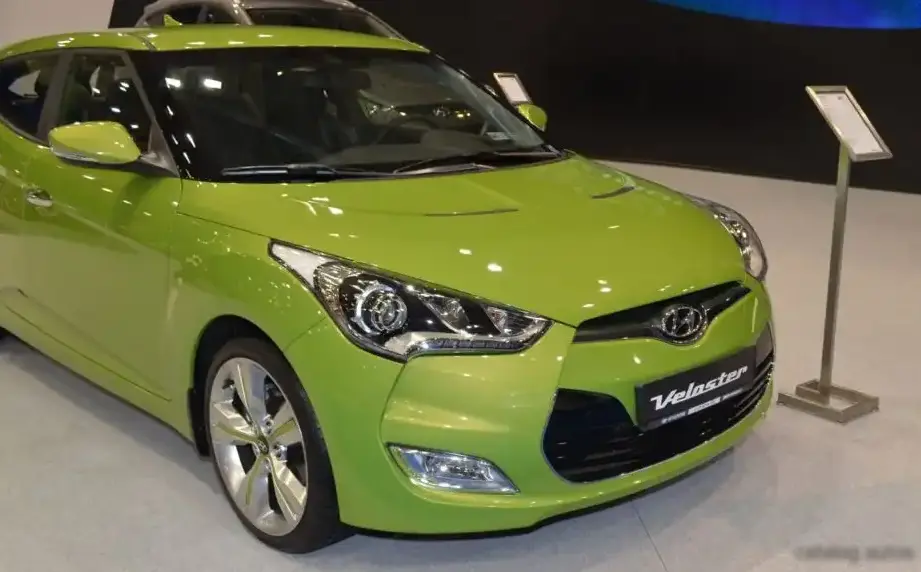
The Hyundai Veloster N 2.0 Turbo GDI, launched in 2019, represents the high-performance variant of Hyundai’s unique three-door coupe. Positioned as the flagship model within the Veloster range, the ‘N’ designation signifies Hyundai’s burgeoning performance division, drawing inspiration from motorsports. This variant aimed to deliver a genuinely engaging driving experience, bridging the gap between affordable compact cars and more established hot hatches. It’s built on the Hyundai-Kia K2 platform, shared with models like the Kia Forte and Hyundai Elantra, but significantly upgraded for track-focused performance. The 2019 model year marked the initial release of the Veloster N in North America, quickly gaining recognition for its value and surprising capabilities.
Technical Specifications
| Brand | Hyundai |
| Model | Veloster |
| Generation | Veloster N |
| Type (Engine) | 2.0 Turbo GDI (250 Hp) |
| Start of production | 2019 |
| Powertrain Architecture | Internal Combustion engine |
| Body type | Coupe, Hatchback |
| Seats | 4 |
| Doors | 4 |
| Fuel consumption (economy) – urban | 10.7 l/100 km (22 US mpg, 26.4 UK mpg, 9.3 km/l) |
| Fuel consumption (economy) – extra urban | 8.4 l/100 km (28 US mpg, 33.6 UK mpg, 11.9 km/l) |
| Fuel consumption (economy) – combined | 9.4 l/100 km (25 US mpg, 30.1 UK mpg, 10.6 km/l) |
| Fuel Type | Petrol (Gasoline) |
| Weight-to-power ratio | 5.5 kg/Hp, 181.6 Hp/tonne |
| Weight-to-torque ratio | 3.9 kg/Nm, 256.4 Nm/tonne |
| Power | 250 Hp @ 6000 rpm |
| Power per litre | 125.1 Hp/l |
| Torque | 353 Nm @ 1450-4000 rpm (260.36 lb.-ft. @ 1450-4000 rpm) |
| Engine layout | Front, Transverse |
| Engine Model/Code | Theta II / G4KH |
| Engine displacement | 1998 cm3 (121.93 cu. in.) |
| Number of cylinders | 4 |
| Engine configuration | Inline |
| Cylinder Bore | 86 mm (3.39 in.) |
| Piston Stroke | 86 mm (3.39 in.) |
| Compression ratio | 9.5:1 |
| Number of valves per cylinder | 4 |
| Fuel injection system | Direct injection |
| Engine aspiration | Turbocharger, Intercooler |
| Valvetrain | DOHC, E-CVVT |
| Engine oil capacity | 4.8 l (5.07 US qt | 4.22 UK qt) |
| Coolant | 7.4 l (7.82 US qt | 6.51 UK qt) |
| Kerb Weight | 1377-1382 kg (3035.77 – 3046.79 lbs.) |
| Max. weight | 1850 kg (4078.55 lbs.) |
| Max load | 468-473 kg (1031.76 – 1042.79 lbs.) |
| Trunk (boot) space – minimum | 563 l (19.88 cu. ft.) |
| Fuel tank capacity | 50 l (13.21 US gal | 11 UK gal) |
| Length | 4265 mm (167.91 in.) |
| Width | 1811 mm (71.3 in.) |
| Height | 1400 mm (55.12 in.) |
| Wheelbase | 2649 mm (104.29 in.) |
| Front track | 1557 mm (61.3 in.) |
| Rear (Back) track | 1567 mm (61.69 in.) |
| Drivetrain Architecture | The Internal combustion engine (ICE) drives the front wheels of the vehicle. |
| Drive wheel | Front wheel drive |
| Number of gears and type of gearbox | 6 gears, manual transmission |
| Front suspension | Independent, type McPherson with coil spring and anti-roll bar |
| Rear suspension | Independent multi-link spring suspension with stabilizer |
| Front brakes | Ventilated discs, 330 mm |
| Rear brakes | Disc, 300 mm |
| Assisting systems | ABS (Anti-lock braking system) |
| Steering type | Steering rack and pinion |
| Power steering | Electric Steering |
| Tires size | 225/40 R18 |
| Wheel rims size | 7.5J x 18 |
Powertrain & Engine Architecture
At the heart of the Veloster N lies the Theta II 2.0-liter turbocharged gasoline direct injection (GDI) engine, designated G4KH. This engine produces 250 horsepower at 6,000 rpm and 260 lb-ft of torque between 1,450 and 4,000 rpm. The engine utilizes a twin-scroll turbocharger, designed to minimize turbo lag and improve responsiveness. Direct injection ensures precise fuel delivery, optimizing combustion efficiency and power output. The engine also features Hyundai’s E-CVVT (Electronic Continuously Variable Valve Timing) system, further enhancing performance and fuel economy. The Veloster N is exclusively offered with a six-speed manual transmission, a deliberate choice by Hyundai to prioritize driver engagement. This transmission features reinforced components to handle the increased power and torque of the ‘N’ engine.
Driving Characteristics
The Veloster N’s driving experience is markedly different from the standard Veloster models. The 250 hp engine, coupled with the close-ratio six-speed manual, delivers brisk acceleration. The turbocharger provides a noticeable surge of power in the mid-range, making overtaking maneuvers effortless. The manual transmission is precise and engaging, with a relatively short throw. Hyundai engineers focused heavily on chassis rigidity, adding extra welding points and bracing to the body shell. This results in minimal body roll and a planted feel during cornering. The suspension is firm, but not overly harsh, providing a good balance between performance and comfort. The exhaust note is also significantly more aggressive than the standard Veloster, adding to the sporty character.
Equipment & Trim Levels
The Veloster N came relatively well-equipped, focusing on performance-oriented features. Standard equipment included sport seats with enhanced bolstering, a leather-wrapped steering wheel, and a performance-tuned suspension. Infotainment was handled by an 8-inch touchscreen display with Apple CarPlay and Android Auto compatibility. Available options included a premium audio system, automatic climate control, and a suite of advanced driver-assistance systems (ADAS) such as forward collision avoidance assist and lane keeping assist. Interior upholstery was primarily cloth, with leather options available. The dashboard layout was functional and driver-focused, with clear instrumentation and easy-to-reach controls.
Chassis & Braking
The Veloster N benefits from significant chassis upgrades compared to the standard Veloster. The front suspension utilizes McPherson struts with coil springs and an anti-roll bar, while the rear features a multi-link setup with a stabilizer bar. Brakes consist of ventilated discs at all four corners, with larger rotors (330mm front, 300mm rear) compared to lower trims. The braking system is designed to withstand repeated hard use, crucial for track driving. The steering is a rack-and-pinion system with electric power assistance, providing precise and responsive steering feel. The car rides on 18-inch alloy wheels with performance tires (225/40 R18), maximizing grip and handling.
Market Reception & Comparison
The Veloster N was generally well-received by automotive critics. It was praised for its engaging driving dynamics, strong performance, and relatively affordable price point. Compared to rivals like the Honda Civic Si and Volkswagen GTI, the Veloster N offered a more raw and visceral driving experience. Fuel economy was respectable, averaging around 25 mpg in combined driving. Reliability reports have been generally positive, although some owners have reported minor issues with the turbocharger and exhaust system. The Veloster N’s unique three-door configuration also set it apart from its competitors, appealing to buyers looking for something different.
Legacy
The Hyundai Veloster N marked a turning point for Hyundai, demonstrating the brand’s commitment to performance and driving enjoyment. The 2.0-liter turbocharged engine and six-speed manual transmission have proven to be relatively durable, with many examples exceeding 100,000 miles without major issues. On the used car market, the Veloster N holds its value well, reflecting its desirability among enthusiasts. It established the ‘N’ sub-brand as a credible competitor in the hot hatch segment, paving the way for future performance models from Hyundai. The Veloster N remains a popular choice for those seeking an affordable and engaging sports coupe.