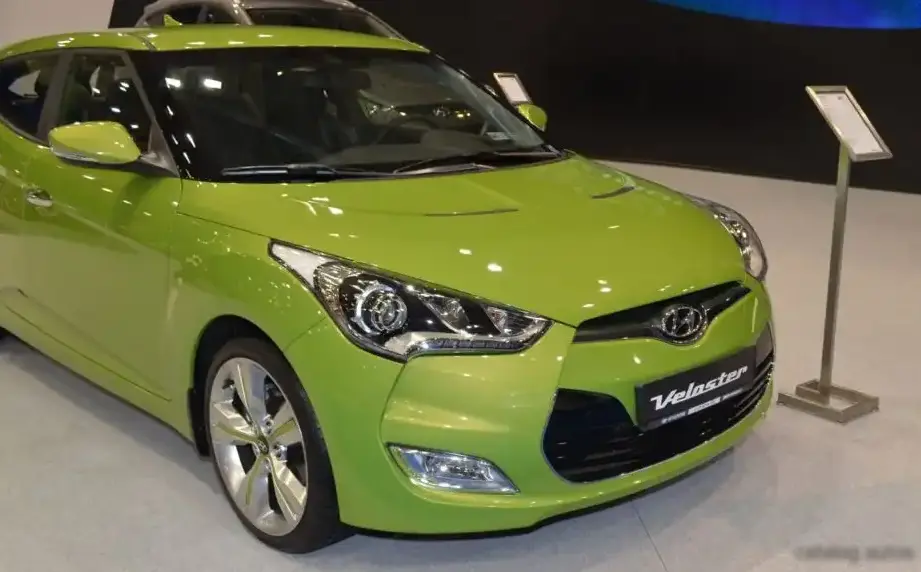
The Hyundai Veloster N 2.0 Turbo GDI, launched in 2019, represents the high-performance variant of Hyundai’s distinctive Veloster coupe. Positioned as the flagship model within the Veloster range, the ‘N’ designation signifies Hyundai’s burgeoning performance division, drawing inspiration from motorsports. This variant aimed to deliver a genuinely engaging driving experience, competing with established hot hatches like the Volkswagen GTI and Honda Civic Si. The Veloster N quickly gained recognition for its accessible performance and playful handling characteristics, marking a significant step forward for Hyundai in the enthusiast market. It’s built on the Hyundai-Kia K2 platform, shared with the Kia Forte, but heavily modified for performance applications.
Technical Specifications
| Brand | Hyundai |
| Model | Veloster |
| Generation | Veloster N |
| Type (Engine) | 2.0 Turbo GDI (275 Hp) |
| Start of production | 2019 |
| Powertrain Architecture | Internal Combustion engine |
| Body type | Coupe, Hatchback |
| Seats | 4 |
| Doors | 4 |
| Fuel consumption (economy) – urban | 10.7 l/100 km (22 US mpg, 26.4 UK mpg, 9.3 km/l) |
| Fuel consumption (economy) – extra urban | 8.4 l/100 km (28 US mpg, 33.6 UK mpg, 11.9 km/l) |
| Fuel consumption (economy) – combined | 9.4 l/100 km (25 US mpg, 30.1 UK mpg, 10.6 km/l) |
| Fuel Type | Petrol (Gasoline) |
| Weight-to-power ratio | 5.1 kg/Hp, 195.2 Hp/tonne |
| Weight-to-torque ratio | 4 kg/Nm, 250.5 Nm/tonne |
| Power | 275 Hp @ 6000 rpm |
| Power per litre | 137.6 Hp/l |
| Torque | 353 Nm @ 1450-4700 rpm (260.36 lb.-ft. @ 1450-4700 rpm) |
| Engine layout | Front, Transverse |
| Engine Model/Code | Theta II / G4KH |
| Engine displacement | 1998 cm3 (121.93 cu. in.) |
| Number of cylinders | 4 |
| Engine configuration | Inline |
| Cylinder Bore | 86 mm (3.39 in.) |
| Piston Stroke | 86 mm (3.39 in.) |
| Compression ratio | 9.5:1 |
| Number of valves per cylinder | 4 |
| Fuel injection system | Direct injection |
| Engine aspiration | Turbocharger, Intercooler |
| Valvetrain | DOHC, E-CVVT |
| Engine oil capacity | 4.8 l (5.07 US qt | 4.22 UK qt) |
| Coolant | 7.4 l (7.82 US qt | 6.51 UK qt) |
| Kerb Weight | 1409-1414 kg (3106.31 – 3117.34 lbs.) |
| Max. weight | 1850 kg (4078.55 lbs.) |
| Max load | 436-441 kg (961.22 – 972.24 lbs.) |
| Trunk (boot) space – minimum | 563 l (19.88 cu. ft.) |
| Fuel tank capacity | 50 l (13.21 US gal | 11 UK gal) |
| Length | 4265 mm (167.91 in.) |
| Width | 1811 mm (71.3 in.) |
| Height | 1394 mm (54.88 in.) |
| Wheelbase | 2649 mm (104.29 in.) |
| Front track | 1554 mm (61.18 in.) |
| Rear (Back) track | 1565 mm (61.61 in.) |
| Drivetrain Architecture | Front wheel drive |
| Number of gears and type of gearbox | 6 gears, manual transmission |
| Front suspension | Independent, type McPherson with coil spring and anti-roll bar |
| Rear suspension | Independent multi-link spring suspension with stabilizer |
| Front brakes | Ventilated discs, 345 mm |
| Rear brakes | Ventilated discs, 315 mm |
| Assisting systems | ABS (Anti-lock braking system) |
| Steering type | Steering rack and pinion |
| Power steering | Electric Steering |
| Tires size | 235/35 R19 |
| Wheel rims size | 8.0J x 19 |
INTRODUCTION
The Hyundai Veloster N 2.0 Turbo GDI, introduced in 2019, marked Hyundai’s serious entry into the performance compact segment. Building upon the unique three-door coupe body style of the standard Veloster, the ‘N’ variant was developed under the direction of Albert Biermann, formerly of BMW M. The goal was to create a car that was not just powerful, but also engaging and rewarding to drive. This model year represented the first generation of the Veloster N, and it quickly became a favorite among driving enthusiasts due to its balanced chassis, potent engine, and relatively affordable price point. It was sold primarily in North America, Europe, and select Asian markets.
Powertrain & Engine Architecture
At the heart of the Veloster N lies the Hyundai Theta II 2.0-liter turbocharged gasoline direct injection (GDI) engine, designated G4KH. This engine produces 275 horsepower at 6000 rpm and 260 lb-ft of torque between 1450 and 4700 rpm. The engine utilizes a twin-scroll turbocharger, which helps to minimize turbo lag and improve responsiveness. Direct injection ensures precise fuel delivery, optimizing combustion efficiency and power output. The engine also features a double overhead camshaft (DOHC) valvetrain with Hyundai’s E-CVVT (Electronic Continuously Variable Valve Timing) system, further enhancing performance and fuel economy. The Veloster N is exclusively offered with a six-speed manual transmission, a deliberate choice by Hyundai to prioritize driver engagement. The transmission features short throws and a precise feel, contributing to the car’s sporty character.
Driving Characteristics
The Veloster N delivers a noticeably more spirited driving experience compared to the standard Veloster models. The 275 hp engine provides ample power for both daily commuting and spirited driving on winding roads. The six-speed manual transmission allows for precise control over gear selection, and the short throw shifter enhances the driving experience. The car’s suspension is tuned for performance, with stiffer springs and dampers compared to the standard Veloster. This results in reduced body roll and improved handling. The steering is well-weighted and provides good feedback, allowing the driver to feel connected to the road. While the front-wheel-drive layout can lead to some torque steer under hard acceleration, the limited-slip differential (standard equipment) helps to mitigate this effect and improve traction. The exhaust note is also significantly more aggressive than the standard Veloster, adding to the car’s sporty character.
Equipment & Trim Levels
The Veloster N came well-equipped as standard, reflecting its performance-oriented positioning. Standard features included a sport-tuned suspension, limited-slip differential, performance brakes, and a sport exhaust system. Inside, the Veloster N featured sport seats with enhanced bolstering, providing excellent support during spirited driving. Infotainment was handled by an 8-inch touchscreen display with Apple CarPlay and Android Auto compatibility. Available options included a premium audio system, automatic climate control, and various cosmetic enhancements. The interior trim was generally focused on functionality and sportiness, with minimal chrome accents and a dark color scheme.
Chassis & Braking
The Veloster N’s chassis underwent significant reinforcement compared to the standard Veloster to handle the increased power and stresses of performance driving. The front suspension utilizes a McPherson strut design with coil springs and an anti-roll bar, while the rear suspension employs a multi-link setup with a stabilizer bar. Braking duties are handled by ventilated disc brakes on all four wheels, measuring 345mm at the front and 315mm at the rear. The braking system provides strong stopping power and good pedal feel. The standard fitment of ABS (Anti-lock Braking System) ensures safe and controlled braking in various conditions.
Market Reception & Comparison
The Veloster N was widely praised by automotive critics for its engaging driving dynamics, strong performance, and value for money. It was often compared favorably to rivals such as the Volkswagen GTI, Honda Civic Si, and Ford Focus ST. Critics noted that the Veloster N offered a more raw and visceral driving experience than some of its more refined competitors. Fuel economy was generally considered to be acceptable for a performance car, with combined fuel consumption figures around 25 US mpg. Reliability reports have been generally positive, although some owners have reported minor issues with the turbocharger and exhaust system.
Legacy
The Hyundai Veloster N 2.0 Turbo GDI established Hyundai as a legitimate player in the performance car market. It demonstrated the company’s commitment to building engaging and rewarding vehicles for driving enthusiasts. The Veloster N has maintained a strong following in the used car market, with well-maintained examples commanding relatively high prices. The powertrain has proven to be generally reliable, although regular maintenance is essential to ensure long-term durability. The Veloster N paved the way for future ‘N’ models from Hyundai, solidifying the brand’s performance credentials and attracting a new generation of customers.