
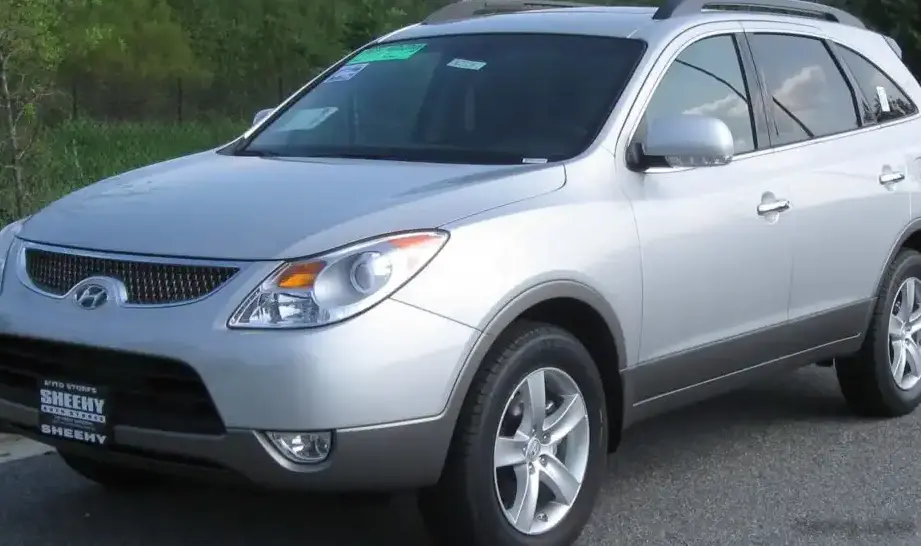
The Hyundai Veracruz 3.8, equipped with a 3.8-liter V6 engine producing 264 horsepower and a six-speed automatic transmission with four-wheel drive, was a significant offering from the Korean automaker in the mid-size SUV segment. Produced from 2006 to 2011, the Veracruz aimed to provide a more premium experience than Hyundai’s earlier SUV offerings, competing with established players like the Honda Pilot, Toyota Highlander, and Ford Explorer. This particular configuration, the 3.8L 4WD Automatic, represented the top-tier engine option for the Veracruz, positioned as the most capable and well-equipped variant in the lineup.
Technical Specifications
| Brand | Hyundai |
| Model | Veracruz |
| Generation | Veracruz |
| Type (Engine) | 3.8 (264 Hp) 4WD Automatic |
| Start of production | 2006 |
| End of production | 2011 |
| Powertrain Architecture | Internal Combustion engine |
| Body type | SUV |
| Seats | 5 |
| Doors | 5 |
| Fuel Type | Petrol (Gasoline) |
| Weight-to-power ratio | 8 kg/Hp, 125.1 Hp/tonne |
| Weight-to-torque ratio | 6.1 kg/Nm, 164.9 Nm/tonne |
| Power | 264 Hp @ 6000 rpm |
| Power per litre | 69.9 Hp/l |
| Torque | 348 Nm @ 4500 rpm, 256.67 lb.-ft. @ 4500 rpm |
| Engine layout | Front, Transverse |
| Engine Model/Code | Lambda / G6DA |
| Engine displacement | 3778 cm3, 230.55 cu. in. |
| Number of cylinders | 6 |
| Engine configuration | V-engine |
| Cylinder Bore | 96 mm, 3.78 in. |
| Piston Stroke | 87 mm, 3.43 in. |
| Compression ratio | 10.4:1 |
| Number of valves per cylinder | 4 |
| Fuel injection system | Multi-port manifold injection |
| Engine aspiration | Naturally aspirated engine |
| Valvetrain | DOHC |
| Engine oil capacity | 5.2 l, 5.49 US qt | 4.58 UK qt |
| Coolant | 10.5 l, 11.1 US qt | 9.24 UK qt |
| Kerb Weight | 2110 kg, 4651.75 lbs |
| Fuel tank capacity | 78 l, 20.61 US gal | 17.16 UK gal |
| Length | 4840 mm, 190.55 in |
| Width | 1970 mm, 77.56 in |
| Height | 1805 mm, 71.06 in |
| Wheelbase | 2805 mm, 110.43 in |
| Front track | 1670 mm, 65.75 in |
| Rear (Back) track | 1670 mm, 65.75 in |
| Ride height (ground clearance) | 205 mm, 8.07 in |
| Drag coefficient (Cd) | 0.38 |
| Minimum turning circle (turning diameter) | 11.4 m, 37.4 ft |
| Drive wheel | All wheel drive (4×4) |
| Number of gears and type of gearbox | 6 gears, automatic transmission |
| Front brakes | Ventilated discs |
| Rear brakes | Disc |
| Assisting systems | ABS (Anti-lock braking system) |
| Tires size | 245/60 R18 H |
| Wheel rims size | 18 |
Powertrain & Engine Architecture
The heart of the Veracruz 3.8 was Hyundai’s Lambda engine, specifically the G6DA variant. This 3.8-liter, naturally aspirated V6 engine featured a 60-degree V-angle and utilized a dual overhead camshaft (DOHC) valvetrain with four valves per cylinder. The engine employed multi-port fuel injection, delivering fuel directly into the intake ports. The Lambda engine was known for its relatively smooth operation and decent power output for its displacement. The six-speed automatic transmission, sourced from Hyundai’s own development, was designed to provide smooth shifts and efficient power delivery. This transmission featured a torque converter and offered a ‘Shiftronic’ manual shift mode, allowing drivers some control over gear selection. The 4WD system was an electronically controlled, full-time system, distributing power between the front and rear axles as needed to maximize traction.
Driving Characteristics
The Veracruz 3.8 4WD Automatic offered a comfortable and capable driving experience. While not a performance-oriented SUV, the 264 horsepower and 256 lb-ft of torque provided adequate acceleration for everyday driving and highway merging. The automatic transmission was generally smooth, although some reviewers noted a slight hesitation during downshifts. Compared to the base 3.0-liter V6 engine option, the 3.8L provided a noticeable increase in power and responsiveness. The 4WD system enhanced stability and traction, particularly in inclement weather conditions. The gear ratios were tuned for a balance of fuel efficiency and usability, prioritizing smooth cruising over aggressive acceleration. The overall driving experience was geared towards comfort and practicality rather than sporty handling.
Equipment & Trim Levels
The Veracruz 3.8 4WD Automatic typically came well-equipped, reflecting its position as the top-of-the-line trim. Standard features often included leather upholstery, heated front seats, a power-adjustable driver’s seat, automatic climate control, a premium sound system, and alloy wheels. Optional extras could include a navigation system, a sunroof, and rear-seat entertainment. The interior design was generally considered upscale for its time, with a focus on comfort and convenience. The dashboard layout was straightforward and easy to use, with logically placed controls. The Veracruz aimed to offer a similar level of features and refinement as its Japanese and American competitors.
Chassis & Braking
The Veracruz utilized a traditional body-on-frame construction, providing a robust and durable platform. The suspension consisted of independent front suspension with coil springs and a multi-link rear suspension, also with coil springs. This setup aimed to provide a comfortable ride while maintaining reasonable handling characteristics. The braking system featured ventilated front discs and solid rear discs, equipped with an Anti-lock Braking System (ABS) as standard. The ABS helped to maintain steering control during hard braking. The 18-inch wheels were fitted with 245/60 R18 tires, providing a good balance of grip and ride comfort.
Market Reception & Comparison
The Hyundai Veracruz 3.8 4WD Automatic was generally well-received by automotive critics. It was praised for its spacious interior, comfortable ride, and generous features list. However, some reviewers noted that its handling was not as sharp as some of its competitors. Fuel economy was considered average for the segment. Compared to the base 3.0-liter Veracruz, the 3.8L offered a significant performance upgrade, but at a higher price point. The 3.8L was also more expensive to maintain due to its larger engine and more complex components. In terms of reliability, the Veracruz generally proved to be a dependable vehicle, although some owners reported minor issues with the automatic transmission and electrical systems.
Legacy
The Hyundai Veracruz played a crucial role in establishing Hyundai as a serious contender in the mid-size SUV market. It demonstrated the automaker’s ability to produce a vehicle that could compete with established brands in terms of quality, features, and refinement. While the Veracruz was eventually replaced by the Santa Fe, the 3.8L 4WD Automatic remains a popular choice in the used car market. Its combination of power, space, and features makes it a practical and affordable option for families and individuals seeking a capable SUV. The Lambda engine, in particular, has proven to be a durable and reliable powerplant, contributing to the Veracruz’s long-term appeal. Today, well-maintained examples of the Veracruz 3.8 can still provide years of reliable service.
