
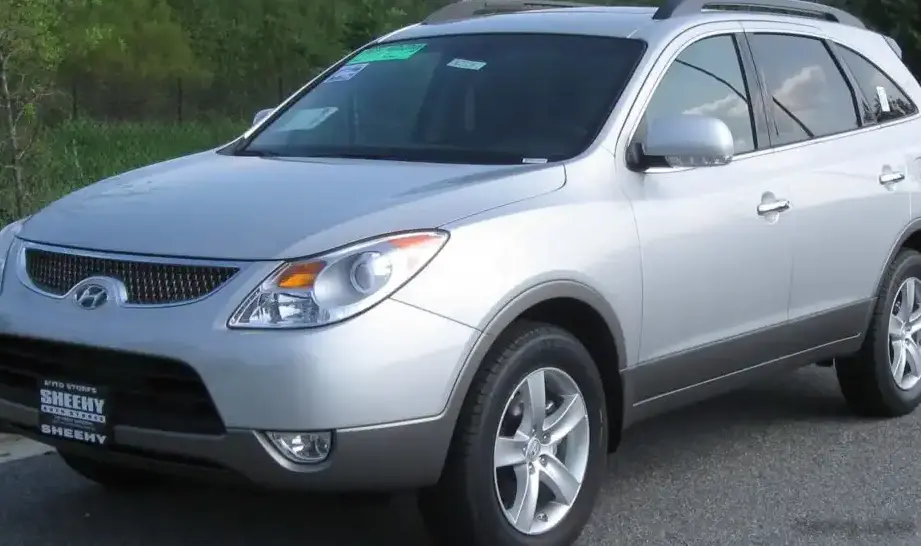
The Hyundai Veracruz 3.8 MPI Automatic, produced from 2011 to 2013, represented a significant offering in Hyundai’s lineup as a mid-size crossover SUV. Positioned as a step up from the Santa Fe, the Veracruz aimed to provide a more premium experience with increased space and available features. This particular variant, equipped with the 3.8-liter V6 engine and a six-speed automatic transmission, served as a popular choice for buyers seeking a balance of power, comfort, and practicality. It was sold primarily in North America, South Korea, and select international markets, representing Hyundai’s ambition to compete with established Japanese and American SUV brands.
Technical Specifications
| Brand | Hyundai |
| Model | Veracruz |
| Generation | Veracruz |
| Type (Engine) | 3.8 MPI (260 Hp) Automatic |
| Start of production | 2011 |
| End of production | 2013 |
| Powertrain Architecture | Internal Combustion engine |
| Body type | SUV |
| Seats | 5 |
| Doors | 5 |
| Fuel consumption (urban) | 16.7 l/100 km (14.1 US mpg) |
| Fuel consumption (extra urban) | 8.6 l/100 km (27.4 US mpg) |
| Fuel consumption (combined) | 11.6 l/100 km (20.3 US mpg) |
| CO2 emissions | 275 g/km |
| Fuel Type | Petrol (Gasoline) |
| Acceleration 0 – 100 km/h | 8.1 sec |
| Acceleration 0 – 62 mph | 8.1 sec |
| Acceleration 0 – 60 mph | 7.7 sec |
| Maximum speed | 190 km/h (118.06 mph) |
| Weight-to-power ratio | 7.3 kg/Hp |
| Weight-to-torque ratio | 5.4 kg/Nm |
| Power | 260 Hp @ 6000 rpm |
| Torque | 348 Nm @ 4500 rpm (256.67 lb.-ft. @ 4500 rpm) |
| Engine layout | Front, Transverse |
| Engine Model/Code | Lambda / G6DA |
| Engine displacement | 3778 cm3 (230.55 cu. in.) |
| Number of cylinders | 6 |
| Engine configuration | V-engine |
| Cylinder Bore | 96 mm (3.78 in.) |
| Piston Stroke | 87 mm (3.43 in.) |
| Compression ratio | 10.4:1 |
| Number of valves per cylinder | 4 |
| Fuel injection system | Multi-port manifold injection |
| Engine aspiration | Naturally aspirated engine |
| Valvetrain | DOHC |
| Engine oil capacity | 5.2 l (5.49 US qt | 4.58 UK qt) |
| Coolant capacity | 10.5 l (11.1 US qt | 9.24 UK qt) |
| Kerb Weight | 1888 kg (4162.33 lbs.) |
| Max. weight | 2560 kg (5643.83 lbs.) |
| Max load | 672 kg (1481.51 lbs.) |
| Fuel tank capacity | 78 l (20.61 US gal | 17.16 UK gal) |
| Length | 4840 mm (190.55 in.) |
| Width | 1970 mm (77.56 in.) |
| Height | 1795 mm (70.67 in.) |
| Wheelbase | 2805 mm (110.43 in.) |
| Front track | 1670 mm (65.75 in.) |
| Rear track | 1670 mm (65.75 in.) |
| Ride height (ground clearance) | 205 mm (8.07 in.) |
| Drag coefficient (Cd) | 0.38 |
| Minimum turning circle | 11.4 m (37.4 ft.) |
| Drivetrain Architecture | Front wheel drive |
| Number of gears | 6 |
| Gearbox type | Automatic transmission |
| Front brakes | Ventilated discs |
| Rear brakes | Disc |
| Assisting systems | ABS (Anti-lock braking system) |
| Tires size | 245/65 R17 |
| Wheel rims size | 17 |
INTRODUCTION
The Hyundai Veracruz 3.8 MPI Automatic, produced between 2011 and 2013, was a key model in Hyundai’s push to establish itself as a serious contender in the mid-size SUV segment. Built on the Hyundai-Kia Y6 platform (also known as the 1HX0/A3 platform), the Veracruz offered a more refined and spacious alternative to the smaller Santa Fe. This 3.8-liter V6 automatic configuration was positioned as the mainstream offering, balancing performance and fuel economy for a broad range of buyers. It represented a significant step forward in terms of interior quality and features compared to earlier Hyundai SUVs.
Powertrain & Engine Architecture
At the heart of the Veracruz 3.8 MPI Automatic lies the Hyundai Lambda engine, specifically the G6DA variant. This 3.8-liter (3778 cc) naturally aspirated V6 engine utilizes a 60-degree V-angle configuration. It features a dual overhead camshaft (DOHC) valvetrain with four valves per cylinder, contributing to its respectable power output. The engine employs multi-port fuel injection (MPI) for precise fuel delivery. The Lambda engine was known for its relatively smooth operation and durability. The six-speed automatic transmission, sourced from Hyundai’s own development, was designed to provide smooth shifts and efficient power delivery. This transmission featured a torque converter and electronically controlled shifting, optimizing performance for both city and highway driving.
Driving Characteristics
The Veracruz 3.8 MPI Automatic offered a comfortable and composed driving experience. With 260 horsepower and 256.67 lb-ft of torque, the V6 engine provided adequate acceleration for everyday driving and highway merging. While not a performance-oriented SUV, the 0-60 mph time of around 7.7 seconds was respectable for its class. The six-speed automatic transmission contributed to a relatively smooth and refined driving experience, although it wasn’t as quick to downshift as some of its competitors. The front-wheel-drive configuration provided good traction in most conditions, and the suspension was tuned for comfort, absorbing bumps and irregularities in the road effectively. Compared to the base 2.7-liter four-cylinder Veracruz, the 3.8 MPI offered a noticeable improvement in acceleration and overall responsiveness. It lacked the sporty feel of some rear-wheel-drive SUVs, but it excelled in providing a comfortable and practical driving experience.
Equipment & Trim Levels
The Veracruz 3.8 MPI Automatic typically came well-equipped, even in its base trim. Standard features generally included air conditioning, power windows and locks, a CD/MP3 stereo system, and alloy wheels. Higher trim levels, such as the Limited, added features like leather upholstery, a sunroof, a navigation system, and a premium sound system. Interior upholstery was typically cloth on the base model, with leather available as an upgrade. The dashboard layout was functional and user-friendly, with clearly labeled controls. Optional extras included a rear-seat entertainment system, heated seats, and a backup camera.
Chassis & Braking
The Veracruz utilized a front-wheel-drive platform with an independent suspension setup at all four corners. The front suspension consisted of MacPherson struts, while the rear featured a multi-link design. This configuration provided a good balance of ride comfort and handling. The braking system consisted of ventilated discs at the front and solid discs at the rear. Anti-lock brakes (ABS) were standard, enhancing safety and control during emergency braking situations. The suspension was tuned to prioritize comfort over sporty handling, resulting in a smooth and stable ride. Stabilizer bars were included at both the front and rear to reduce body roll during cornering.
Market Reception & Comparison
The Hyundai Veracruz 3.8 MPI Automatic was generally well-received by automotive critics. It was praised for its spacious interior, comfortable ride, and generous features list. However, some critics noted that its styling was somewhat conservative compared to some of its competitors. Fuel economy was considered average for its class, with combined fuel consumption around 20.3 US mpg. Compared to other SUVs in its segment, such as the Honda Pilot and Toyota Highlander, the Veracruz offered a competitive value proposition, often undercutting its rivals in price while offering similar levels of equipment. Reliability was generally good, although some owners reported minor issues with the automatic transmission over the long term.
Legacy
The Hyundai Veracruz, while discontinued after 2013, remains a relatively reliable and affordable option in the used car market. The 3.8-liter V6 engine and six-speed automatic transmission have proven to be reasonably durable, although regular maintenance is essential. The Veracruz’s spacious interior and comfortable ride continue to appeal to buyers seeking a practical and family-friendly SUV. While it may not have the brand recognition of some of its competitors, the Veracruz represents a significant step forward for Hyundai in terms of quality and refinement, paving the way for the successful Santa Fe and Palisade models that followed.
