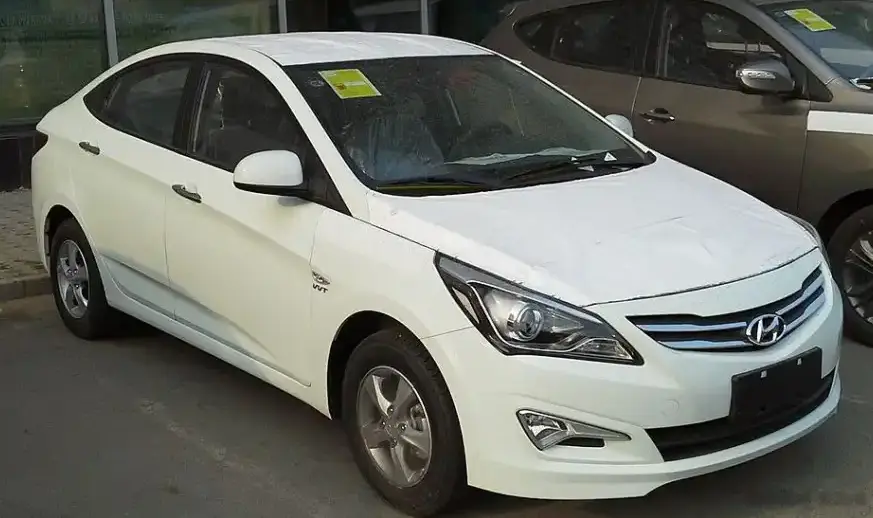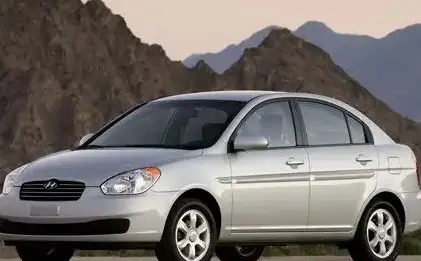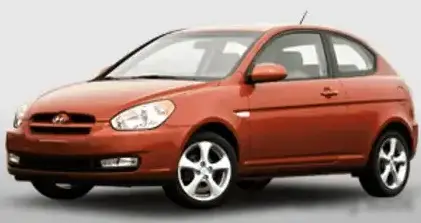
The Hyundai Verna Hatchback 1.4 i 16V (97 hp) was a subcompact car produced by Hyundai from 2006 to 2009. Positioned as an entry-level offering within the Verna range, this variant catered to buyers seeking an affordable and practical hatchback. It was primarily sold in markets outside of North America, serving as a key model in Hyundai’s expansion into Europe and other international regions. This particular configuration, with its 1.4-liter engine and five-speed manual transmission, represented a balance between fuel efficiency and acceptable performance for urban driving.
Technical Specifications
| Brand | Hyundai |
| Model | Verna |
| Generation | Verna Hatchback |
| Type (Engine) | 1.4 i 16V (97 Hp) |
| Start of production | 2006 |
| End of production | 2009 |
| Powertrain Architecture | Internal Combustion engine |
| Body type | Hatchback |
| Seats | 5 |
| Doors | 3 |
| Fuel consumption (urban) | 8 l/100 km (29.4 US mpg) |
| Fuel consumption (extra urban) | 5.1 l/100 km (46.1 US mpg) |
| Fuel Type | Petrol (Gasoline) |
| Acceleration 0 – 100 km/h | 12.3 sec |
| Acceleration 0 – 62 mph | 12.3 sec |
| Acceleration 0 – 60 mph | 11.7 sec |
| Maximum speed | 177 km/h (109.98 mph) |
| Weight-to-power ratio | 10.8 kg/Hp |
| Power | 97 Hp |
| Engine Model/Code | Alpha II / G4EE |
| Engine aspiration | Naturally aspirated |
| Engine oil capacity | 3.3 l (3.49 US qt) |
| Coolant capacity | 5.5 l (5.81 US qt) |
| Kerb Weight | 1050 kg (2314.85 lbs) |
| Max. weight | 1595 kg (3516.37 lbs) |
| Max load | 545 kg (1201.52 lbs) |
| Trunk (boot) space – minimum | 367 l (12.96 cu. ft) |
| Trunk (boot) space – maximum | 801 l (28.29 cu. ft) |
| Fuel tank capacity | 45 l (11.89 US gal) |
| Length | 4280 mm (168.5 in) |
| Width | 1695 mm (66.73 in) |
| Height | 1470 mm (57.87 in) |
| Wheelbase | 2500 mm (98.43 in) |
| Front track | 1470 mm (57.87 in) |
| Rear track | 1460 mm (57.48 in) |
| Drivetrain Architecture | Front wheel drive |
| Number of gears | 5 |
| Gearbox type | Manual transmission |
| Front suspension | Independent, McPherson with coil spring and anti-roll bar |
| Rear suspension | Coil spring |
| Front brakes | Disc |
| Rear brakes | Drum |
| Assisting systems | ABS |
| Steering type | Steering rack and pinion |
| Tires size | 185/65 R14 |
Powertrain & Engine Architecture
The Verna Hatchback 1.4 i 16V was powered by Hyundai’s Alpha II engine, specifically the G4EE code. This 1.4-liter, naturally aspirated inline-four engine featured a single overhead camshaft (SOHC) design with four valves per cylinder. Fuel delivery was managed by a multi-point fuel injection system, providing a reasonable balance between efficiency and performance. The engine produced 97 horsepower and approximately 127 Nm (94 lb-ft) of torque. The five-speed manual transmission was the standard offering for this variant, providing drivers with direct control over gear selection. The transmission was chosen for its simplicity and cost-effectiveness, contributing to the vehicle’s affordability.
Driving Characteristics
The 1.4-liter engine, paired with the five-speed manual, offered adequate performance for typical urban and suburban driving. Acceleration was not particularly brisk, with a 0-60 mph time of around 11.7 seconds, but it was sufficient for everyday commuting. The gear ratios were tuned for fuel economy, meaning the engine needed to be revved relatively high to achieve optimal acceleration. Compared to the more powerful engine options available in the Verna lineup, such as the 1.6-liter, this variant felt noticeably less responsive. However, the lighter engine weight contributed to better handling and a more nimble feel in city traffic. The manual transmission allowed for greater driver engagement and control compared to the optional automatic transmission.
Equipment & Trim Levels
The 1.4 i 16V Verna Hatchback typically came with a basic level of standard equipment. This included power steering, central locking, and an AM/FM radio. Air conditioning was often an optional extra. Interior upholstery was typically cloth, with a relatively simple dashboard layout. Higher trim levels, if available, might have included features like power windows, alloy wheels, and a more sophisticated audio system. The focus of this variant was on providing essential transportation at an affordable price point, so luxury features were generally limited.
Chassis & Braking
The Verna Hatchback utilized a front-wheel-drive layout with an independent McPherson strut suspension in the front and a coil spring suspension in the rear. The front suspension incorporated an anti-roll bar to reduce body roll during cornering. Braking duties were handled by disc brakes in the front and drum brakes in the rear. ABS (Anti-lock Braking System) was included as a standard safety feature. The suspension setup was tuned for comfort, providing a reasonably smooth ride over typical road surfaces. The drum brakes on the rear were a cost-saving measure, and while adequate for normal driving, they didn’t offer the same stopping power as disc brakes.
Market Reception & Comparison
The Hyundai Verna Hatchback 1.4 i 16V was generally well-received as an affordable and practical option in its segment. Critics praised its fuel efficiency and reasonable running costs. However, some reviewers noted that the engine lacked power, particularly when fully loaded or driving on inclines. Compared to other subcompact hatchbacks available at the time, such as the Ford Fiesta or Volkswagen Polo, the Verna offered a competitive price point and a generous amount of interior space. The 1.6-liter Verna offered significantly more performance, but at a higher price. The 1.4-liter version appealed to buyers prioritizing economy and affordability over outright speed.
Legacy
The Hyundai Verna Hatchback 1.4 i 16V has proven to be a relatively reliable vehicle in the used car market. The Alpha II engine is known for its durability, and with regular maintenance, it can provide many years of service. Common issues are typically related to wear and tear on suspension components and brake systems. Parts availability is generally good, and repair costs are relatively low. Today, these vehicles are often sought after as affordable and economical transportation options, particularly by first-time car buyers or those seeking a practical city car. While not a performance icon, the Verna 1.4 i 16V played a significant role in establishing Hyundai as a competitive player in the global automotive market.