Technical Specifications
| Brand | Hyundai |
| Model | Verna |
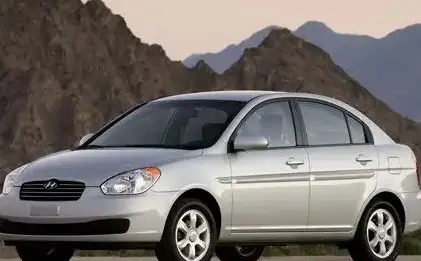
| Generation | Verna Sedan |
| Type (Engine) | 1.6 i 16V (112 Hp) |
| Start of production | 2006 |
| End of production | 2009 |
| Powertrain Architecture | Internal Combustion engine |
| Body type | Sedan |
| Seats | 5 |
| Doors | 4 |
| Fuel consumption (urban) | 8.4 l/100 km (28 US mpg) |
| Fuel consumption (extra urban) | 5.2 l/100 km (45.2 US mpg) |
| Fuel Type | Petrol (Gasoline) |
| Acceleration 0 – 100 km/h | 10.2 sec |
| Acceleration 0 – 62 mph | 10.2 sec |
| Acceleration 0 – 60 mph | 9.7 sec |
| Maximum speed | 190 km/h (118.06 mph) |
| Weight-to-power ratio | 9.2 kg/Hp |
| Weight-to-torque ratio | 7.1 kg/Nm |
| Power | 112 Hp @ 6000 rpm |
| Torque | 146 Nm @ 4500 rpm (107.68 lb.-ft. @ 4500 rpm) |
| Engine layout | Front, Transverse |
| Engine Model/Code | Alpha II / G4ED |
| Engine displacement | 1599 cm3 (97.58 cu. in.) |
| Number of cylinders | 4 |
| Engine configuration | Inline |
| Cylinder Bore | 76.5 mm (3.01 in.) |
| Piston Stroke | 87 mm (3.43 in.) |
| Compression ratio | 10:1 |
| Number of valves per cylinder | 4 |
| Fuel injection system | Multi-port manifold injection |
| Engine aspiration | Naturally aspirated engine |
| Valvetrain | DOHC |
| Engine oil capacity | 3.3 l (3.49 US qt | 2.9 UK qt) |
| Coolant capacity | 5.5 l (5.81 US qt | 4.84 UK qt) |
| Kerb Weight | 1035 kg (2281.78 lbs.) |
| Max. weight | 1580 kg (3483.3 lbs.) |
| Max load | 545 kg (1201.52 lbs.) |
| Trunk (boot) space – maximum | 390 l (13.77 cu. ft.) |
| Fuel tank capacity | 45 l (11.89 US gal | 9.9 UK gal) |
| Length | 4280 mm (168.5 in.) |
| Width | 1695 mm (66.73 in.) |
| Height | 1470 mm (57.87 in.) |
| Wheelbase | 2500 mm (98.43 in.) |
| Front track | 1470 mm (57.87 in.) |
| Rear (Back) track | 1460 mm (57.48 in.) |
| Drivetrain Architecture | Front wheel drive |
| Number of gears and type of gearbox | 5 gears, manual transmission |
| Front suspension | Independent, type McPherson with coil spring and anti-roll bar |
| Rear suspension | Coil spring |
| Front brakes | Disc |
| Rear brakes | Drum |
| Assisting systems | ABS (Anti-lock braking system) |
| Steering type | Steering rack and pinion |
| Tires size | 185/65 R14 |
The Hyundai Verna Sedan 1.6 i 16V (112 Hp) was a key model in Hyundai’s expansion into global markets. Introduced as part of the second-generation Verna (internally designated as the XCD), this model aimed to offer a more refined and modern alternative to existing compact sedans. The 1.6L engine and five-speed manual transmission combination was a popular choice, providing a balance between performance and fuel economy. This variant was particularly important in markets where fuel efficiency and affordability were paramount, such as Eastern Europe, South America, and parts of Asia. It represented Hyundai’s growing commitment to producing vehicles that could compete on a global scale.
Powertrain & Engine Architecture
At the heart of the Verna 1.6 i 16V lies the Hyundai Alpha II engine, specifically the G4ED code. This 1.6-liter inline-four cylinder engine utilizes a multi-port fuel injection (MPI) system, delivering fuel directly into the intake ports. The engine features a double overhead camshaft (DOHC) valvetrain, operating 16 valves (four per cylinder) to optimize airflow and enhance volumetric efficiency. The 10:1 compression ratio was a standard for the time, balancing performance and fuel economy. The engine’s design prioritized reliability and ease of maintenance. The five-speed manual transmission was a conventional design, offering smooth and precise gear changes. The transmission’s gear ratios were tuned to provide adequate acceleration while maintaining reasonable fuel consumption at highway speeds.
Driving Characteristics
The 112 horsepower and 146 Nm (107.68 lb-ft) of torque produced by the 1.6L engine provided adequate, though not exhilarating, performance. Acceleration from 0-60 mph took approximately 9.7 seconds, and the car had a top speed of around 118 mph. Compared to higher-output Verna variants (if available in certain markets), this version felt less responsive, particularly during overtaking maneuvers. However, the 1.6L engine offered a smoother and more refined driving experience than smaller displacement engines. The manual transmission allowed for greater driver control, and the gear ratios were well-suited for everyday driving conditions. The suspension provided a comfortable ride, absorbing bumps and imperfections in the road surface effectively. However, it wasn’t particularly sporty, with noticeable body roll during cornering.
Equipment & Trim Levels
The Verna 1.6 i 16V typically came equipped with a reasonable level of standard features. These generally included power steering, air conditioning, power windows, and central locking. Interior upholstery was typically cloth, with a relatively simple dashboard layout. Depending on the market and optional packages, features like an audio system with CD player, alloy wheels, and fog lights could be added. Safety features typically included dual front airbags and ABS (Anti-lock Braking System). Higher trim levels might have included features like a sunroof, upgraded audio system, and leather upholstery.
Chassis & Braking
The Verna utilized a front-wheel-drive layout with an independent McPherson strut suspension in the front and a coil spring suspension in the rear. The front suspension incorporated an anti-roll bar to reduce body roll during cornering. Braking duties were handled by disc brakes in the front and drum brakes in the rear. The ABS system helped to prevent wheel lockup during hard braking, improving stability and control. The chassis was designed to provide a balance between ride comfort and handling. The steering system employed a rack and pinion setup, offering precise and responsive steering feel.
Market Reception & Comparison
The Hyundai Verna 1.6 i 16V was generally well-received by critics as a practical and affordable compact sedan. It was praised for its fuel efficiency, comfortable ride, and reasonable level of standard features. However, some critics noted that its performance was not as exciting as some of its competitors. Compared to other trims in the Verna lineup, the 1.6L version offered a more economical option for buyers who prioritized fuel efficiency and affordability over outright performance. It was often seen as a good choice for first-time car buyers or those seeking a reliable and economical daily driver.
Legacy
The Hyundai Verna 1.6 i 16V has proven to be a relatively reliable vehicle, with many examples still on the road today. The Alpha II engine is known for its durability and relatively low maintenance costs. While not a particularly collectible car, it holds a place in Hyundai’s history as a key model that helped establish the brand as a serious competitor in the global automotive market. In the used car market, these Vernas are often sought after for their affordability and practicality, making them a popular choice for budget-conscious buyers. Common maintenance issues typically involve wear and tear items such as brakes, suspension components, and exhaust systems. Overall, the Verna 1.6 i 16V remains a testament to Hyundai’s commitment to providing value and reliability.