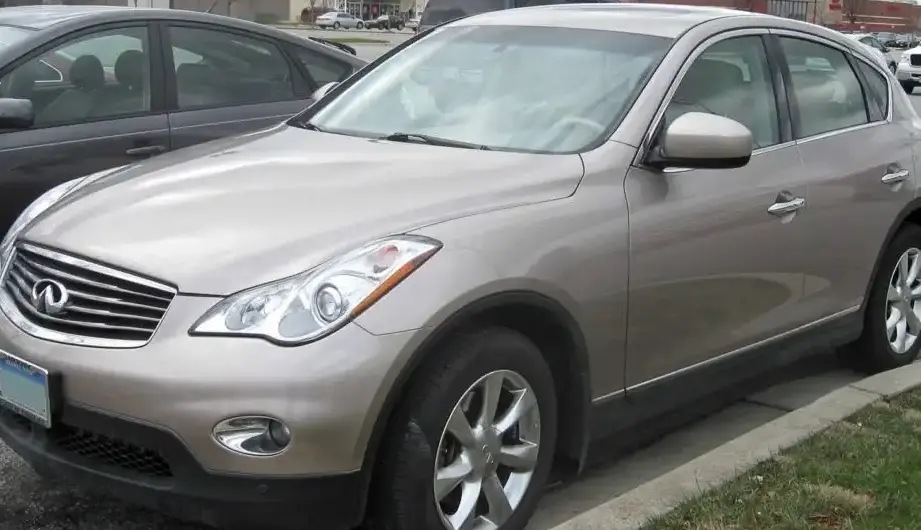
Technical Specifications
| Brand | Infiniti |
| Model | EX |
| Generation | EX 35 |
| Type (Engine) | 3.5i V6 (302 Hp) 4WD Automatic |
| Start of production | 2009 |
| End of production | 2013 |
| Powertrain Architecture | Internal Combustion engine |
| Body type | SUV |
| Seats | 5 |
| Doors | 5 |
| Fuel consumption (urban) | 15.9 l/100 km (14.8 US mpg, 17.8 UK mpg, 6.3 km/l) |
| Fuel consumption (extra urban) | 10.2 l/100 km (23.1 US mpg, 27.7 UK mpg, 9.8 km/l) |
| Fuel consumption (combined) | 12.3 l/100 km (19.1 US mpg, 23 UK mpg, 8.1 km/l) |
| Fuel Type | Petrol (Gasoline) |
| Acceleration 0 – 100 km/h | 6.9 sec |
| Acceleration 0 – 62 mph | 6.9 sec |
| Acceleration 0 – 60 mph | 6.6 sec |
| Maximum speed | 231 km/h (143.54 mph) |
| Emission standard | Euro 4 |
| Weight-to-power ratio | 6.4 kg/Hp, 156.3 Hp/tonne |
| Power | 302 Hp |
| Power per litre | 86.3 Hp/l |
| Engine layout | Front, Longitudinal |
| Engine Model/Code | VQ35HR |
| Engine displacement | 3500 cm3 (213.58 cu. in.) |
| Number of cylinders | 6 |
| Engine configuration | V-engine |
| Number of valves per cylinder | 4 |
| Fuel injection system | Multi-port manifold injection |
| Engine aspiration | Naturally aspirated engine |
| Valvetrain | DOHC |
| Engine oil capacity | 4.9 l (5.18 US qt, 4.31 UK qt) |
| Coolant capacity | 8.6 l (9.09 US qt, 7.57 UK qt) |
| Kerb Weight | 1932 kg (4259.33 lbs.) |
| Trunk (boot) space (minimum) | 309 l (10.91 cu. ft.) |
| Fuel tank capacity | 80 l (21.13 US gal, 17.6 UK gal) |
| Length | 4630 mm (182.28 in.) |
| Width | 1800 mm (70.87 in.) |
| Height | 1575 mm (62.01 in.) |
| Wheelbase | 2800 mm (110.24 in.) |
| Front track | 1540 mm (60.63 in.) |
| Rear track | 1545 mm (60.83 in.) |
| Drive wheel | All wheel drive (4×4) |
| Number of gears and type of gearbox | 5 gears, automatic transmission |
| Front brakes | Ventilated discs |
| Rear brakes | Ventilated discs |
| Assisting systems | ABS (Anti-lock braking system) |
| Steering type | Steering rack and pinion |
| Tires size | 225/55 R18 |
The Infiniti EX35, produced from 2009 to 2013, marked Infiniti’s entry into the increasingly popular compact luxury crossover SUV segment. Positioned as a smaller and more accessible alternative to the larger FX series, the EX35 aimed to deliver Infiniti’s signature blend of performance and luxury in a more manageable package. This specific variant, featuring the 3.5-liter V6 engine producing 302 horsepower, paired with a five-speed automatic transmission and standard all-wheel drive, served as the cornerstone of the EX35 lineup throughout its production run in the North American market. No significant powertrain alternatives were offered to US consumers.
Powertrain & Engine Architecture
At the heart of the EX35 lay Nissan’s VQ35HR 3.5-liter V6 engine. This engine belonged to the highly-regarded VQ family, renowned for its smooth power delivery and overall reliability. The “HR” designation indicated a “high revolution” version, incorporating a redesigned cylinder head, variable valve timing (VVEL) on both intake and exhaust valves, and a higher compression ratio compared to earlier VQ35DE engines. These enhancements resulted in increased horsepower and torque output. The engine employed multi-port fuel injection and a dual overhead camshaft (DOHC) valvetrain. The five-speed automatic transmission, while generally dependable, drew some criticism from reviewers who found it less responsive than newer transmissions with six or more gears. The transmission was electronically controlled and included a manual shift mode, though its operation wasn’t particularly sporty.
Driving Characteristics
The EX35 3.5i equipped with the automatic transmission provided brisk acceleration, achieving 0-60 mph in approximately 6.6 to 6.9 seconds. While not a performance-oriented vehicle, the engine delivered ample power for everyday driving and passing situations. The automatic transmission, while smooth in normal operation, could occasionally exhibit hesitation during quick downshifts. The standard all-wheel-drive system provided excellent traction in diverse weather conditions, enhancing stability and driver confidence. A manual transmission option was not available in the US market; therefore, the automatic represented the sole transmission choice. Compared to a hypothetical manual version, the automatic would have likely resulted in a slight decrease in fuel economy and a reduction in driver engagement. The gear ratios were optimized for a balance between acceleration and fuel efficiency, prioritizing a comfortable driving experience over outright performance.
Equipment & Trim Levels
The EX35 came well-equipped even in its base configuration. Standard features generally included leather upholstery, power-adjustable front seats, a rearview monitor, a Bose audio system, and automatic climate control. Optional extras encompassed a navigation system, a panoramic sunroof, adaptive cruise control, and lane departure warning. Trim levels were relatively straightforward, with most variations stemming from the addition of these optional packages. The interior design was generally considered upscale and comfortable, emphasizing quality materials and a user-friendly layout. Infiniti focused on providing a premium experience without the complexity of numerous trim levels.
Chassis & Braking
The EX35 featured a fully independent suspension system, utilizing MacPherson struts at the front and a multi-link setup at the rear. This configuration delivered a comfortable ride while maintaining reasonable handling characteristics. The all-wheel-drive system employed a viscous limited-slip center differential, dynamically distributing torque between the front and rear axles as needed. Braking was provided by ventilated discs on all four wheels, coupled with an anti-lock braking system (ABS). The braking performance was adequate for the vehicle’s weight and power, although some reviewers noted a slightly soft pedal feel. The suspension tuning prioritized ride comfort over aggressive cornering.
Market Reception & Comparison
The Infiniti EX35 received generally positive reviews from automotive critics. It was lauded for its comfortable ride, spacious interior, and powerful engine. However, the five-speed automatic transmission was frequently cited as a weakness, particularly when contrasted with competitors offering six or eight-speed automatics. Fuel economy was considered average for the segment. Compared to rivals such as the BMW X3 and Audi Q5, the EX35 offered a more affordable entry point but lacked the same level of brand prestige and dynamic driving experience. In comparison to the Acura RDX, the EX35 boasted a more powerful engine but a less refined interior ambiance.
Legacy
The Infiniti EX35, discontinued after the 2013 model year, remains a relatively common vehicle on the used car market. The VQ35HR engine is known for its durability and longevity, provided it receives regular maintenance. Common issues reported by owners include oil consumption – a characteristic often observed in the VQ engine family – and potential problems with the automatic transmission after significant mileage. Despite these potential concerns, the EX35 continues to be a popular choice for buyers seeking a comfortable, reliable, and relatively affordable luxury crossover SUV. Its combination of performance, features, and value has ensured its continued presence in the used car landscape, making it a viable option for those seeking a well-rounded luxury vehicle.