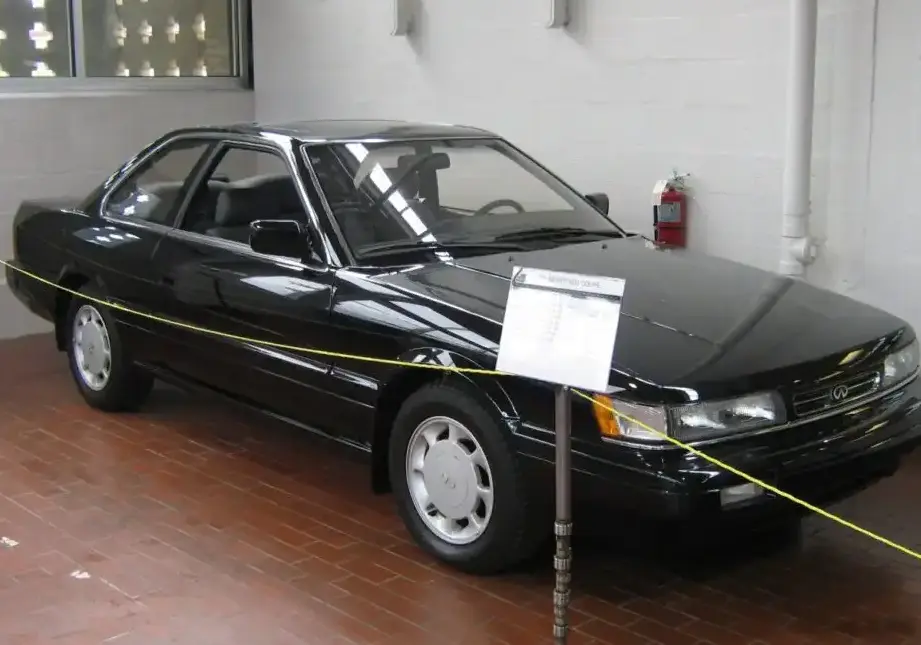
The Infiniti M I Coupe (F31) 30, produced between 1989 and 1992, represented a unique offering in the burgeoning luxury coupe market. Positioned as the entry-level variant of the first-generation M series, it aimed to provide a blend of sporty styling and comfortable grand touring capabilities. The F31 chassis underpinned this model, sharing components with the Nissan Leopard, and marked Infiniti’s initial foray into a dedicated coupe segment. This vehicle was primarily marketed in North America, representing Nissan’s attempt to establish a premium brand identity separate from its mainstream offerings.
Technical Specifications
| Brand | Infiniti |
| Model | M |
| Generation | M I Coupe (F31) |
| Type (Engine) | 30 (164 Hp) |
| Start of production | 1989 |
| End of production | 1992 |
| Powertrain Architecture | Internal Combustion engine |
| Body type | Coupe |
| Seats | 2 |
| Doors | 2 |
| Fuel Type | Petrol (Gasoline) |
| Acceleration 0 – 100 km/h | 10.2 sec |
| Acceleration 0 – 62 mph | 10.2 sec |
| Acceleration 0 – 60 mph | 9.7 sec |
| Maximum speed | 205 km/h (127.38 mph) |
| Weight-to-power ratio | 9.2 kg/Hp, 108.5 Hp/tonne |
| Weight-to-torque ratio | 6.2 kg/Nm, 161.4 Nm/tonne |
| Power | 164 Hp @ 6000 rpm |
| Power per litre | 55.4 Hp/l |
| Torque | 244 Nm @ 3500 rpm (179.97 lb.-ft. @ 3500 rpm) |
| Engine displacement | 2960 cm3 (180.63 cu. in.) |
| Number of cylinders | 6 |
| Engine configuration | V-engine |
| Cylinder Bore | 87 mm (3.43 in.) |
| Piston Stroke | 83 mm (3.27 in.) |
| Compression ratio | 9:1 |
| Number of valves per cylinder | 2 |
| Fuel injection system | Multi-port manifold injection |
| Engine aspiration | Naturally aspirated engine |
| Valvetrain | SOHC |
| Engine oil capacity | 4.7 l (4.97 US qt | 4.14 UK qt) |
| Coolant | 9 l (9.51 US qt | 7.92 UK qt) |
| Kerb Weight | 1512 kg (3333.39 lbs.) |
| Fuel tank capacity | 65 l (17.17 US gal | 14.3 UK gal) |
| Length | 4795 mm (188.78 in.) |
| Width | 1690 mm (66.54 in.) |
| Height | 1380 mm (54.33 in.) |
| Wheelbase | 2615 mm (102.95 in.) |
| Front track | 1435 mm (56.5 in.) |
| Rear (Back) track | 1435 mm (56.5 in.) |
| Drag coefficient (Cd) | 0.35 |
| Minimum turning circle | 10.4 m (34.12 ft.) |
| Drivetrain Architecture | Rear wheel drive |
| Drive wheel | Rear wheel drive |
| Number of gears | 4 |
| Gearbox type | automatic transmission |
| Front brakes | Ventilated discs |
| Rear brakes | Disc |
| Tires size | 215/60 HR15 |
| Wheel rims size | 15 |
Powertrain & Engine Architecture
The heart of the M I Coupe 30 was the VG30E, a 3.0-liter naturally aspirated V6 engine. This engine, part of Nissan’s VG series, was well-regarded for its smoothness and relative reliability. The VG30E featured a single overhead camshaft (SOHC) valvetrain operating two valves per cylinder. Fuel delivery was handled by a multi-port fuel injection system, contributing to improved efficiency and throttle response compared to earlier carbureted designs. The engine produced 164 horsepower at 6000 rpm and 244 Nm (179.97 lb-ft) of torque at 3500 rpm. This power was channeled through a four-speed automatic transmission, a key characteristic of this particular variant. The automatic transmission was chosen to appeal to buyers prioritizing comfort and ease of use over outright performance.
Driving Characteristics
The combination of the VG30E engine and the four-speed automatic transmission resulted in a driving experience geared towards comfortable cruising rather than spirited acceleration. While the 0-60 mph time of around 9.7 seconds wasn’t particularly quick for the era, the engine provided adequate power for highway merging and passing maneuvers. The automatic transmission, while smooth, lacked the responsiveness of a manual gearbox, and its gear ratios were optimized for fuel economy and relaxed driving. Compared to potential higher-output versions (which were not offered in the US market for this generation), the 30 model felt noticeably less eager to rev, but offered a more refined and less demanding driving experience.
Equipment & Trim Levels
The M I Coupe 30 came reasonably well-equipped for its price point. Standard features typically included power windows, power locks, air conditioning, and a basic sound system. Interior upholstery was generally cloth, although leather was available as an option. The dashboard layout was functional and straightforward, with a focus on ease of use. Optional extras included a premium sound system, sunroof, and upgraded interior trim. The trim level was generally considered the base model, offering a more accessible entry point into the Infiniti lineup.
Chassis & Braking
The F31 chassis featured independent suspension all around, utilizing MacPherson struts at the front and a multi-link setup at the rear. This suspension configuration aimed to provide a balance between ride comfort and handling precision. Braking duties were handled by ventilated discs at the front and solid discs at the rear. The braking system was adequate for the vehicle’s weight and performance, but lacked the stopping power of more modern systems. The car rode on 15-inch wheels with 215/60 HR15 tires.
Market Reception & Comparison
The Infiniti M I Coupe 30 received mixed reviews from automotive critics. While the styling was generally praised, the performance of the 3.0-liter engine and automatic transmission was often criticized as being underwhelming. Compared to other coupes in its class, such as the BMW 3-Series or the Mercedes-Benz 190E, the M I Coupe 30 offered a more affordable alternative, but lacked the same level of refinement and performance. Fuel economy was average for the time, and reliability was generally considered good, although preventative maintenance was crucial.
Legacy
The Infiniti M I Coupe 30, while not a sales blockbuster, played an important role in establishing the Infiniti brand in the North American market. The VG30E engine proved to be a durable and reliable powerplant, and many examples remain on the road today. The four-speed automatic transmission, while not particularly advanced, has also proven to be relatively trouble-free. In the used car market, the M I Coupe 30 is often sought after by enthusiasts looking for a unique and affordable classic coupe. Its relative rarity and distinctive styling have contributed to its growing collector appeal. However, finding well-maintained examples can be challenging, and potential buyers should be prepared to address age-related maintenance issues.