
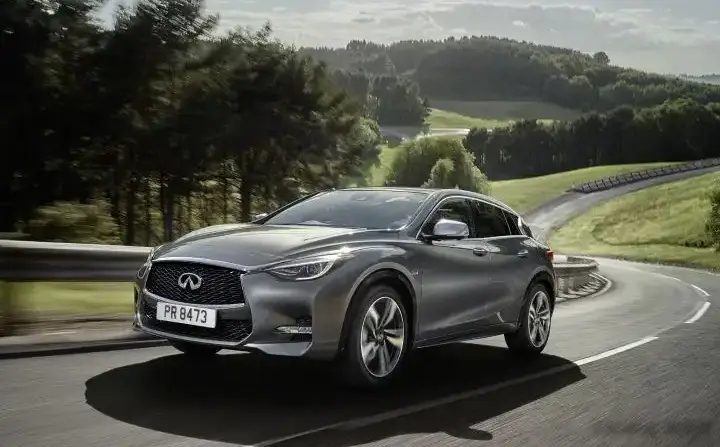
Technical Specifications
| Brand | Infiniti |
| Model | Q30 |
| Generation | Q30 |
| Type (Engine) | 1.5 CDI (109 Hp) DCT |
| Start of production | December, 2015 |
| End of production | February, 2018 |
| Powertrain Architecture | Internal Combustion engine |
| Body type | Hatchback, Crossover |
| Seats | 5 |
| Doors | 5 |
| Fuel consumption (urban) | 4.7-4.8 l/100 km (50 – 49 US mpg, 60.1 – 58.9 UK mpg, 21.3 – 20.8 km/l) |
| Fuel consumption (extra urban) | 4 l/100 km (58.8 US mpg, 70.6 UK mpg, 25 km/l) |
| Fuel consumption (combined) | 4.3 l/100 km (54.7 US mpg, 65.7 UK mpg, 23.3 km/l) |
| CO2 emissions | 111-113 g/km |
| Fuel Type | Diesel |
| Acceleration 0 – 100 km/h | 11.9 sec |
| Acceleration 0 – 62 mph | 11.9 sec |
| Acceleration 0 – 60 mph | 11.3 sec |
| Maximum speed | 190 km/h (118.06 mph) |
| Emission standard | Euro 6 |
| Weight-to-power ratio | 13 kg/Hp, 76.7 Hp/tonne |
| Weight-to-torque ratio | 5.5 kg/Nm, 182.8 Nm/tonne |
| Power | 109 Hp @ 4000 rpm |
| Power per litre | 74.6 Hp/l |
| Torque | 260 Nm @ 1750-2500 rpm (191.77 lb.-ft. @ 1750-2500 rpm) |
| Engine layout | Front, Transverse |
| Engine Model/Code | K9K 481 |
| Engine displacement | 1461 cm3 (89.16 cu. in.) |
| Number of cylinders | 4 |
| Engine configuration | Inline |
| Fuel injection system | Diesel Commonrail |
| Engine aspiration | Turbocharger, Intercooler |
| Valvetrain | OHC |
| Engine oil capacity | 4.5 l (4.76 US qt | 3.96 UK qt) |
| Coolant | 7.3 l (7.71 US qt | 6.42 UK qt) |
| Kerb Weight | 1422 kg (3134.97 lbs.) |
| Max. weight | 1960 kg (4321.06 lbs.) |
| Max load | 538 kg (1186.09 lbs.) |
| Trunk (boot) space – minimum | 430 l (15.19 cu. ft.) |
| Fuel tank capacity | 50 l (13.21 US gal | 11 UK gal) |
| Permitted trailer load with brakes (12%) | 1200 kg (2645.55 lbs.) |
| Permitted trailer load without brakes | 735 kg (1620.4 lbs.) |
| Length | 4425 mm (174.21 in.) |
| Width | 1805 mm (71.06 in.) |
| Height | 1495 mm (58.86 in.) |
| Wheelbase | 2700 mm (106.3 in.) |
| Front track | 1572 mm (61.89 in.) |
| Rear (Back) track | 1573 mm (61.93 in.) |
| Drag coefficient (Cd) | 0.31 |
| Minimum turning circle | 11.4 m (37.4 ft.) |
| Drivetrain Architecture | Front wheel drive |
| Number of gears and type of gearbox | 7 gears, automatic transmission DCT |
| Front suspension | Independent type McPherson |
| Rear suspension | Independent multi-link suspension |
| Front brakes | Ventilated discs |
| Rear brakes | Disc |
| Assisting systems | ABS (Anti-lock braking system) |
| Steering type | Steering rack and pinion |
| Power steering | Electric Steering |
| Tires size | 235/50 R18; 235/45 R19 |
| Wheel rims size | 18; 19 |
The Infiniti Q30 1.5 CDI (109 hp) DCT was a front-wheel-drive compact crossover produced between December 2015 and February 2018. Positioned as an entry-level offering within the Q30 range, it aimed to provide a more fuel-efficient and accessible option compared to the higher-powered gasoline variants. The Q30 itself was a significant model for Infiniti, representing the brand’s first foray into the premium compact segment, and was based on the Mercedes-Benz MFA platform (shared with the A-Class and GLA). This variant was primarily marketed in Europe and other regions where diesel engines held significant market share.
Powertrain & Engine Architecture
The Q30 1.5 CDI utilized the Renault-sourced K9K 481 engine, a 1.5-liter inline-four cylinder diesel. This engine was a common choice in various European compact cars due to its efficiency and relatively low emissions. The K9K engine featured a turbocharger with an intercooler to boost power output, and a diesel commonrail fuel injection system for precise fuel delivery. The engine produced 109 horsepower at 4000 rpm and 260 Nm (191.77 lb-ft) of torque between 1750 and 2500 rpm. This torque figure was a key characteristic, providing good low-end responsiveness. The engine also incorporated an overhead camshaft (OHC) valvetrain. Paired with the engine was a 7-speed dual-clutch transmission (DCT), offering quicker shifts compared to a traditional automatic and contributing to improved fuel economy. The DCT was tuned for comfort and efficiency rather than outright performance.
Driving Characteristics
The Q30 1.5 CDI DCT offered a comfortable and refined driving experience, prioritizing fuel efficiency over sporty performance. Acceleration from 0-60 mph took approximately 11.3 seconds, and top speed was limited to 190 km/h (118 mph). The DCT transmission provided smooth gear changes in normal driving conditions, but could occasionally feel hesitant during rapid acceleration. Compared to the more powerful 2.0t gasoline variants, the 1.5 CDI felt noticeably slower, particularly when overtaking. However, the abundant low-end torque made it well-suited for urban driving and highway cruising. The front-wheel-drive configuration provided predictable handling, but lacked the all-weather capability of the optional all-wheel-drive system available on other Q30 models.
Equipment & Trim Levels
The 1.5 CDI trim typically came with a respectable level of standard equipment. This included features like automatic climate control, a 7-inch touchscreen infotainment system, Bluetooth connectivity, and alloy wheels. Interior upholstery was generally cloth, with leather options available as an upgrade. Safety features such as ABS, electronic stability control, and multiple airbags were standard. Optional extras included a panoramic sunroof, premium audio system, and parking sensors. The trim level sat as the entry point to the Q30 range, offering a more affordable option for buyers prioritizing fuel economy and practicality.
Chassis & Braking
The Q30 1.5 CDI featured independent suspension all around, with a McPherson strut setup at the front and a multi-link setup at the rear. This provided a comfortable ride quality, absorbing bumps and imperfections in the road effectively. Front brakes were ventilated discs, while rear brakes were solid discs. The steering was electrically assisted, offering light and precise control. The suspension was tuned for comfort, resulting in a slight degree of body roll during cornering. The relatively low weight of the 1.5 CDI variant (1422 kg / 3134.97 lbs) helped to mitigate the effects of the modest power output.
Market Reception & Comparison
The Infiniti Q30 1.5 CDI was generally well-received by critics as a practical and fuel-efficient option in the premium compact segment. However, some reviewers noted that the engine lacked the refinement and performance of its competitors. Compared to the higher-powered Q30 variants, the 1.5 CDI offered significantly better fuel economy (around 54.7 US mpg combined) but at the expense of performance. Against rivals like the Audi A3 TDI and BMW 116d, the Q30 1.5 CDI offered a competitive price point but didn’t quite match their driving dynamics or brand prestige. Reliability reports were generally positive, with the Renault-sourced engine proving to be reasonably durable.
Legacy
The Infiniti Q30, including the 1.5 CDI variant, enjoyed a relatively short production run. While it didn’t achieve the sales success of some of its competitors, it established Infiniti as a player in the premium compact market. The K9K engine, known for its robustness, continues to be found in numerous vehicles, and parts availability remains good. On the used car market, the Q30 1.5 CDI represents a relatively affordable entry point into the Infiniti brand, appealing to buyers seeking a stylish and fuel-efficient crossover. Its long-term reliability is considered good, provided regular maintenance is performed, making it a viable option for those seeking a practical and economical vehicle.
