
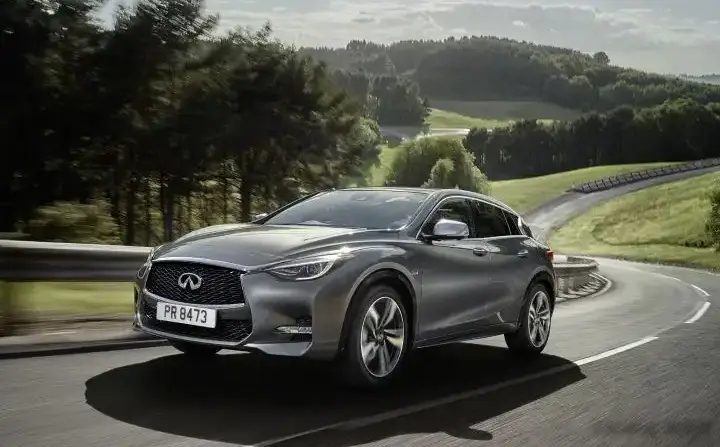
The Infiniti Q30 1.6, producing 122 horsepower, was a front-wheel-drive compact crossover introduced in December 2015 and remained in production through 2018. Positioned as an entry-level offering within the Q30 range, it aimed to attract buyers seeking a premium-branded vehicle with reasonable running costs. The Q30 itself was a significant model for Infiniti, representing their first foray into the compact premium crossover segment, and was based on the Mercedes-Benz MFA platform shared with the A-Class and GLA. This variant specifically targeted European markets and buyers prioritizing fuel efficiency and affordability within the Infiniti lineup.
Technical Specifications
| Brand | Infiniti |
| Model | Q30 |
| Generation | Q30 |
| Type (Engine) | 1.6 (122 Hp) |
| Start of production | December, 2015 |
| End of production | 2018 |
| Powertrain Architecture | Internal Combustion engine |
| Body type | Hatchback, Crossover |
| Seats | 5 |
| Doors | 5 |
| Fuel consumption (urban) | 7.8-8.0 l/100 km (30.2 – 29.4 US mpg) |
| Fuel consumption (extra urban) | 4.6-4.9 l/100 km (51.1 – 48 US mpg) |
| Fuel consumption (combined) | 5.7-6.0 l/100 km (41.3 – 39.2 US mpg) |
| CO2 emissions | 133-140 g/km |
| Fuel Type | Petrol (Gasoline) |
| Acceleration 0 – 100 km/h | 9.4 sec |
| Acceleration 0 – 62 mph | 9.4 sec |
| Acceleration 0 – 60 mph | 8.9 sec |
| Maximum speed | 200 km/h (124.27 mph) |
| Emission standard | Euro 6 |
| Weight-to-power ratio | 10.9 kg/Hp |
| Weight-to-torque ratio | 6.7 kg/Nm |
| Power | 122 Hp @ 5000 rpm |
| Torque | 200 Nm @ 1250-4000 rpm (147.51 lb.-ft. @ 1250-4000 rpm) |
| Engine layout | Front, Transverse |
| Engine Model/Code | M 270.910 |
| Engine displacement | 1595 cm3 (97.33 cu. in.) |
| Number of cylinders | 4 |
| Engine configuration | Inline |
| Fuel injection system | Direct injection |
| Engine aspiration | Turbocharger, Intercooler |
| Valvetrain | DOHC |
| Engine oil capacity | 5.8 l (6.13 US qt | 5.1 UK qt) |
| Coolant | 6.6 l (6.97 US qt | 5.81 UK qt) |
| Kerb Weight | 1332-1383 kg (2936.56 – 3048.99 lbs.) |
| Max. weight | 1920 kg (4232.88 lbs.) |
| Max load | 537-588 kg (1183.88 – 1296.32 lbs.) |
| Trunk (boot) space – minimum | 430 l (15.19 cu. ft.) |
| Fuel tank capacity | 50 l (13.21 US gal | 11 UK gal) |
| Permitted trailer load with brakes (12%) | 1200 kg (2645.55 lbs.) |
| Permitted trailer load without brakes | 700 kg (1543.24 lbs.) |
| Length | 4425 mm (174.21 in.) |
| Width | 1805 mm (71.06 in.) |
| Height | 1495 mm (58.86 in.) |
| Wheelbase | 2700 mm (106.3 in.) |
| Front track | 1572 mm (61.89 in.) |
| Rear (Back) track | 1573 mm (61.93 in.) |
| Drag coefficient (Cd) | 0.29-0.30 |
| Minimum turning circle (turning diameter) | 11.4 m (37.4 ft.) |
| Drivetrain Architecture | Front wheel drive |
| Number of gears and type of gearbox | 6 gears, manual transmission |
| Front suspension | Independent type McPherson |
| Rear suspension | Independent multi-link suspension |
| Front brakes | Ventilated discs |
| Rear brakes | Disc |
| Assisting systems | ABS (Anti-lock braking system) |
| Steering type | Steering rack and pinion |
| Power steering | Electric Steering |
| Tires size | 215/60 R17; 235/50 R18; 235/45 R19 |
| Wheel rims size | 17; 18; 19 |
Powertrain & Engine Architecture
The Q30 1.6 utilized the Mercedes-Benz M 270.910 engine, a 1.6-liter turbocharged inline-four cylinder gasoline engine. This engine was part of the modular M270 family, known for its direct fuel injection and sophisticated engine management systems. The turbocharger, coupled with an intercooler, helped to boost power output and improve efficiency. The engine featured a double overhead camshaft (DOHC) valvetrain, optimizing airflow for enhanced performance. The 1.6L engine produced 122 horsepower at 5000 rpm and 200 Nm (147.51 lb-ft) of torque between 1250 and 4000 rpm. This engine was paired with a 6-speed manual transmission, delivering power to the front wheels. While an automatic transmission was available on other Q30 trims, the 1.6L was exclusively offered with a manual gearbox in most markets.
Driving Characteristics
The Q30 1.6 with the manual transmission offered a reasonably engaging driving experience, though it wasn’t particularly sporty. The turbocharger provided a noticeable boost in power during acceleration, but the overall performance was geared towards efficiency rather than outright speed. The 0-60 mph time of around 8.9 seconds reflects this focus. The manual gearbox, while providing more driver involvement than an automatic, had a slightly longer throw compared to some competitors. The gear ratios were tuned for fuel economy, meaning the engine could feel somewhat strained at higher speeds or when carrying a full load. Compared to the more powerful 2.0t models, the 1.6L felt noticeably less responsive, particularly during overtaking maneuvers.
Equipment & Trim Levels
The Q30 1.6 typically came with a respectable level of standard equipment, positioning it as a well-equipped entry-level option. Standard features often included alloy wheels, automatic headlights, rain-sensing wipers, a 7-inch touchscreen infotainment system with Bluetooth connectivity, and a rearview camera. Interior upholstery was typically cloth, with options for leather upgrades on higher trims. Available optional extras included a panoramic sunroof, heated front seats, and a premium audio system. The trim levels varied slightly depending on the market, but generally followed a progression from base models to more luxurious variants with additional features.
Chassis & Braking
The Q30’s chassis utilized an independent McPherson strut suspension at the front and an independent multi-link suspension at the rear, providing a comfortable ride quality. The suspension was tuned to prioritize comfort over sporty handling. Braking duties were handled by ventilated discs at the front and solid discs at the rear, equipped with an Anti-lock Braking System (ABS). The steering was an electric power-assisted rack and pinion system, offering a light and precise feel. The Q30 1.6, being one of the lighter variants, benefited from a slightly more agile feel compared to the heavier, more powerful models.
Market Reception & Comparison
The Infiniti Q30 1.6 received mixed reviews from automotive critics. While praised for its stylish design and comfortable interior, the 1.6L engine was often criticized for feeling underpowered, especially when compared to rivals like the Audi A3 or BMW 1 Series. Fuel economy was generally considered good, and the Q30 offered a competitive price point. Compared to the Q30 2.0t, the 1.6L was significantly less expensive to purchase and insure, making it an attractive option for budget-conscious buyers. However, the lack of an automatic transmission option for this engine was a drawback for some consumers.
Legacy
The Infiniti Q30, while not a massive sales success, represented an important step for Infiniti in expanding its model range and entering the competitive compact premium crossover segment. The 1.6L engine, while not the most powerful option, proved to be relatively reliable, with few widespread mechanical issues reported. On the used car market, the Q30 1.6 offers a relatively affordable entry point into the premium crossover class. Its fuel efficiency and reasonable running costs make it a practical choice for urban commuters and those seeking a stylish and comfortable vehicle.
