
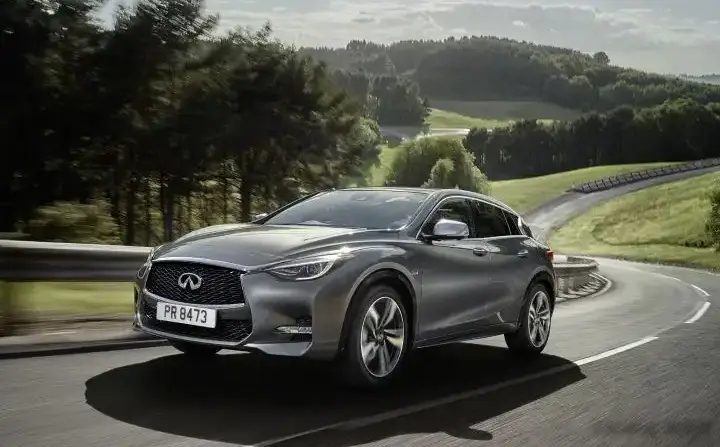
Technical Specifications
| Brand | Infiniti |
| Model | Q30 |
| Generation | Q30 |
| Type (Engine) | 2.2 CDI (170 Hp) AWD DCT |
| Start of production | December, 2015 |
| End of production | 2018 |
| Powertrain Architecture | Internal Combustion engine |
| Body type | Hatchback, Crossover |
| Seats | 5 |
| Doors | 5 |
| Fuel consumption (urban) | 6 l/100 km (39.2 US mpg, 47.1 UK mpg, 16.7 km/l) |
| Fuel consumption (extra urban) | 4.2-4.3 l/100 km (56 – 54.7 US mpg, 67.3 – 65.7 UK mpg, 23.8 – 23.3 km/l) |
| Fuel consumption (combined) | 4.9 l/100 km (48 US mpg, 57.6 UK mpg, 20.4 km/l) |
| CO2 emissions | 127-129 g/km |
| Fuel Type | Diesel |
| Acceleration 0 – 100 km/h | 8.5 sec |
| Acceleration 0 – 62 mph | 8.5 sec |
| Acceleration 0 – 60 mph | 8.1 sec |
| Maximum speed | 215 km/h (133.59 mph) |
| Emission standard | Euro 6 |
| Weight-to-power ratio | 9 kg/Hp, 111.6 Hp/tonne |
| Weight-to-torque ratio | 4.4 kg/Nm, 229.8 Nm/tonne |
| Power | 170 Hp @ 3400-4000 rpm |
| Power per litre | 79.3 Hp/l |
| Torque | 350 Nm @ 1400-3400 rpm (258.15 lb.-ft. @ 1400-3400 rpm) |
| Engine layout | Front, Transverse |
| Engine Model/Code | OM 651.930 |
| Engine displacement | 2143 cm3 (130.77 cu. in.) |
| Number of cylinders | 4 |
| Engine configuration | Inline |
| Fuel injection system | Diesel Commonrail |
| Engine aspiration | Turbocharger, Intercooler |
| Valvetrain | DOHC |
| Engine oil capacity | 6.5 l (6.87 US qt | 5.72 UK qt) |
| Coolant | 9.6 l (10.14 US qt | 8.45 UK qt) |
| Kerb Weight | 1523-1534 kg (3357.64 – 3381.89 lbs.) |
| Max. weight | 2075 kg (4574.59 lbs.) |
| Max load | 541-552 kg (1192.7 – 1216.95 lbs.) |
| Trunk (boot) space – minimum | 430 l (15.19 cu. ft.) |
| Fuel tank capacity | 56 l (14.79 US gal | 12.32 UK gal) |
| Permitted trailer load with brakes (12%) | 1800 kg (3968.32 lbs.) |
| Permitted trailer load without brakes | 750 kg (1653.47 lbs.) |
| Length | 4425 mm (174.21 in.) |
| Width | 1805 mm (71.06 in.) |
| Height | 1495 mm (58.86 in.) |
| Wheelbase | 2700 mm (106.3 in.) |
| Front track | 1572 mm (61.89 in.) |
| Rear (Back) track | 1573 mm (61.93 in.) |
| Drag coefficient (Cd) | 0.32-0.31 |
| Minimum turning circle (turning diameter) | 11.4 m (37.4 ft.) |
| Drive wheel | All wheel drive (4×4) |
| Number of gears and type of gearbox | 7 gears, automatic transmission DCT |
| Front suspension | Independent type McPherson |
| Rear suspension | Independent multi-link suspension |
| Front brakes | Ventilated discs |
| Rear brakes | Disc |
| Assisting systems | ABS (Anti-lock braking system) |
| Steering type | Steering rack and pinion |
| Power steering | Electric Steering |
| Tires size | 235/50 R18; 235/45 R19 |
| Wheel rims size | 18; 19 |
The Infiniti Q30 2.2 CDI AWD DCT, produced from December 2015 to 2018, represents a distinctive offering within the compact luxury crossover segment. Positioned as a more style-conscious alternative to traditional hatchbacks, the Q30 aimed to attract buyers seeking a premium experience with a touch of individuality. Built upon the Mercedes-Benz MFA platform – shared with the A-Class and GLA – the Q30 was Infiniti’s first truly global compact vehicle, designed to appeal to European and Asian markets as well as North America. This particular variant, equipped with the 2.2-liter turbocharged diesel engine producing 170 horsepower and paired with a 7-speed dual-clutch transmission (DCT) and all-wheel drive, occupied a mid-range position in the Q30 lineup, offering a balance of performance, efficiency, and all-weather capability.
Powertrain & Engine Architecture
The heart of the Q30 2.2 CDI is the OM651.930, a 2.143-liter inline-four cylinder diesel engine developed by Mercedes-Benz. This engine is a member of the OM651 family, known for its robust construction and efficiency. It features a common-rail direct injection system, delivering fuel at extremely high pressures for optimized combustion. A turbocharger with an intercooler further enhances performance by forcing more air into the cylinders. The engine utilizes a double overhead camshaft (DOHC) valvetrain, contributing to its responsive nature. The 7-speed dual-clutch transmission (DCT) provides quick and smooth gear changes, enhancing both acceleration and fuel economy. The DCT operates with two separate clutches, pre-selecting the next gear for seamless transitions. All-wheel drive is managed by a sophisticated system that dynamically distributes torque between the front and rear axles, improving traction and stability in various driving conditions.
Driving Characteristics
The Q30 2.2 CDI AWD DCT offers a comfortable and refined driving experience. While not overtly sporty, the 170 horsepower and 350 Nm (258 lb-ft) of torque provide adequate performance for everyday driving and highway cruising. Acceleration from 0-60 mph takes approximately 8.1 seconds. The DCT transmission contributes to a responsive feel, although some drivers may notice slight hesitation at low speeds. The all-wheel-drive system provides confident handling in inclement weather. Compared to the higher-output petrol versions of the Q30, the 2.2 CDI prioritizes fuel efficiency and torque delivery over outright speed. The manual transmission variants, when available, offered a more engaging driving experience, but the DCT provides convenience and ease of use.
Equipment & Trim Levels
The Q30 2.2 CDI AWD DCT typically came equipped with a generous array of standard features. These included automatic climate control, a 7-inch touchscreen infotainment system, Bluetooth connectivity, and a rearview camera. Interior upholstery was generally a combination of cloth and leatherette, with higher trims offering full leather options. Optional extras included a premium audio system, navigation, heated front seats, and a panoramic sunroof. The Q30’s interior design emphasized a modern and minimalist aesthetic, reflecting Infiniti’s design language.
Chassis & Braking
The Q30’s chassis utilizes independent suspension all around – McPherson struts at the front and a multi-link setup at the rear – providing a comfortable ride and good handling characteristics. The front brakes are ventilated discs, while the rear brakes are solid discs. Anti-lock braking system (ABS) is standard, enhancing safety and control during emergency braking. The Q30’s suspension tuning is geared towards comfort, prioritizing ride quality over aggressive handling. Stabilizer bars are fitted to both the front and rear axles to reduce body roll during cornering.
Market Reception & Comparison
The Infiniti Q30 received mixed reviews from automotive critics. It was praised for its stylish design, comfortable interior, and available all-wheel drive. However, some critics found the engine performance to be underwhelming, particularly compared to competitors offering more powerful engines. Fuel economy was generally considered good for its class. Compared to other trims in the Q30 lineup, the 2.2 CDI AWD DCT appealed to buyers prioritizing efficiency and all-weather capability over outright performance. The petrol-powered variants offered more spirited acceleration, while the lower-powered diesel trims were more affordable.
Legacy
The OM651 diesel engine, used in the Q30 2.2 CDI, has a reputation for reliability and longevity, provided it is properly maintained. Regular servicing, including oil changes and filter replacements, is crucial for ensuring its continued performance. In the used car market, the Q30 2.2 CDI AWD DCT represents a relatively affordable entry point into the compact luxury crossover segment. Its combination of style, comfort, and all-wheel-drive capability continues to appeal to buyers seeking a practical and refined vehicle.
