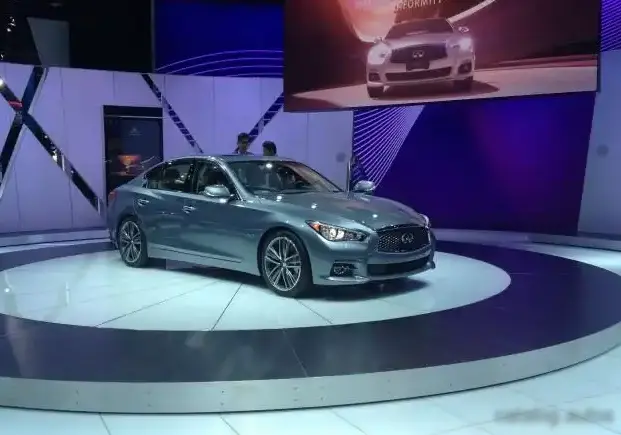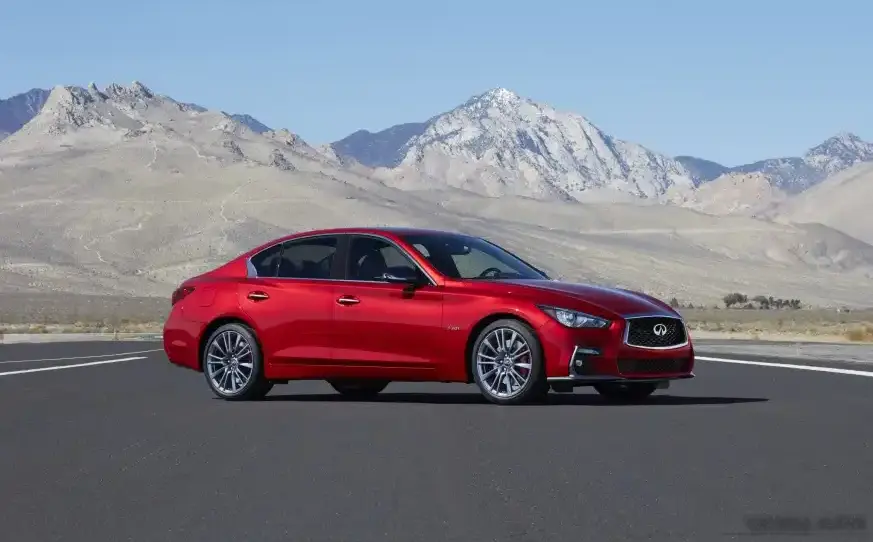
The Infiniti Q50 2.0t, introduced with the 2017 facelift, represented a key entry point into the luxury sport sedan market for the Japanese automaker. Positioned below the more powerful 3.0t variants, the 2.0t offered a balance of performance, fuel efficiency, and accessible pricing. This iteration of the Q50, built on the V37 platform, aimed to attract buyers seeking a premium experience without the higher running costs associated with larger displacement engines. Production continued through subsequent model years with minor revisions, solidifying its place as a popular choice in the compact executive car segment.
Technical Specifications
| Brand | Infiniti |
| Model | Q50 |
| Generation | Q50 (facelift 2017) |
| Type (Engine) | 2.0t (211 Hp) Automatic |
| Start of production | 2017 |
| Powertrain Architecture | Internal Combustion engine |
| Body type | Sedan |
| Seats | 5 |
| Doors | 4 |
| Fuel consumption (urban) | 8.6-8.8 l/100 km (27.4 – 26.7 US mpg) |
| Fuel consumption (extra urban) | 5.0-5.2 l/100 km (47 – 45.2 US mpg) |
| Fuel consumption (combined) | 6.3-6.5 l/100 km (37.3 – 36.2 US mpg) |
| CO2 emissions | 146-151 g/km |
| Fuel Type | Petrol (Gasoline) |
| Acceleration 0 – 100 km/h | 7.2 sec |
| Acceleration 0 – 62 mph | 7.2 sec |
| Acceleration 0 – 60 mph | 6.8 sec |
| Maximum speed | 245 km/h (152.24 mph) |
| Emission standard | Euro 6 |
| Weight-to-power ratio | 7.2 kg/Hp, 139.6 Hp/tonne |
| Weight-to-torque ratio | 4.3 kg/Nm, 231.5 Nm/tonne |
| Power | 211 Hp @ 5500 rpm |
| Torque | 350 Nm @ 1250-3500 rpm (258.15 lb.-ft. @ 1250-3500 rpm) |
| Engine layout | Front, Longitudinal |
| Engine Model/Code | M 274 |
| Engine displacement | 1991 cm3 (121.5 cu. in.) |
| Number of cylinders | 4 |
| Engine configuration | Inline |
| Number of valves per cylinder | 4 |
| Fuel injection system | Direct injection |
| Engine aspiration | Turbocharger, Intercooler |
| Engine oil capacity | 6.3 l (6.66 US qt | 5.54 UK qt) |
| Coolant capacity | 9 l (9.51 US qt | 7.92 UK qt) |
| Kerb Weight | 1512-1692 kg (3333.39 – 3730.22 lbs.) |
| Trunk (boot) space | 500 l (17.66 cu. ft.) |
| Fuel tank capacity | 80 l (21.13 US gal | 17.6 UK gal) |
| Permitted trailer load (braked) | 1500 kg (3306.93 lbs.) |
| Permitted trailer load (unbraked) | 750 kg (1653.47 lbs.) |
| Length | 4810 mm (189.37 in.) |
| Width | 1820 mm (71.65 in.) |
| Width (with mirrors) | 2084 mm (82.05 in.) |
| Height | 1445 mm (56.89 in.) |
| Wheelbase | 2850 mm (112.2 in.) |
| Drag coefficient (Cd) | 0.26-0.27 |
| Drivetrain | Rear wheel drive |
| Number of gears | 7 |
| Gearbox type | Automatic transmission |
| Front brakes | Ventilated discs |
| Rear brakes | Ventilated discs |
| Steering type | Steering rack and pinion |
| Power steering | Electric |
INTRODUCTION
The 2017 facelift of the Infiniti Q50 brought with it the introduction of the 2.0t engine option, a turbocharged four-cylinder designed to broaden the appeal of the Q50. This variant occupied the entry-level position in the Q50 lineup, slotting below the more potent 3.0t models powered by the VR30DDTT twin-turbo V6. The 2.0t aimed to deliver a more accessible luxury experience, prioritizing fuel economy and a comfortable ride over outright performance. It was a direct response to market demands for a more efficient and affordable option within the competitive sport sedan segment.
Powertrain & Engine Architecture
At the heart of the Q50 2.0t lies the Mercedes-Benz M274 2.0-liter inline-four engine. This engine, a product of the Daimler-Renault-Nissan alliance, features direct fuel injection, a single twin-scroll turbocharger, and variable valve timing. The engine code is commonly found in various Mercedes-Benz models as well. The turbocharger is key to the engine’s output, providing boost from as low as 1250 rpm, resulting in a relatively flat torque curve. The seven-speed automatic transmission, also sourced from Mercedes-Benz (7G-TRONIC), is designed for smooth and efficient gear changes. While not offering the lightning-fast shifts of a dual-clutch transmission, it provides a comfortable and refined driving experience. The transmission features adaptive shift programs that adjust to driving style.
Driving Characteristics
The Q50 2.0t delivers a respectable driving experience, though it differs significantly from the more aggressive character of the 3.0t models. With 211 horsepower and 350 lb-ft of torque, acceleration from 0-60 mph takes around 6.8 seconds. The turbocharger provides a noticeable surge of power, but it’s not as dramatic as in higher-output engines. The automatic transmission is well-tuned for everyday driving, offering smooth upshifts and downshifts. Gear ratios are optimized for fuel efficiency, meaning the engine doesn’t always feel as responsive as it could be. Compared to the manual transmission options available on some Q50 models, the automatic prioritizes comfort and ease of use over driver engagement. The rear-wheel-drive configuration contributes to a balanced feel, but the 2.0t lacks the playful agility of the more powerful variants.
Equipment & Trim Levels
The Q50 2.0t typically came standard with a generous array of features, including leatherette upholstery, a dual-screen infotainment system, a rearview camera, and automatic climate control. Higher trim levels, such as the Premium Plus package, added features like genuine leather seats, a Bose premium audio system, navigation, and advanced safety technologies like blind-spot monitoring and lane departure warning. Optional extras included a panoramic sunroof, heated and ventilated front seats, and a power-adjustable steering column. Interior color options typically included graphite, wheat, and black. The dashboard layout was consistent across all Q50 models, featuring the signature dual-screen display.
Chassis & Braking
The Q50 2.0t utilizes a MacPherson strut front suspension and a multi-link rear suspension. The suspension tuning is geared towards comfort, providing a smooth ride over most road surfaces. Stabilizer bars are fitted to both the front and rear axles to reduce body roll during cornering. Braking duties are handled by ventilated discs on all four wheels, providing adequate stopping power. The standard braking system includes ABS, electronic brake-force distribution, and brake assist. The lighter weight of the 2.0t model, compared to the 3.0t, contributes to slightly improved braking performance.
Market Reception & Comparison
Critics generally praised the Q50 2.0t for its fuel efficiency and comfortable ride, but some found the engine to be somewhat underwhelming compared to the competition. The 2.0t offered better fuel economy than the 3.0t models, achieving around 26-27 mpg in the city and 36-37 mpg on the highway. However, rivals like the BMW 320i and Audi A4 offered more engaging driving experiences. In terms of reliability, the M274 engine has proven to be generally dependable, although some owners have reported issues with the turbocharger and fuel injectors. Maintenance costs are relatively reasonable, comparable to other luxury sport sedans.
Legacy
The Infiniti Q50 2.0t served as an important stepping stone for the brand, attracting a wider range of customers to the Q50 lineup. While the 3.0t models remain more desirable among enthusiasts, the 2.0t continues to represent a good value on the used car market. The M274 engine, despite its origins in Mercedes-Benz, has proven to be a relatively robust and reliable powertrain. As a result, well-maintained Q50 2.0t models can provide years of dependable service. The Q50 2.0t remains a viable option for buyers seeking a comfortable, fuel-efficient, and reasonably priced luxury sport sedan.