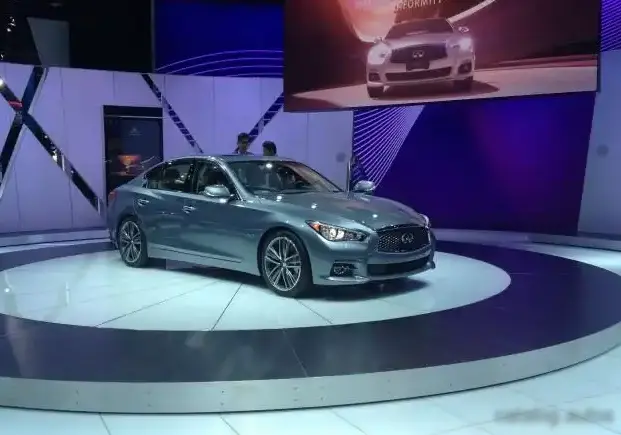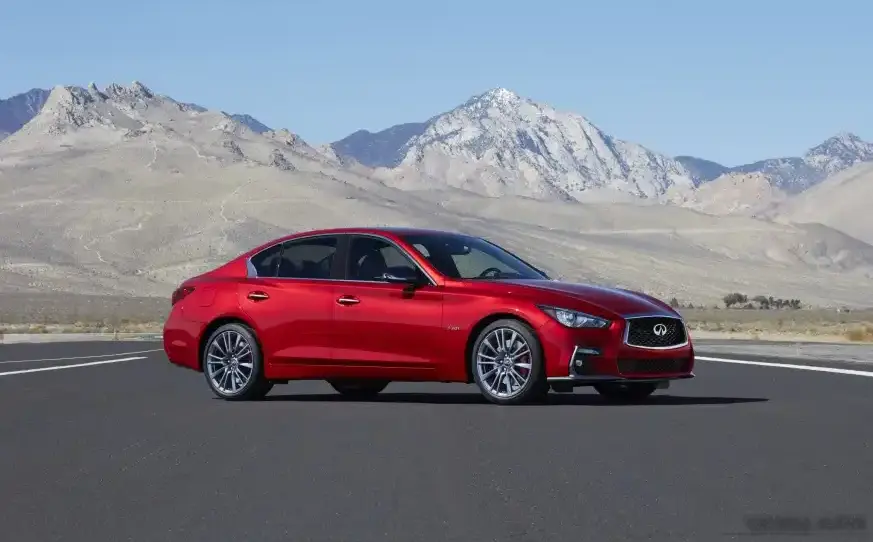
The Infiniti Q50 2.2d, introduced with the 2017 facelift, represented a significant step for the brand in appealing to the European and Asian markets, where diesel engines held considerable popularity. Positioned as an entry-level offering within the Q50 range, it aimed to provide a balance of luxury, performance, and fuel efficiency. This variant, powered by a 2.2-liter turbocharged diesel engine producing 170 horsepower, was primarily sold in Europe and select Asian countries. It offered a more economical alternative to the gasoline-powered Q50 models, while still delivering the brand’s signature refinement and technology. The Q50 itself is a compact executive sedan, replacing the G37, and is built on the Nissan FM platform.
Technical Specifications
| Brand | Infiniti |
| Model | Q50 |
| Generation | Q50 (facelift 2017) |
| Type (Engine) | 2.2d (170 Hp) |
| Start of production | 2017 |
| Powertrain Architecture | Internal Combustion engine |
| Body type | Sedan |
| Seats | 5 |
| Doors | 4 |
| Fuel consumption (urban) | 5.5-5.7 l/100 km (42.8 – 41.3 US mpg) |
| Fuel consumption (extra urban) | 3.7-3.8 l/100 km (63.6 – 61.9 US mpg) |
| Fuel consumption (combined) | 4.3-4.5 l/100 km (54.7 – 52.3 US mpg) |
| CO2 emissions | 114-118 g/km |
| Fuel Type | Diesel |
| Acceleration 0 – 100 km/h | 8.9 sec |
| Acceleration 0 – 62 mph | 8.9 sec |
| Acceleration 0 – 60 mph | 8.5 sec |
| Maximum speed | 231 km/h (143.54 mph) |
| Emission standard | Euro 6 |
| Weight-to-power ratio | 9.4 kg/Hp |
| Weight-to-torque ratio | 4 kg/Nm |
| Power | 170 Hp @ 3200-4000 rpm |
| Torque | 400 Nm @ 1600-2800 rpm (295.02 lb.-ft.) |
| Engine layout | Front, Longitudinal |
| Engine Model/Code | OM 651.930 |
| Engine displacement | 2143 cm3 (130.77 cu. in.) |
| Number of cylinders | 4 |
| Engine configuration | Inline |
| Number of valves per cylinder | 4 |
| Fuel injection system | Diesel Commonrail |
| Engine aspiration | Turbocharger, Intercooler |
| Engine oil capacity | 6.5 l (6.87 US qt | 5.72 UK qt) |
| Coolant capacity | 9 l (9.51 US qt | 7.92 UK qt) |
| Kerb Weight | 1592-1757 kg (3509.76 – 3873.52 lbs.) |
| Trunk (boot) space | 450 l (15.89 cu. ft.) |
| Fuel tank capacity | 74 l (19.55 US gal | 16.28 UK gal) |
| Permitted trailer load (braked) | 1500 kg (3306.93 lbs.) |
| Permitted trailer load (unbraked) | 750 kg (1653.47 lbs.) |
| Length | 4810 mm (189.37 in.) |
| Width | 1820 mm (71.65 in.) |
| Width (with mirrors) | 2084 mm (82.05 in.) |
| Height | 1445 mm (56.89 in.) |
| Wheelbase | 2850 mm (112.2 in.) |
| Drag coefficient (Cd) | 0.26-0.27 |
| Drivetrain | Rear wheel drive |
| Number of gears | 6 |
| Gearbox type | Manual transmission |
| Front brakes | Ventilated discs |
| Rear brakes | Ventilated discs |
Powertrain & Engine Architecture
The heart of the Q50 2.2d is the OM651.930, a 2.143-liter inline-four cylinder diesel engine developed by Mercedes-Benz and supplied to Infiniti under a strategic partnership. This engine is a common rail direct injection diesel, utilizing piezoelectric injectors for precise fuel delivery. The turbocharger, coupled with an intercooler, helps to boost power and torque while managing intake air temperature. The engine produces 170 horsepower at 3200-4000 rpm and a substantial 400 Nm (295 lb-ft) of torque between 1600-2800 rpm. This broad torque curve is a hallmark of diesel engines, providing strong pulling power at lower engine speeds. The 6-speed manual transmission was the standard offering, providing drivers with full control over gear selection. While an automatic transmission was available in other Q50 trims, it wasn’t offered with the 2.2d engine.
Driving Characteristics
The Q50 2.2d, with its manual transmission, offered a more engaging driving experience than its automatic counterparts. The 6-speed gearbox was well-matched to the engine’s torque characteristics, allowing for relaxed cruising and responsive acceleration. While not a sports car, the Q50 2.2d provided adequate performance for everyday driving, with a 0-60 mph time of around 8.5 seconds. The rear-wheel-drive configuration contributed to a balanced feel, although it lacked the all-wheel-drive capability of some higher-trim Q50 models. The engine’s torque delivery meant that frequent downshifts weren’t necessary during normal driving, and the engine remained relatively quiet and refined at highway speeds.
Equipment & Trim Levels
The Q50 2.2d typically came with a respectable level of standard equipment, though it was positioned below the higher-powered gasoline variants. Standard features generally included automatic climate control, a 7-inch touchscreen display with infotainment system, Bluetooth connectivity, and a rearview camera. Interior upholstery was typically cloth, with leather options available as an upgrade. Optional extras included a premium audio system, navigation, and various driver-assistance features like lane departure warning and blind-spot monitoring. The trim level was generally considered the base model, focusing on providing essential features at a competitive price point.
Chassis & Braking
The Q50 2.2d utilized a MacPherson strut front suspension and a multi-link rear suspension, providing a comfortable ride and decent handling characteristics. Brakes consisted of ventilated discs on all four wheels, offering adequate stopping power for the vehicle’s weight and performance. The steering system was an electric power-assisted rack and pinion, providing a responsive and precise feel. Stabilizer bars were fitted front and rear to reduce body roll during cornering. The suspension tuning was geared towards comfort rather than outright sportiness, making it well-suited for long-distance driving.
Market Reception & Comparison
The Q50 2.2d was generally well-received by automotive critics as a practical and efficient option within the executive sedan segment. Its fuel economy was a major selling point, offering significantly better mileage than the gasoline-powered Q50 models. However, some reviewers noted that the engine lacked the refinement and power of its competitors, such as the BMW 320d and Audi A4 TDI. Compared to the Q50 3.0t (V6 gasoline), the 2.2d offered significantly lower running costs but sacrificed performance. The manual transmission was praised by some for its engaging feel, but others preferred the convenience of an automatic.
Legacy
The Infiniti Q50 2.2d, while not a high-volume seller in all markets, established Infiniti as a contender in the diesel-powered executive sedan segment. The OM651 engine, known for its durability, has proven to be relatively reliable in long-term ownership. On the used car market, these models are often sought after for their fuel efficiency and lower maintenance costs compared to the gasoline variants. However, potential buyers should be aware of the potential for diesel particulate filter (DPF) issues, particularly if the vehicle has been primarily used for short trips. Overall, the Q50 2.2d represents a sensible and economical choice for those seeking a comfortable and refined executive sedan.