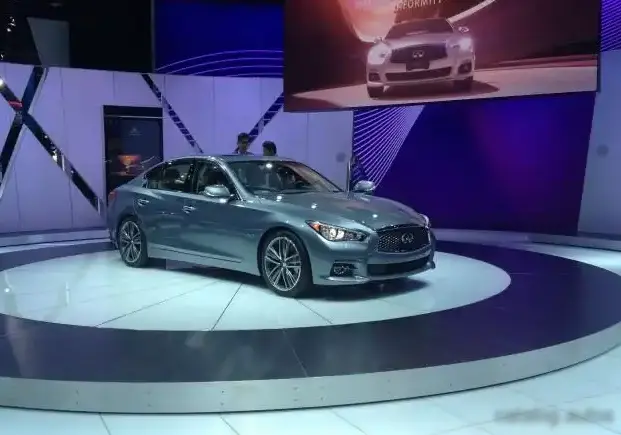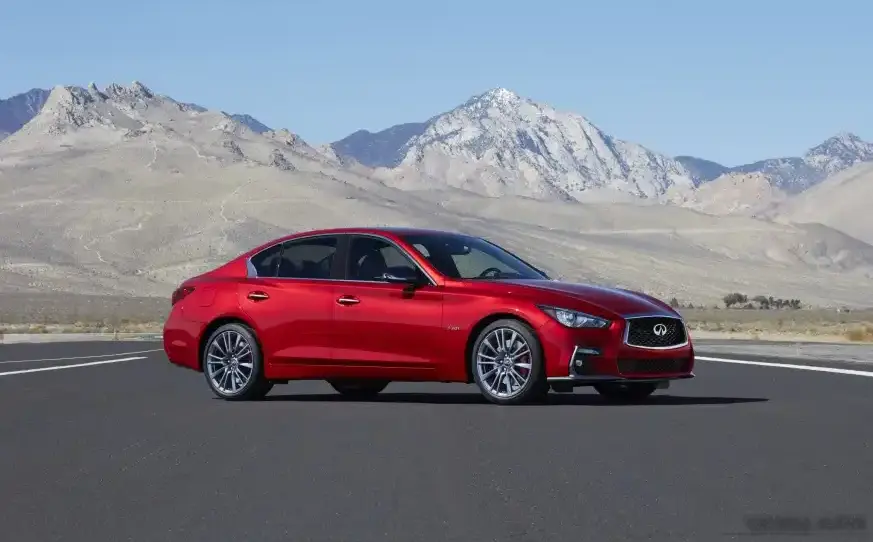
The Infiniti Q50 3.5 Hybrid Automatic, introduced with the 2017 facelift, represents a significant offering in the luxury sport sedan segment. Positioned as a performance-oriented variant within the Q50 lineup, it combined a potent 3.5-liter V6 engine with an electric motor, delivering a total system output of 364 horsepower. This model year marked a substantial refresh for the Q50, incorporating updated styling, enhanced technology, and a more refined driving experience. Production continued through subsequent years with minor revisions, solidifying its place as a key competitor to established European brands like BMW and Mercedes-Benz.
Technical Specifications
| Brand | Infiniti |
| Model | Q50 |
| Generation | Q50 (facelift 2017) |
| Type (Engine) | 3.5 (364 Hp) Hybrid Automatic |
| Start of production | 2017 |
| Powertrain Architecture | FHEV (Full Hybrid Electric Vehicle) |
| Body type | Sedan |
| Seats | 5 |
| Doors | 4 |
| Fuel consumption (urban) | 8.0-8.2 l/100 km (29.4 – 28.7 US mpg) |
| Fuel consumption (extra urban) | 5.1 l/100 km (46.1 US mpg) |
| Fuel consumption (combined) | 5.9-6.2 l/100 km (39.9 – 37.9 US mpg) |
| CO2 emissions | 139-144 g/km |
| Fuel Type | Petrol (Gasoline) |
| Acceleration 0 – 100 km/h | 5.1 sec |
| Acceleration 0 – 62 mph | 5.1 sec |
| Acceleration 0 – 60 mph | 4.8 sec |
| Maximum speed | 250 km/h (155.34 mph) |
| Emission standard | Euro 6 |
| Weight-to-power ratio | 4.8 kg/Hp, 209.6 Hp/tonne |
| Weight-to-torque ratio | 3.2 kg/Nm, 314.3 Nm/tonne |
| Electric motor power | 68 Hp |
| Electric motor Torque | 270 Nm (199.14 lb.-ft.) |
| System power | 364 Hp |
| System torque | 546 Nm (402.71 lb.-ft.) |
| Engine Power | 306 Hp @ 6800 rpm |
| Power per litre | 87.5 Hp/l |
| Engine Torque | 350 Nm @ 5000 rpm (258.15 lb.-ft. @ 5000 rpm) |
| Engine layout | Front, Longitudinal |
| Engine Model/Code | VQ35HR |
| Engine displacement | 3498 cm3 (213.46 cu. in.) |
| Number of cylinders | 6 |
| Engine configuration | V-engine |
| Number of valves per cylinder | 4 |
| Fuel injection system | Multi-port manifold injection |
| Engine oil capacity | 4.9 l (5.18 US qt | 4.31 UK qt) |
| Coolant capacity | 9.8 l (10.36 US qt | 8.62 UK qt) |
| Kerb Weight | 1737-1787 kg (3829.43 – 3939.66 lbs.) |
| Trunk (boot) space | 400 l (14.13 cu. ft.) |
| Fuel tank capacity | 70 l (18.49 US gal | 15.4 UK gal) |
| Permitted trailer load (braked) | 1500 kg (3306.93 lbs.) |
| Permitted trailer load (unbraked) | 750 kg (1653.47 lbs.) |
| Length | 4810 mm (189.37 in.) |
| Width | 1820 mm (71.65 in.) |
| Width (with mirrors) | 2084 mm (82.05 in.) |
| Height | 1430 mm (56.3 in.) |
| Wheelbase | 2850 mm (112.2 in.) |
| Drag coefficient (Cd) | 0.26-0.27 |
| Drive wheel | Rear wheel drive |
| Number of gears | 7 |
| Gearbox type | Automatic transmission |
| Front brakes | Ventilated discs |
| Rear brakes | Ventilated discs |
Introduction
The 2017 Infiniti Q50 3.5 Hybrid Automatic arrived as part of a mid-cycle refresh for the Q50, a luxury sedan initially launched in 2013. Built on the Nissan FM platform (shared with models like the 370Z), the Q50 aimed to blend sporty handling with premium comfort. The hybrid variant, utilizing Infiniti’s Direct Response Hybrid system, was positioned above the 2.0t and 3.0t models in terms of performance and technology, but often represented a value proposition compared to similarly equipped European rivals. The facelift brought revised front and rear styling, an upgraded interior, and most notably, the introduction of ProPILOT Assist, Infiniti’s semi-autonomous driving technology.
Powertrain & Engine Architecture
At the heart of the Q50 3.5 Hybrid lies the VQ35HR 3.5-liter V6 engine. This engine, a staple of Nissan and Infiniti lineups for years, is known for its robust construction and smooth power delivery. The VQ35HR features multi-port fuel injection and variable valve timing, contributing to its efficiency and responsiveness. The hybrid system adds a 68-horsepower electric motor integrated into the 7-speed automatic transmission. This system allows for electric-only driving at low speeds and provides a boost during acceleration. The electric motor draws power from a compact lithium-ion battery pack. The 7-speed automatic transmission itself is a conventional torque-converter automatic, tuned for both efficiency and performance. It features adaptive shift control, adjusting shift points based on driving conditions.
Driving Characteristics
The Q50 3.5 Hybrid Automatic delivers a noticeably different driving experience compared to the non-hybrid variants. The instant torque from the electric motor fills in gaps in the V6’s powerband, resulting in brisk acceleration. The 0-60 mph time of around 4.8 seconds is competitive within the luxury sedan segment. While the transmission is generally smooth, it can occasionally exhibit some hesitation during downshifts. The steering, while precise, lacks some of the feedback found in European competitors. The hybrid system prioritizes fuel efficiency, and the transition between electric and gasoline power is generally seamless, though occasionally noticeable. The added weight of the hybrid components does slightly impact handling agility compared to the lighter Q50 3.0t models.
Equipment & Trim Levels
The Q50 3.5 Hybrid Automatic was typically offered in well-equipped trims, often including features like leather upholstery, heated and ventilated front seats, a dual-screen infotainment system, and a premium audio system. Standard safety features included automatic emergency braking, lane departure warning, and blind-spot monitoring. Optional extras included ProPILOT Assist, adaptive cruise control, and a surround-view camera system. Interior color options typically included graphite, stone gray, and java. Dashboard trim could be specified in wood, aluminum, or carbon fiber.
Chassis & Braking
The Q50 3.5 Hybrid utilizes a multi-link suspension system at all four corners, tuned for a balance between comfort and handling. The suspension geometry is optimized to manage the added weight of the hybrid components. Braking duties are handled by ventilated discs at all four wheels. The hybrid system incorporates regenerative braking, which helps to recapture energy during deceleration and improve fuel efficiency. The Q50 3.5 Hybrid typically features larger brake rotors compared to the base models, providing improved stopping power. Stabilizer bars are fitted front and rear to reduce body roll during cornering.
Market Reception & Comparison
Critics generally praised the Q50 3.5 Hybrid for its strong performance, comfortable ride, and generous standard features. However, some reviewers noted that the infotainment system could be complex to use and that the steering lacked the engagement of some European rivals. Compared to the Q50 3.0t, the hybrid offered superior fuel economy and a smoother, more refined driving experience. Against competitors like the BMW 5 Series and Mercedes-Benz E-Class, the Q50 Hybrid offered a compelling value proposition, often undercutting them in price while providing comparable levels of luxury and technology. Reliability reports suggest that the hybrid system is generally dependable, though routine maintenance is crucial to ensure optimal performance.
Legacy
The Infiniti Q50 3.5 Hybrid Automatic remains a popular choice in the used car market, offering a blend of performance, luxury, and fuel efficiency. The VQ35HR engine is known for its longevity, and the hybrid system has proven to be relatively reliable with proper maintenance. While the Q50 has since been replaced by newer models, the 2017 facelifted version, particularly the 3.5 Hybrid, represents a well-rounded and capable luxury sedan that continues to appeal to buyers seeking a distinctive alternative to the established German brands.