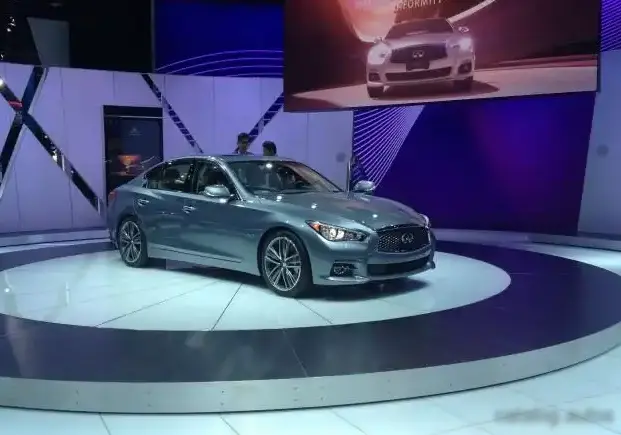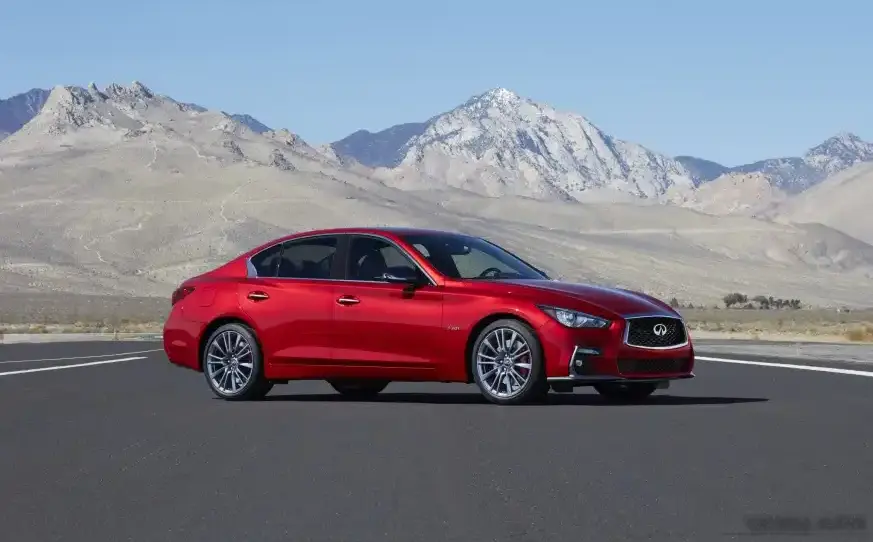
The Infiniti Q50 3.5 Hybrid AWD Automatic, introduced with the 2017 facelift, represents a significant offering in the luxury sport sedan segment. Positioned as a near-top-tier trim within the Q50 lineup, it combined a potent gasoline engine with an electric motor to deliver both performance and improved fuel efficiency. Production began in 2017 and continued through subsequent model years with minor revisions. This variant aimed to appeal to buyers seeking a balance between spirited driving dynamics and the benefits of hybrid technology, competing with established players like the BMW 5 Series Hybrid and Lexus GS Hybrid in the North American market.
Technical Specifications
| Brand | Infiniti |
| Model | Q50 |
| Generation | Q50 (facelift 2017) |
| Type (Engine) | 3.5 (364 Hp) Hybrid AWD Automatic |
| Start of production | 2017 |
| Powertrain Architecture | FHEV (Full Hybrid Electric Vehicle) |
| Body type | Sedan |
| Seats | 5 |
| Doors | 4 |
| Fuel consumption (urban) | 9.4-9.6 l/100 km (25 – 24.5 US mpg) |
| Fuel consumption (extra urban) | 5.1-5.3 l/100 km (46.1 – 44.4 US mpg) |
| Fuel consumption (combined) | 6.6-6.8 l/100 km (35.6 – 34.6 US mpg) |
| CO2 emissions | 154-159 g/km |
| Fuel Type | Petrol (Gasoline) |
| Acceleration 0 – 100 km/h | 5.4 sec |
| Acceleration 0 – 62 mph | 5.4 sec |
| Acceleration 0 – 60 mph | 5.1 sec |
| Maximum speed | 250 km/h (155.34 mph) |
| Emission standard | Euro 6 |
| Weight-to-power ratio | 5 kg/Hp, 200.8 Hp/tonne |
| Weight-to-torque ratio | 3.3 kg/Nm, 301.2 Nm/tonne |
| Electric motor power | 68 Hp |
| Electric motor Torque | 270 Nm (199.14 lb.-ft.) |
| System power | 364 Hp |
| System torque | 546 Nm (402.71 lb.-ft.) |
| Engine Power | 306 Hp @ 6800 rpm |
| Power per litre | 87.5 Hp/l |
| Engine Torque | 350 Nm @ 5000 rpm (258.15 lb.-ft. @ 5000 rpm) |
| Engine layout | Front, Longitudinal |
| Engine Model/Code | VQ35HR |
| Engine displacement | 3498 cm3 (213.46 cu. in.) |
| Number of cylinders | 6 |
| Engine configuration | V-engine |
| Number of valves per cylinder | 4 |
| Fuel injection system | Multi-port manifold injection |
| Engine oil capacity | 4.9 l (5.18 US qt | 4.31 UK qt) |
| Coolant capacity | 10.3 l (10.88 US qt | 9.06 UK qt) |
| Kerb Weight | 1813-1861 kg (3996.98 – 4102.8 lbs.) |
| Trunk (boot) space | 400 l (14.13 cu. ft.) |
| Fuel tank capacity | 70 l (18.49 US gal | 15.4 UK gal) |
| Permitted trailer load (braked) | 1500 kg (3306.93 lbs.) |
| Permitted trailer load (unbraked) | 750 kg (1653.47 lbs.) |
| Length | 4810 mm (189.37 in.) |
| Width | 1820 mm (71.65 in.) |
| Width (with mirrors) | 2084 mm (82.05 in.) |
| Height | 1445 mm (56.89 in.) |
| Wheelbase | 2850 mm (112.2 in.) |
| Drag coefficient (Cd) | 0.27-0.28 |
| Drive wheel | All wheel drive (4×4) |
| Number of gears | 7 |
| Gearbox type | Automatic transmission |
| Front brakes | Ventilated discs |
| Rear brakes | Ventilated discs |
| Steering type | Steering rack and pinion |
| Power steering | Electric |
INTRODUCTION
The 2017 Infiniti Q50 3.5 Hybrid AWD Automatic arrived as part of a mid-cycle refresh for the Q50 model. Building upon the foundation of the Q50, which debuted in 2013 as a replacement for the G37, the facelift brought updated styling, enhanced technology, and this hybrid powertrain option. The Q50, built on the Nissan FM platform (shared with models like the 370Z), aimed to deliver a more refined and technologically advanced experience than its predecessor. The 3.5 Hybrid AWD Automatic sat near the top of the Q50 range, offering a compelling alternative to the 3.0t models while providing improved fuel economy compared to the non-hybrid V6.
Powertrain & Engine Architecture
At the heart of the Q50 3.5 Hybrid lies Nissan’s VQ35HR 3.5-liter V6 engine. This engine, known for its reliability and smooth power delivery, produces 306 horsepower at 6800 rpm and 258 lb-ft of torque at 5000 rpm. It utilizes multi-port fuel injection and a dual continuously variable valve timing system (CVTCS) to optimize performance and efficiency. The hybrid system adds a 68-horsepower electric motor, powered by a compact lithium-ion battery pack, contributing an additional 199 lb-ft of torque. The combined system output reaches 364 horsepower and 402 lb-ft of torque. Power is sent to all four wheels via a 7-speed automatic transmission with manual shift mode. The transmission is specifically tuned to work in conjunction with the hybrid system, seamlessly blending power from both the engine and the electric motor. The hybrid system operates in various modes, including EV-only mode for short distances at low speeds.
Driving Characteristics
The Q50 3.5 Hybrid AWD Automatic delivers a refined and responsive driving experience. The electric motor provides instant torque, filling in gaps in the V6’s powerband and resulting in brisk acceleration – 0-60 mph in approximately 5.1 seconds. While not as overtly sporty as some of its European rivals, the Q50 Hybrid offers a comfortable ride and confident handling. The all-wheel-drive system provides excellent traction in various weather conditions. The 7-speed automatic transmission shifts smoothly and efficiently, although it may not offer the same level of engagement as a dual-clutch transmission. Compared to the Q50 3.0t models, the Hybrid prioritizes fuel efficiency and a more relaxed driving experience, while still offering respectable performance. The manual shift mode allows for some driver control, but the transmission’s programming tends to favor smooth transitions over aggressive downshifts.
Equipment & Trim Levels
The Q50 3.5 Hybrid AWD Automatic typically came well-equipped with standard features including leather upholstery, heated front seats, a dual-screen infotainment system with navigation, a rearview camera, and a suite of advanced safety technologies such as automatic emergency braking, lane departure warning, and blind-spot monitoring. Optional extras included premium audio systems, ventilated front seats, a power-adjustable steering column, and adaptive cruise control. Interior trim levels varied, with options for wood or aluminum accents. The overall interior design focused on a blend of luxury and technology, with a driver-centric layout and high-quality materials.
Chassis & Braking
The Q50 3.5 Hybrid utilizes a multi-link suspension system at all four corners, tuned to provide a balance between comfort and handling. The all-wheel-drive system employs a rear-biased torque distribution, enhancing driving dynamics. Braking duties are handled by ventilated discs on all four wheels, providing ample stopping power. The electronic stability control (ESC) system is integrated with the hybrid system, optimizing braking performance and stability. The Q50 Hybrid’s weight, due to the battery pack and hybrid components, is slightly higher than that of the non-hybrid models, but the added weight is offset by the electric motor’s instant torque.
Market Reception & Comparison
The Infiniti Q50 3.5 Hybrid AWD Automatic received generally positive reviews from automotive critics. It was praised for its fuel efficiency, comfortable ride, and advanced technology. However, some reviewers noted that the infotainment system could be complex to use and that the steering feel lacked the precision of some competitors. Compared to the Q50 3.0t models, the Hybrid offered better fuel economy but slightly less outright performance. Against rivals like the Lexus GS Hybrid and BMW 5 Series Hybrid, the Q50 Hybrid offered a competitive combination of features, performance, and price.
Legacy
The Q50 3.5 Hybrid AWD Automatic represents a significant step in Infiniti’s efforts to embrace hybrid technology. The VQ35HR engine, known for its durability, has proven to be a reliable powertrain. While the hybrid system itself has generally been dependable, maintenance costs can be higher due to the complexity of the system. On the used car market, the Q50 Hybrid offers a compelling value proposition for buyers seeking a luxury sport sedan with good fuel economy and a comfortable driving experience. Its blend of performance, technology, and refinement continues to make it a desirable option in its segment.