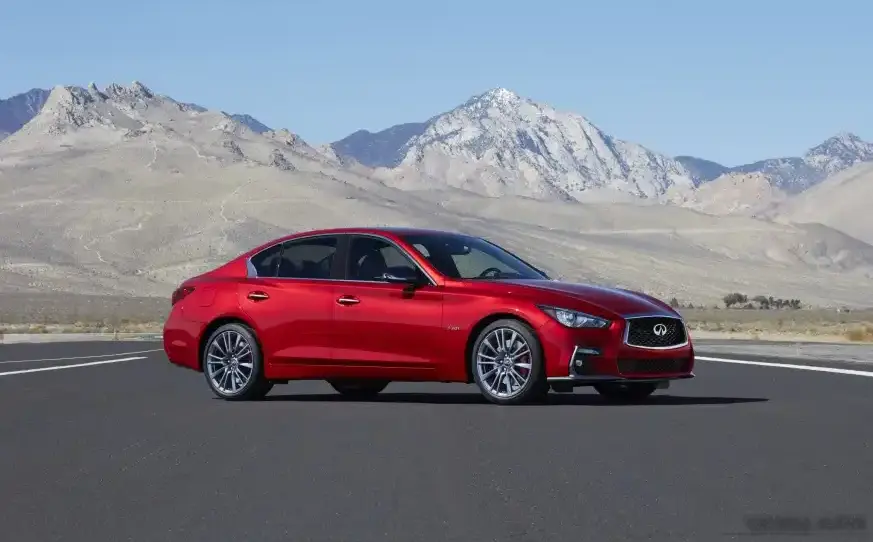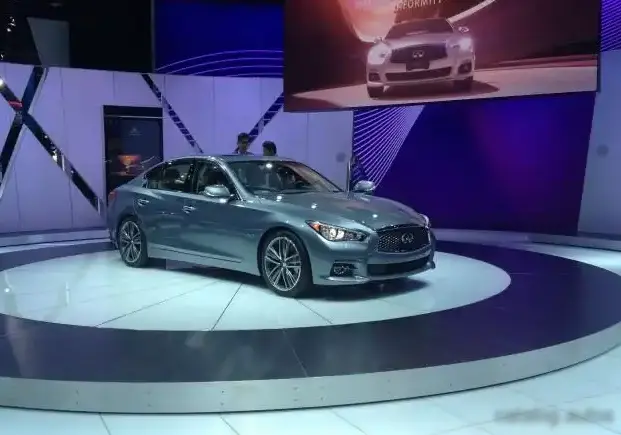
The Infiniti Q50 S 3.0 V6 Automatic, produced from 2016 to 2017, represented a significant step forward for the Q50 model line. Positioned as the performance-oriented variant within the third generation (V36 chassis), it aimed to deliver a more engaging driving experience than the base models. This version slotted in as the top-tier offering before the introduction of the Red Sport 400, emphasizing luxury and spirited performance. It was a key model in Infiniti’s attempt to compete with established German rivals in the sports sedan segment within the North American market.
Technical Specifications
| Brand | Infiniti |
| Model | Q50 |
| Generation | Q50 |
| Type (Engine) | S 3.0 V6 (405 Hp) Automatic |
| Start of production | 2016 |
| End of production | 2017 |
| Powertrain Architecture | Internal Combustion engine |
| Body type | Sedan |
| Seats | 5 |
| Doors | 4 |
| Fuel consumption (urban) | 13.3 l/100 km (17.7 US mpg, 21.2 UK mpg, 7.5 km/l) |
| Fuel consumption (extra urban) | 6.7 l/100 km (35.1 US mpg, 42.2 UK mpg, 14.9 km/l) |
| Fuel consumption (combined) | 9.1 l/100 km (25.8 US mpg, 31 UK mpg, 11 km/l) |
| CO2 emissions | 206 g/km |
| Fuel Type | Petrol (Gasoline) |
| Acceleration 0 – 100 km/h | 5.1 sec |
| Acceleration 0 – 62 mph | 5.1 sec |
| Acceleration 0 – 60 mph | 4.8 sec |
| Maximum speed | 250 km/h (155.34 mph) |
| Emission standard | Euro 6 b |
| Weight-to-power ratio | 4.2 kg/Hp, 236.6 Hp/tonne |
| Weight-to-torque ratio | 3.6 kg/Nm, 277.5 Nm/tonne |
| Power | 405 Hp @ 6400 rpm |
| Power per litre | 135.1 Hp/l |
| Torque | 475 Nm @ 1600-5200 rpm (350.34 lb.-ft. @ 1600-5200 rpm) |
| Engine layout | Front, Longitudinal |
| Engine Model/Code | VR30DDTT |
| Engine displacement | 2997 cm3 (182.89 cu. in.) |
| Number of cylinders | 6 |
| Engine configuration | V-engine |
| Fuel injection system | Direct injection |
| Engine aspiration | Turbocharger, Intercooler |
| Engine oil capacity | 4.8 l (5.07 US qt | 4.22 UK qt) |
| Coolant capacity | 10.3 l (10.88 US qt | 9.06 UK qt) |
| Kerb Weight | 1712 kg (3774.31 lbs.) |
| Trunk (boot) space – minimum | 500 l (17.66 cu. ft.) |
| Fuel tank capacity | 80 l (21.13 US gal | 17.6 UK gal) |
| Permitted trailer load with brakes (12%) | 1500 kg (3306.93 lbs.) |
| Permitted trailer load without brakes | 750 kg (1653.47 lbs.) |
| Length | 4800 mm (188.98 in.) |
| Width with mirrors folded | 1820 mm (71.65 in.) |
| Width including mirrors | 2084 mm (82.05 in.) |
| Height | 1430 mm (56.3 in.) |
| Wheelbase | 2850 mm (112.2 in.) |
| Front track | 1535-1545 mm (60.43 – 60.83 in.) |
| Rear (Back) track | 1555-1565 mm (61.22 – 61.61 in.) |
| Drag coefficient (Cd) | 0.28 |
| Minimum turning circle (turning diameter) | 11.2 m (36.75 ft.) |
| Drivetrain Architecture | Rear wheel drive |
| Number of gears and type of gearbox | 7 gears, automatic transmission |
| Front suspension | Double wishbone |
| Rear suspension | Independent multi-link suspension |
| Front brakes | Ventilated discs |
| Rear brakes | Ventilated discs |
| Assisting systems | ABS (Anti-lock braking system) |
| Steering type | Steering rack and pinion |
| Power steering | Electric Steering |
INTRODUCTION
The Infiniti Q50 S 3.0 V6 Automatic, launched in 2016, was a pivotal model for the brand, representing a move towards more performance-focused luxury sedans. Built on the Q50 platform, which debuted in 2014, the ‘S’ trim signified a step up in both power and features. This variant was specifically designed to appeal to drivers seeking a blend of refinement and dynamic handling, offering a compelling alternative to European competitors like the BMW 3 Series and Audi A4. The Q50 S 3.0 V6 Automatic was produced for the 2016 and 2017 model years before being superseded by the higher-performance Red Sport 400.
Powertrain & Engine Architecture
At the heart of the Q50 S 3.0 V6 Automatic lies the VR30DDTT 3.0-liter V6 engine. This engine is a significant departure from the earlier VQ-series engines traditionally used by Infiniti. The VR30DDTT utilizes direct injection and a single twin-scroll turbocharger with intercooling to produce 405 horsepower at 6400 rpm and 475 Nm (350 lb-ft) of torque between 1600 and 5200 rpm. The engine’s architecture is notable for its compact design and efficient combustion process. The engine is longitudinally mounted, driving the rear wheels. The transmission is a seven-speed automatic gearbox, offering smooth and responsive shifts. This transmission was chosen for its ability to handle the engine’s power output and provide a comfortable driving experience. While not a dual-clutch transmission, it featured adaptive shift control and manual shift mode for more driver involvement.
Driving Characteristics
The Q50 S 3.0 V6 Automatic delivers a noticeably more engaging driving experience compared to the base Q50 models. The 405 hp engine provides strong acceleration, with a 0-60 mph time of around 4.8 seconds. The seven-speed automatic transmission is well-tuned, offering quick and seamless gear changes. The rear-wheel-drive configuration contributes to a balanced feel, although the steering, while utilizing Infiniti’s Direct Adaptive Steering (DAS) system, received mixed reviews. Some drivers found the DAS system to feel artificial, while others appreciated its quick response and variable ratio. The suspension is tuned for a balance between comfort and handling, providing a reasonably compliant ride without sacrificing cornering stability. Compared to the 3.7-liter V6 found in earlier Q50 models, the 3.0-liter turbo offers improved fuel efficiency and a broader torque curve.
Equipment & Trim Levels
The Q50 S 3.0 V6 Automatic came standard with a comprehensive list of features, including leather upholstery, heated front seats, a dual-screen infotainment system, a rearview camera, and a suite of advanced safety technologies. Optional extras included a premium audio system, navigation, climate-controlled seats, and various driver-assistance features like adaptive cruise control and lane departure prevention. The interior design emphasized a modern and luxurious aesthetic, with high-quality materials and a driver-focused layout. The ‘S’ trim also included unique exterior styling cues, such as a sportier front fascia, side skirts, and a rear spoiler.
Chassis & Braking
The Q50 S 3.0 V6 Automatic features a double wishbone front suspension and an independent multi-link rear suspension. This setup provides a good balance of ride comfort and handling precision. The braking system consists of ventilated discs on all four wheels, providing ample stopping power. Anti-lock brakes (ABS) and electronic brake-force distribution (EBD) are standard features. The chassis is designed to be rigid and lightweight, contributing to the car’s overall handling characteristics. The standard tire size is 245/40R19, providing good grip and stability.
Market Reception & Comparison
The Infiniti Q50 S 3.0 V6 Automatic was generally well-received by automotive critics, who praised its powerful engine, comfortable interior, and comprehensive feature list. However, the Direct Adaptive Steering system was a point of contention, with some reviewers finding it to be disconnected and unnatural. Compared to its rivals, the Q50 S 3.0 V6 Automatic offered a compelling value proposition, with a higher level of standard equipment and a more powerful engine than many competitors in its price range. Fuel economy was respectable for a performance sedan, averaging around 25.8 US mpg in combined driving. Reliability has been generally good, although some owners have reported minor issues with the infotainment system.
Legacy
The Infiniti Q50 S 3.0 V6 Automatic represents a significant chapter in Infiniti’s history, showcasing the brand’s commitment to performance and luxury. The VR30DDTT engine proved to be a capable and reliable powerplant, and the Q50 S model helped to establish Infiniti as a serious contender in the sports sedan segment. On the used car market, these models hold their value reasonably well, particularly those in good condition with low mileage. The Q50 S 3.0 V6 Automatic remains a desirable option for drivers seeking a stylish, powerful, and well-equipped luxury sedan.