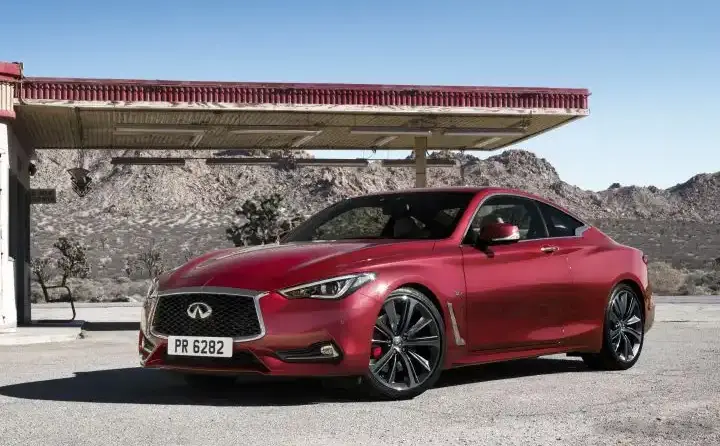
The Infiniti Q60 II Coupe S 3.0 V6 (405 Hp) Automatic, produced from 2016 to 2018, represents the performance-oriented pinnacle of the second-generation Q60 lineup. Positioned as the flagship trim, it offered a significant step up in power and refinement compared to the 2.0t models. The Q60 II, internally designated as the CV35, aimed to recapture the spirit of the earlier G35 Coupe while offering modern technology and luxury features. This variant played a crucial role in Infiniti’s strategy to compete with established luxury sports coupes like the BMW 4 Series and Audi S5 in the North American market.
Technical Specifications
| Brand | Infiniti |
| Model | Q60 |
| Generation | Q60 II Coupe |
| Type (Engine) | S 3.0 V6 (405 Hp) Automatic |
| Start of production | 2016 |
| End of production | 2018 |
| Powertrain Architecture | Internal Combustion engine |
| Body type | Coupe |
| Seats | 4 |
| Doors | 2 |
| Fuel consumption (urban) | 11.8 l/100 km (19.9 US mpg) |
| Fuel consumption (extra urban) | 8.7 l/100 km (27 US mpg) |
| Fuel Type | Petrol (Gasoline) |
| Weight-to-power ratio | 4.3 kg/Hp, 231.2 Hp/tonne |
| Weight-to-torque ratio | 3.7 kg/Nm, 271.1 Nm/tonne |
| Power | 405 Hp @ 6400 rpm |
| Power per litre | 135.1 Hp/l |
| Torque | 475 Nm @ 1600-5200 rpm (350.34 lb.-ft. @ 1600-5200 rpm) |
| Engine layout | Front, Longitudinal |
| Engine Model/Code | VR30DDTT |
| Engine displacement | 2997 cm3 (182.89 cu. in.) |
| Number of cylinders | 6 |
| Engine configuration | V-engine |
| Cylinder Bore | 86 mm (3.39 in.) |
| Piston Stroke | 86 mm (3.39 in.) |
| Compression ratio | 10.3:1 |
| Number of valves per cylinder | 4 |
| Fuel injection system | Direct injection |
| Engine aspiration | Twin-Turbo, Intercooler |
| Valvetrain | DOHC-CVVT |
| Engine oil capacity | 4.8 l (5.07 US qt | 4.22 UK qt) |
| Coolant capacity | 10.3 l (10.88 US qt | 9.06 UK qt) |
| Kerb Weight | 1752 kg (3862.5 lbs.) |
| Trunk (boot) space (minimum) | 246 l (8.69 cu. ft.) |
| Fuel tank capacity | 76 l (20.08 US gal | 16.72 UK gal) |
| Length | 4684 mm (184.41 in.) |
| Width | 1849 mm (72.8 in.) |
| Height | 1384 mm (54.49 in.) |
| Wheelbase | 2850 mm (112.2 in.) |
| Drag coefficient (Cd) | 0.29 |
| Minimum turning circle | 11.2 m (36.75 ft.) |
| Drivetrain Architecture | Rear wheel drive |
| Number of gears and type of gearbox | 7 gears, automatic transmission |
| Front suspension | Double wishbone |
| Rear suspension | Independent multi-link spring suspension with stabilizer |
| Front brakes | Ventilated discs |
| Rear brakes | Ventilated discs |
| Assisting systems | ABS (Anti-lock braking system) |
| Steering type | Steering rack and pinion |
| Power steering | Electric Steering |
| Tires size | 255/35 R20; 275/30 R20 |
| Wheel rims size | 9J x 20; 9.5J x 20 |
Powertrain & Engine Architecture
The heart of the Q60 S 3.0 is the VR30DDTT 3.0-liter twin-turbocharged V6 engine. This engine is a significant departure from the naturally aspirated VQ-series engines previously used in Infiniti coupes. The VR30DDTT utilizes direct injection and Infiniti’s Variable Valve Timing Control (CVVT) system to optimize performance and efficiency. The twin-turbochargers, positioned centrally within the V, contribute to a broad torque curve and minimal turbo lag. The engine produces 400 horsepower and 350 lb-ft of torque. The engine is longitudinally mounted, driving the rear wheels. The seven-speed automatic transmission, sourced from Mercedes-Benz (7G-TRONIC), is well-matched to the engine’s power delivery, offering smooth and relatively quick shifts. While not a dual-clutch transmission, it provides adequate performance for spirited driving.
Driving Characteristics
The Q60 S 3.0 Automatic delivers a noticeably more engaging driving experience than the 2.0t models. The abundance of torque, available from as low as 1600 rpm, provides strong acceleration in everyday driving situations. The seven-speed automatic transmission is programmed for comfort, but drivers can utilize paddle shifters for more control. Compared to a manual transmission equipped Q60 (not widely available in the US), the automatic offers slightly slower acceleration times, but provides greater convenience. The rear-wheel-drive configuration contributes to a balanced feel, although the Q60’s weight (around 3862 lbs) is noticeable during aggressive cornering. The steering is precise, but lacks the ultimate feedback found in some European sports coupes.
Equipment & Trim Levels
The Q60 S 3.0 Automatic came standard with a comprehensive list of features, including leather upholstery, heated and ventilated front seats, a dual-screen infotainment system, a Bose premium audio system, and a suite of advanced safety technologies like forward emergency braking and lane departure warning. Optional extras included a carbon fiber spoiler, upgraded interior trim, and a driver assist package with adaptive cruise control and blind-spot monitoring. The interior design prioritized luxury and comfort, with a focus on high-quality materials and a user-friendly interface.
Chassis & Braking
The Q60 II Coupe utilizes a double wishbone front suspension and an independent multi-link rear suspension, both incorporating stabilizer bars to minimize body roll. The S 3.0 model featured larger brakes than the 2.0t variants, with ventilated discs at all four corners. ABS (Anti-lock Braking System) was standard. The suspension tuning aimed for a balance between comfort and handling, providing a relatively compliant ride quality while maintaining good control in corners. The standard tire size was 255/35 R20 for the front and 275/30 R20 for the rear, contributing to grip and stability.
Market Reception & Comparison
Critics generally praised the Q60 S 3.0 for its powerful engine, luxurious interior, and attractive styling. However, some reviewers noted that the handling wasn’t as sharp as some of its European rivals. Fuel economy was also a point of concern, with combined ratings around 22 mpg. Compared to the 2.0t models, the S 3.0 offered a substantial performance upgrade, but at a higher price point. The 2.0t models were aimed at buyers prioritizing fuel efficiency and affordability, while the S 3.0 targeted enthusiasts seeking a more engaging driving experience. Compared to the BMW 4 Series and Audi S5, the Q60 offered a compelling value proposition, with a similar level of performance and luxury at a potentially lower price.
Legacy
The VR30DDTT engine, while generally reliable, has been known to exhibit some issues with oil consumption in certain examples. Regular oil level checks are recommended. The seven-speed automatic transmission has proven to be durable, but requires proper maintenance, including fluid changes at the recommended intervals. On the used car market, the Q60 S 3.0 Automatic holds its value relatively well, particularly well-maintained examples with low mileage. It remains a desirable option for buyers seeking a stylish and powerful luxury coupe with a unique character. The Q60 S 3.0 represents a significant step forward for Infiniti in terms of performance and technology, and it continues to be appreciated by enthusiasts today.