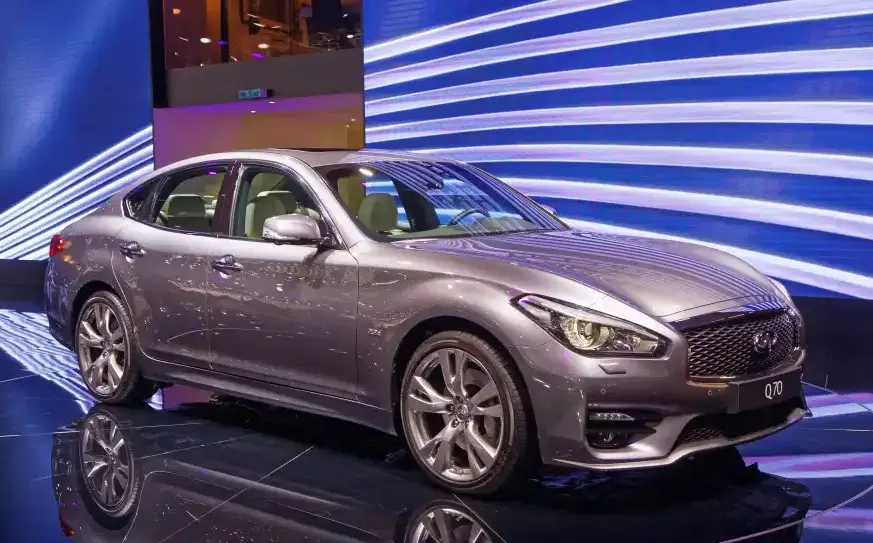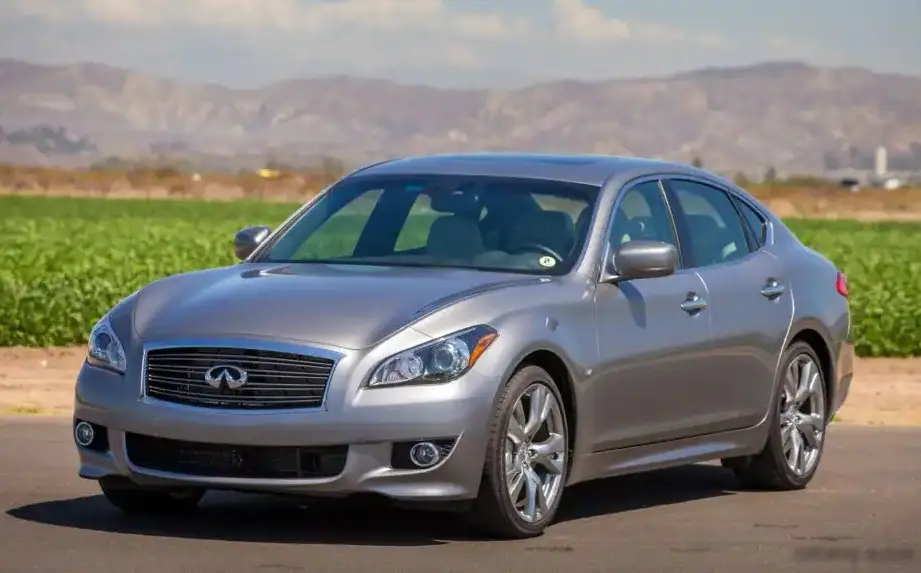
The Infiniti Q70 3.5 V6 Hybrid Automatic, produced for the 2013 and 2014 model years, represented a significant step in Infiniti’s pursuit of fuel efficiency and performance within the luxury sedan segment. Positioned as a mid-to-premium offering within the Q70 lineup (previously known as the M series), this variant combined a 3.5-liter V6 gasoline engine with an electric motor, creating a full hybrid electric vehicle (FHEV) system. It aimed to deliver a balance of power, refinement, and reduced emissions, appealing to buyers seeking a sophisticated and technologically advanced luxury car. The Q70, in general, served as Infiniti’s flagship sedan, competing with established European and domestic rivals like the BMW 5 Series, Mercedes-Benz E-Class, and Cadillac XTS.
Technical Specifications
| Brand | Infiniti |
| Model | Q70 |
| Generation | Q70 |
| Type (Engine) | 3.5 V6 (364 Hp) Hybrid Automatic |
| Start of production | 2013 |
| End of production | 2014 |
| Powertrain Architecture | FHEV (Full Hybrid Electric Vehicle) |
| Body type | Sedan |
| Seats | 5 |
| Doors | 4 |
| Fuel consumption (economy) – urban (NEDC) | 9 l/100 km (26.1 US mpg, 31.4 UK mpg, 11.1 km/l) |
| Fuel consumption (economy) – extra urban (NEDC) | 5.6 l/100 km (42 US mpg, 50.4 UK mpg, 17.9 km/l) |
| Fuel consumption (economy) – combined (NEDC) | 6.9 l/100 km (34.1 US mpg, 40.9 UK mpg, 14.5 km/l) |
| CO2 emissions (NEDC) | 159 g/km |
| Fuel Type | Petrol (Gasoline) |
| Acceleration 0 – 100 km/h | 5.5 sec |
| Acceleration 0 – 62 mph | 5.5 sec |
| Acceleration 0 – 60 mph | 5.2 sec |
| Maximum speed | 250 km/h (155.34 mph), Electronically limited |
| Emission standard | Euro 5 |
| Weight-to-power ratio | 5 kg/Hp, 198.9 Hp/tonne |
| Weight-to-torque ratio | 5.2 kg/Nm, 191.3 Nm/tonne |
| Battery voltage | 400 V |
| Battery technology | Lithium-ion (Li-Ion) |
| Battery weight | 55 kg (121.25 lbs.) |
| Battery location | Inside the trunk |
| Electric motor power | 68 Hp @ 1770-2000 rpm |
| Electric motor Torque | 270 Nm @ 1770 rpm (199.14 lb.-ft. @ 1770 rpm) |
| Electric motor location | Between the combustion engine and the transmission |
| System power | 364 Hp |
| Internal combustion engine power | 306 Hp @ 6800 rpm |
| Power per litre | 87.5 Hp/l |
| Torque | 350 Nm @ 5000 rpm (258.15 lb.-ft. @ 5000 rpm) |
| Engine layout | Front, Longitudinal |
| Engine Model/Code | VQ35HR |
| Engine displacement | 3498 cm3 (213.46 cu. in.) |
| Number of cylinders | 6 |
| Engine configuration | V-engine |
| Cylinder Bore | 95.5 mm (3.76 in.) |
| Piston Stroke | 81.4 mm (3.2 in.) |
| Number of valves per cylinder | 4 |
| Fuel injection system | Multi-port manifold injection |
| Engine aspiration | Naturally aspirated engine |
| Valvetrain | DOHC, CVTCS |
| Engine oil capacity | 4.9 l (5.18 US qt | 4.31 UK qt) |
| Coolant | 8.6 l (9.09 US qt | 7.57 UK qt) |
| Kerb Weight | 1830 kg (4034.46 lbs.) |
| Max. weight | 2400 kg (5291.09 lbs.) |
| Max load | 570 kg (1256.63 lbs.) |
| Trunk (boot) space – minimum | 350 l (12.36 cu. ft.) |
| Fuel tank capacity | 70 l (18.49 US gal | 15.4 UK gal) |
| Permitted trailer load with brakes (12%) | 1500 kg (3306.93 lbs.) |
| Permitted trailer load without brakes | 750 kg (1653.47 lbs.) |
| Length | 4945 mm (194.69 in.) |
| Width | 1845 mm (72.64 in.) |
| Width including mirrors | 2061 mm (81.14 in.) |
| Height | 1500 mm (59.06 in.) |
| Wheelbase | 2900 mm (114.17 in.) |
| Front track | 1575 mm (62.01 in.) |
| Rear (Back) track | 1570 mm (61.81 in.) |
| Drag coefficient (Cd) | 0.26 |
| Minimum turning circle (turning diameter) | 11.2 m (36.75 ft.) |
| Drivetrain Architecture | The Internal combustion engine (ICE) and electric motor drive the rear wheels of the car with the ability to work in full electric or mixed mode. |
| Drive wheel | Rear wheel drive |
| Number of gears and type of gearbox | 7 gears, automatic transmission |
| Front suspension | Double wishbone, Independent coil spring, Transverse stabilizer |
| Rear suspension | Independent multi-link spring suspension with stabilizer |
| Front brakes | Ventilated discs, 320×28 mm |
| Rear brakes | Ventilated discs, 308×15 mm |
| Assisting systems | ABS (Anti-lock braking system) |
| Steering type | Steering rack and pinion |
| Power steering | Electric Steering |
| Tires size | 245/50 R18 |
| Wheel rims size | 8J x 18 |
INTRODUCTION
The Infiniti Q70 3.5 V6 Hybrid Automatic, launched in 2013 and continuing through 2014, was a key component of Infiniti’s strategy to offer a more fuel-efficient and environmentally conscious luxury sedan. Built on the same platform (Nissan FM platform) as the earlier M35h, it represented a refinement of the hybrid technology. The Q70 aimed to bridge the gap between performance and economy, offering a compelling alternative to traditional gasoline-powered luxury cars. It was positioned above the standard Q70 3.7 models in terms of technology and fuel efficiency, but below the higher-performance trims.
Powertrain & Engine Architecture
At the heart of the Q70 Hybrid lies the Nissan VQ35HR 3.5-liter V6 engine. This engine, known for its reliability and smooth power delivery, produces 306 horsepower at 6800 rpm and 258 lb-ft of torque at 5000 rpm. It utilizes multi-port fuel injection and a Double Overhead Camshaft (DOHC) valvetrain with Continuously Variable Valve Timing Control System (CVTCS). The engine is paired with a 68-horsepower electric motor, drawing power from a 400V lithium-ion battery pack located in the trunk. The electric motor generates 199 lb-ft of torque. The combined system output is 364 horsepower. The transmission is a 7-speed automatic, specifically tuned to work seamlessly with the hybrid powertrain. The system allows for all-electric driving at low speeds and assists the gasoline engine during acceleration, optimizing fuel economy and reducing emissions.
Driving Characteristics
The Q70 3.5 V6 Hybrid delivers a refined and comfortable driving experience. The electric motor provides instant torque, resulting in brisk acceleration – 0-60 mph in approximately 5.2 seconds. While not as overtly sporty as the Q70 3.7, the hybrid model offers ample power for everyday driving and highway passing. The 7-speed automatic transmission provides smooth and responsive shifts. The hybrid system prioritizes fuel efficiency, and the transition between electric and gasoline power is generally seamless. Compared to the standard Q70 models, the hybrid feels slightly heavier due to the battery pack, which can subtly impact handling. However, the weight distribution is well-managed, and the car remains stable and predictable.
Equipment & Trim Levels
The Q70 3.5 V6 Hybrid typically came well-equipped with standard features including leather upholstery, heated front seats, a power-adjustable driver’s seat, a Bose premium audio system, a navigation system, and a rearview camera. Available options included a premium package with features like semi-aniline leather, a power-adjustable passenger seat, and a climate-controlled front seats. Safety features were also comprehensive, including ABS, traction control, stability control, and multiple airbags. The interior design was characterized by a blend of luxury and technology, with a focus on comfort and convenience.
Chassis & Braking
The Q70 Hybrid utilizes a double wishbone front suspension and an independent multi-link rear suspension, providing a comfortable ride and good handling characteristics. Stabilizer bars are fitted to both axles to reduce body roll. Braking duties are handled by ventilated discs on all four wheels, providing ample stopping power. The ABS (Anti-lock Braking System) helps maintain control during hard braking. The steering is a rack-and-pinion system with electric power assist, offering precise and responsive steering feel.
Market Reception & Comparison
The Infiniti Q70 Hybrid was generally well-received by automotive critics, who praised its fuel efficiency, comfortable ride, and luxurious interior. However, some reviewers noted that the hybrid system added weight and complexity, and that the car wasn’t as engaging to drive as some of its European rivals. Compared to the Q70 3.7, the hybrid offered significantly better fuel economy but slightly less outright performance. Against competitors like the Lexus GS 450h and the Acura RLX Sport Hybrid, the Q70 Hybrid offered a competitive combination of features, performance, and price.
Legacy
The Infiniti Q70 3.5 V6 Hybrid, while only produced for two model years, represents an important step in Infiniti’s development of hybrid technology. The VQ35HR engine, known for its durability, has proven to be a reliable powertrain. The hybrid system itself has also demonstrated reasonable long-term reliability, although the battery pack may eventually require replacement. On the used car market, the Q70 Hybrid remains a relatively affordable luxury option, appealing to buyers seeking a fuel-efficient and well-equipped sedan. Its combination of luxury, technology, and fuel economy continues to make it a viable choice for those looking for a sophisticated and practical vehicle.