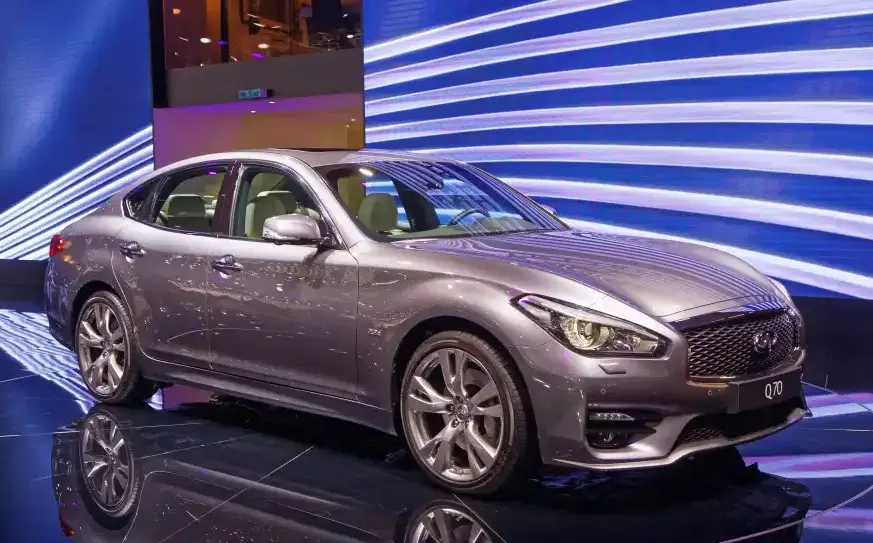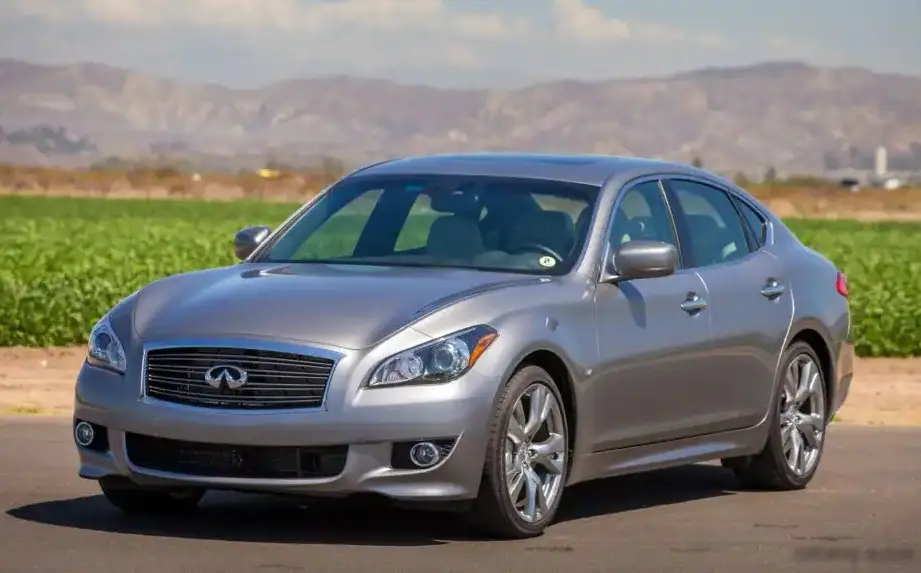
The Infiniti Q70 3.7, specifically the variant equipped with the 3.7-liter V6 engine producing 320 horsepower and a 7-speed automatic transmission, represents a significant iteration of Infiniti’s mid-size luxury sedan. Introduced for the 2014 model year, this configuration occupied a central position within the Q70 lineup, offering a balance between performance and refinement. It served as a direct successor to the M37, undergoing a rebranding as part of Infiniti’s model name restructuring. The Q70 aimed to compete with established European rivals like the BMW 5 Series, Audi A6, and Mercedes-Benz E-Class, offering a distinctive blend of Japanese engineering and luxury features tailored to the North American market.
Technical Specifications
| Brand | Infiniti |
| Model | Q70 |
| Generation | Q70 |
| Type (Engine) | 3.7 V6 (320 Hp) Automatic |
| Start of production | 2014 |
| End of production | 2014 |
| Powertrain Architecture | Internal Combustion engine |
| Body type | Sedan |
| Seats | 5 |
| Doors | 4 |
| Fuel consumption (economy) – urban (NEDC) | 14.9 l/100 km (15.8 US mpg, 19 UK mpg, 6.7 km/l) |
| Fuel consumption (economy) – extra urban (NEDC) | 7.4 l/100 km (31.8 US mpg, 38.2 UK mpg, 13.5 km/l) |
| Fuel consumption (economy) – combined (NEDC) | 10.2 l/100 km (23.1 US mpg, 27.7 UK mpg, 9.8 km/l) |
| CO2 emissions (NEDC) | 235 g/km |
| Fuel Type | Petrol (Gasoline) |
| Acceleration 0 – 100 km/h | 6.2 sec |
| Acceleration 0 – 62 mph | 6.2 sec |
| Acceleration 0 – 60 mph | 5.9 sec |
| Maximum speed | 250 km/h (155.34 mph), Electronically limited |
| Emission standard | Euro 5 |
| Weight-to-power ratio | 5.4 kg/Hp, 186.6 Hp/tonne |
| Weight-to-torque ratio | 4.8 kg/Nm, 209.9 Nm/tonne |
| Power | 320 Hp @ 7000 rpm |
| Power per litre | 86.6 Hp/l |
| Torque | 360 Nm @ 5200 rpm (265.52 lb.-ft. @ 5200 rpm) |
| Engine layout | Front, Longitudinal |
| Engine Model/Code | VQ37VHR |
| Engine displacement | 3696 cm3 (225.54 cu. in.) |
| Number of cylinders | 6 |
| Engine configuration | V-engine |
| Cylinder Bore | 95.5 mm (3.76 in.) |
| Piston Stroke | 86 mm (3.39 in.) |
| Number of valves per cylinder | 4 |
| Fuel injection system | Multi-port manifold injection |
| Engine aspiration | Naturally aspirated engine |
| Valvetrain | DOHC, VVEL |
| Engine oil capacity | 4.9 l (5.18 US qt | 4.31 UK qt) |
| Coolant | 8.4 l (8.88 US qt | 7.39 UK qt) |
| Kerb Weight | 1715 kg (3780.93 lbs.) |
| Max. weight | 2255 kg (4971.42 lbs.) |
| Max load | 540 kg (1190.5 lbs.) |
| Trunk (boot) space – minimum | 500 l (17.66 cu. ft.) |
| Fuel tank capacity | 80 l (21.13 US gal | 17.6 UK gal) |
| Permitted trailer load with brakes (12%) | 1500 kg (3306.93 lbs.) |
| Permitted trailer load without brakes | 750 kg (1653.47 lbs.) |
| Length | 4945 mm (194.69 in.) |
| Width | 1845 mm (72.64 in.) |
| Width including mirrors | 2061 mm (81.14 in.) |
| Height | 1500 mm (59.06 in.) |
| Wheelbase | 2900 mm (114.17 in.) |
| Front track | 1575 mm (62.01 in.) |
| Rear (Back) track | 1570 mm (61.81 in.) |
| Drag coefficient (Cd) | 0.28 |
| Minimum turning circle (turning diameter) | 11.2 m (36.75 ft.) |
| Drive wheel | Rear wheel drive |
| Number of gears and type of gearbox | 7 gears, automatic transmission |
| Front suspension | Double wishbone, Independent coil spring, Transverse stabilizer |
| Rear suspension | Independent multi-link spring suspension with stabilizer |
| Front brakes | Ventilated discs, 355 mm |
| Rear brakes | Ventilated discs, 350 mm |
| Assisting systems | ABS (Anti-lock braking system) |
| Steering type | Steering rack and pinion |
| Power steering | Electric Steering |
| Tires size | 245/40 R20 |
| Wheel rims size | 9J x 20 |
Powertrain & Engine Architecture
The heart of the Q70 3.7 is the VQ37VHR 3.7-liter V6 engine. This engine is a member of Nissan’s highly regarded VQ engine family, known for its smooth operation, reliability, and strong performance. The “VHR” designation stands for “Variable Valve Event and Lift,” indicating the engine’s advanced valvetrain technology. This system continuously adjusts valve timing and lift based on driving conditions, optimizing both power and fuel efficiency. The engine utilizes multi-port fuel injection and a naturally aspirated design, delivering a responsive and linear power delivery. The 7-speed automatic transmission, sourced from Jatco, features adaptive shift control, adjusting shift points based on driving style and road conditions. This transmission was chosen for its smoothness and efficiency, complementing the engine’s characteristics.
Driving Characteristics
The Q70 3.7 Automatic offers a comfortable and refined driving experience. While not as overtly sporty as some of its European competitors, it provides ample power for everyday driving and confident highway passing. The 320 horsepower and 265 lb-ft of torque translate to a 0-60 mph time of around 5.9 seconds. The 7-speed automatic transmission contributes to smooth gear changes, although it can sometimes feel slightly hesitant during quick downshifts. The rear-wheel-drive configuration provides a balanced feel, and the suspension is tuned for comfort, absorbing bumps and imperfections in the road effectively. Compared to the higher-performance Q70 models with different engine options, the 3.7 offers a more accessible and fuel-efficient experience.
Equipment & Trim Levels
The Q70 3.7 typically came well-equipped with standard features such as leather upholstery, a power-adjustable driver’s seat, dual-zone automatic climate control, a premium audio system, and a navigation system. Optional extras included a rear-view camera, blind-spot monitoring, adaptive cruise control, and a premium sound system. Interior trim levels varied, with options for wood or metallic accents. The Q70 aimed to provide a luxurious and comfortable interior environment, focusing on high-quality materials and attention to detail.
Chassis & Braking
The Q70 3.7 features a double-wishbone front suspension and an independent multi-link rear suspension, providing a comfortable ride and stable handling. Ventilated disc brakes are used on all four wheels, offering strong stopping power. The Q70 is equipped with an Anti-lock Braking System (ABS) and Electronic Brake-force Distribution (EBD) as standard safety features. The chassis is designed to balance comfort and handling, providing a stable and predictable driving experience.
Market Reception & Comparison
The Infiniti Q70 3.7 was generally well-received by automotive critics, who praised its comfortable ride, spacious interior, and strong engine performance. However, some critics noted that its styling was somewhat conservative compared to its European rivals. Fuel economy was considered average for its class. Compared to the Q70 Hybrid, the 3.7 offered a lower price point but sacrificed fuel efficiency. Against the V8-powered Q70, it provided a more balanced combination of performance and economy.
Legacy
The Infiniti Q70 3.7, while not a high-volume seller, has established a reputation for reliability and durability. The VQ37VHR engine is known for its longevity, and the 7-speed automatic transmission has proven to be generally reliable. On the used car market, the Q70 3.7 represents a good value proposition for buyers seeking a comfortable and well-equipped luxury sedan. Maintenance costs are generally reasonable, and parts availability is good. The Q70 3.7 remains a viable option for those seeking a refined and reliable luxury car with a strong V6 engine.