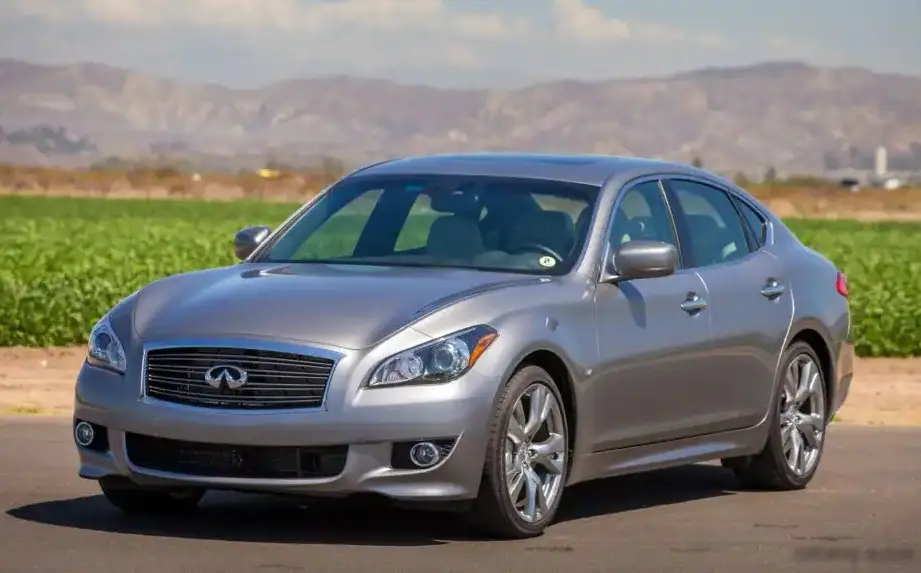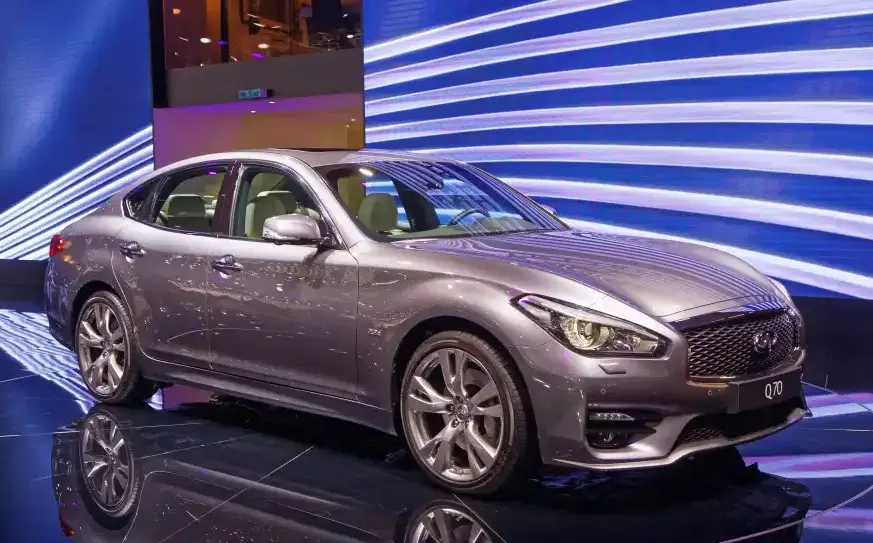
The Infiniti Q70, particularly the facelifted version introduced for the 2014 model year and continuing through 2018, represented Infiniti’s offering in the mid-size luxury sedan segment. This iteration of the Q70, a successor to the M series, aimed to blend performance, comfort, and technology. The 3.7 V6 Automatic variant occupied a central position in the Q70 lineup, offering a balance between the base model and the more powerful, long-wheelbase Q70L. It was primarily marketed towards buyers seeking a refined driving experience with ample power for everyday use and highway cruising.
Technical Specifications
| Brand | Infiniti |
| Model | Q70 |
| Generation | Q70 (facelift 2014) |
| Type (Engine) | 3.7 V6 (330 Hp) Automatic |
| Start of production | 2014 |
| End of production | 2018 |
| Powertrain Architecture | Internal Combustion engine |
| Body type | Sedan |
| Seats | 5 |
| Doors | 4 |
| Fuel consumption (urban) | 13.1 l/100 km (18 US mpg, 21.6 UK mpg, 7.6 km/l) |
| Fuel consumption (extra urban) | 9.4 l/100 km (25 US mpg, 30.1 UK mpg, 10.6 km/l) |
| Fuel Type | Petrol (Gasoline) |
| Weight-to-power ratio | 5.3 kg/Hp, 188.1 Hp/tonne |
| Weight-to-torque ratio | 4.8 kg/Nm, 208.7 Nm/tonne |
| Power | 330 Hp @ 7000 rpm |
| Power per litre | 89.3 Hp/l |
| Torque | 366 Nm @ 5200 rpm (269.95 lb.-ft. @ 5200 rpm) |
| Engine layout | Front, Longitudinal |
| Engine Model/Code | VQ37VHR |
| Engine displacement | 3696 cm3 (225.54 cu. in.) |
| Number of cylinders | 6 |
| Engine configuration | V-engine |
| Cylinder Bore | 95.5 mm (3.76 in.) |
| Piston Stroke | 86 mm (3.39 in.) |
| Compression ratio | 11:1 |
| Number of valves per cylinder | 4 |
| Fuel injection system | Multi-port manifold injection |
| Engine aspiration | Naturally aspirated engine |
| Valvetrain | DOHC, VVEL |
| Engine oil capacity | 4.9 l (5.18 US qt | 4.31 UK qt) |
| Coolant | 8.7 l (9.19 US qt | 7.65 UK qt) |
| Kerb Weight | 1754 kg (3866.91 lbs.) |
| Trunk (boot) space – minimum | 422 l (14.9 cu. ft.) |
| Fuel tank capacity | 76 l (20.08 US gal | 16.72 UK gal) |
| Length | 4981 mm (196.1 in.) |
| Width | 1844 mm (72.6 in.) |
| Height | 1501 mm (59.09 in.) |
| Wheelbase | 2901 mm (114.21 in.) |
| Front track | 1575 mm (62.01 in.) |
| Rear (Back) track | 1570 mm (61.81 in.) |
| Drag coefficient (Cd) | 0.27 |
| Minimum turning circle (turning diameter) | 11.2 m (36.75 ft.) |
| Drivetrain Architecture | The Internal combustion engine (ICE) drives the rear wheels of the vehicle. |
| Drive wheel | Rear wheel drive |
| Number of gears and type of gearbox | 7 gears, automatic transmission ASC |
| Front suspension | Double wishbone |
| Rear suspension | Independent multi-link spring suspension with stabilizer |
| Front brakes | Ventilated discs |
| Rear brakes | Ventilated discs |
| Assisting systems | ABS (Anti-lock braking system) |
| Steering type | Steering rack and pinion |
| Power steering | Electric Steering |
| Tires size | 245/50 R18 |
| Wheel rims size | 8J x 18 |
INTRODUCTION
The 2014-2018 Infiniti Q70 3.7 V6 Automatic represented a significant update to Infiniti’s mid-size luxury sedan. Built on the Nissan FM platform (also known as the 1HX0/A3 platform), the Q70 aimed to deliver a compelling alternative to established European rivals like the BMW 5 Series and Audi A6. The 3.7-liter V6 engine, paired with a seven-speed automatic transmission, was positioned as the sweet spot in the lineup, offering a balance of performance and fuel efficiency. It catered to buyers who desired a luxurious and capable sedan without the added cost and complexity of the long-wheelbase Q70L or the potential maintenance concerns of a hybrid powertrain.
Powertrain & Engine Architecture
At the heart of the Q70 3.7 was the VQ37VHR engine, a 3.7-liter naturally aspirated V6. This engine, a member of Nissan’s highly regarded VQ family, was known for its smooth power delivery and reliability. The “VHR” designation indicated Variable Valve Event and Lift, a system that optimized valve timing and lift for improved performance and efficiency. The engine utilized multi-port fuel injection and a compression ratio of 11:1. The 3.7L V6 produced 330 horsepower at 7000 rpm and 269.95 lb-ft of torque at 5200 rpm. The engine’s longitudinal mounting and rear-wheel-drive configuration contributed to a balanced driving experience. The seven-speed automatic transmission, designated ASC, provided smooth and responsive shifts. While not offering the lightning-fast shifts of some dual-clutch transmissions, it was well-suited to the Q70’s grand touring character.
Driving Characteristics
The Q70 3.7 V6 Automatic delivered a comfortable and refined driving experience. The 330 horsepower engine provided ample acceleration for merging onto highways and passing maneuvers. While not a sports sedan, the Q70 offered a respectable 0-60 mph time in the low-to-mid 5-second range. The seven-speed automatic transmission was programmed for smooth shifts and generally kept the engine in its optimal power band. Compared to the base 3.5-liter V6 model, the 3.7 offered a noticeable increase in power and responsiveness. It also felt more composed at higher speeds. Compared to the Q70L, the standard wheelbase model felt more agile and engaging to drive, though it sacrificed some rear passenger legroom.
Equipment & Trim Levels
The Q70 3.7 V6 Automatic typically came well-equipped with standard features including leather upholstery, power-adjustable front seats, a rearview camera, and a premium audio system. Available options included a navigation system, a Bose premium sound system, heated and cooled front seats, and a suite of advanced safety features such as lane departure warning and blind-spot monitoring. Trim levels varied slightly depending on the year, but generally included base, Premium, and Sport packages. The Sport package added features like sport-tuned suspension, unique alloy wheels, and paddle shifters for manual gear selection.
Chassis & Braking
The Q70 featured a double wishbone front suspension and an independent multi-link rear suspension, providing a comfortable ride and good handling characteristics. Stabilizer bars were fitted to both axles to reduce body roll during cornering. The Q70 3.7 utilized ventilated disc brakes on all four wheels, providing ample stopping power. An Anti-lock Braking System (ABS) was standard. The steering was a rack-and-pinion system with electric power assist, offering a responsive and precise feel.
Market Reception & Comparison
Critics generally praised the Q70 3.7 V6 Automatic for its comfortable ride, spacious interior, and strong engine. However, some reviewers noted that the interior design felt dated compared to newer rivals. Fuel economy was considered average for the segment, with EPA estimates around 18 mpg city and 25 mpg highway. Compared to the Q70 3.5, the 3.7 offered a significant performance upgrade, justifying the higher price. The Q70L, while offering more rear legroom, was often criticized for its cumbersome handling. Reliability was generally good, though some owners reported minor issues with the infotainment system.
Legacy
The Infiniti Q70 3.7 V6 Automatic has established a reputation as a reliable and comfortable luxury sedan in the used car market. The VQ37VHR engine is known for its durability, and with proper maintenance, can provide many years of service. While the Q70 has been discontinued, it remains a viable option for buyers seeking a well-equipped and capable mid-size luxury sedan at a reasonable price. Its blend of performance, comfort, and reliability continues to appeal to a wide range of drivers.