
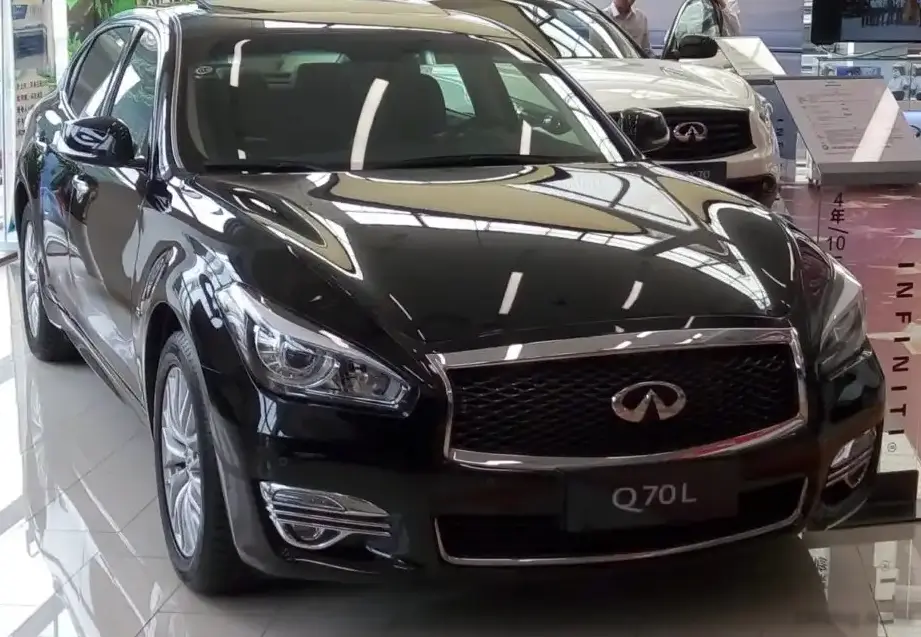
The Infiniti Q70L (facelift, introduced in 2014) with the 3.7-liter V6 engine and seven-speed automatic transmission represents a significant iteration of Infiniti’s full-size luxury sedan. Produced from 2014 through 2018, the Q70L was specifically designed to appeal to buyers in markets, like China, where a longer wheelbase and increased rear passenger space were highly valued. The “L” designation denotes the long-wheelbox version, offering an additional 5.9 inches (150 mm) of length compared to the standard Q70. This variant occupied the upper-midrange of the Q70 lineup, positioned above the base models and offering a blend of performance, luxury, and technology.
Technical Specifications
| Brand | Infiniti |
| Model | Q70 |
| Generation | Q70L (facelift 2014) |
| Type (Engine) | 3.7 V6 (330 Hp) Automatic |
| Start of production | 2014 |
| End of production | 2018 |
| Powertrain Architecture | Internal Combustion engine |
| Body type | Sedan |
| Seats | 5 |
| Doors | 4 |
| Fuel consumption (urban) | 13.1 l/100 km (18 US mpg, 21.6 UK mpg, 7.6 km/l) |
| Fuel consumption (extra urban) | 9.4 l/100 km (25 US mpg, 30.1 UK mpg, 10.6 km/l) |
| Fuel Type | Petrol (Gasoline) |
| Weight-to-power ratio | 5.4 kg/Hp, 183.5 Hp/tonne |
| Weight-to-torque ratio | 4.9 kg/Nm, 203.6 Nm/tonne |
| Power | 330 Hp @ 7000 rpm |
| Power per litre | 89.3 Hp/l |
| Torque | 366 Nm @ 5200 rpm (269.95 lb.-ft. @ 5200 rpm) |
| Engine layout | Front, Longitudinal |
| Engine Model/Code | VQ37VHR |
| Engine displacement | 3696 cm3 (225.54 cu. in.) |
| Number of cylinders | 6 |
| Engine configuration | V-engine |
| Cylinder Bore | 95.5 mm (3.76 in.) |
| Piston Stroke | 86 mm (3.39 in.) |
| Compression ratio | 11:1 |
| Number of valves per cylinder | 4 |
| Fuel injection system | Multi-port manifold injection |
| Engine aspiration | Naturally aspirated engine |
| Valvetrain | DOHC, VVEL |
| Engine oil capacity | 4.9 l (5.18 US qt | 4.31 UK qt) |
| Coolant | 8.7 l (9.19 US qt | 7.65 UK qt) |
| Kerb Weight | 1798 kg (3963.91 lbs.) |
| Trunk (boot) space | 422 l (14.9 cu. ft.) |
| Fuel tank capacity | 76 l (20.08 US gal | 16.72 UK gal) |
| Length | 5131 mm (202.01 in.) |
| Width | 1844 mm (72.6 in.) |
| Height | 1501 mm (59.09 in.) |
| Wheelbase | 3051 mm (120.12 in.) |
| Front track | 1575 mm (62.01 in.) |
| Rear track | 1570 mm (61.81 in.) |
| Drag coefficient (Cd) | 0.27 |
| Minimum turning circle | 11.2 m (36.75 ft.) |
| Drivetrain Architecture | Rear wheel drive |
| Drive wheel | Rear wheel drive |
| Number of gears | 7 |
| Gearbox type | Automatic transmission ASC |
| Front suspension | Double wishbone |
| Rear suspension | Independent multi-link spring suspension with stabilizer |
| Front brakes | Ventilated discs |
| Rear brakes | Ventilated discs |
| Assisting systems | ABS (Anti-lock braking system) |
| Steering type | Steering rack and pinion |
| Power steering | Electric Steering |
| Tires size | 245/50 R18 |
| Wheel rims size | 8J x 18 |
INTRODUCTION
The Q70L facelift, launched in 2014, represented Infiniti’s attempt to refine and modernize its flagship sedan. Building upon the foundation of the M series (rebranded as the Q70), the “L” variant specifically targeted markets with a preference for spacious rear accommodations. The 3.7-liter V6 engine, paired with a seven-speed automatic, provided a balance of performance and refinement, making it a competitive offering in the luxury sedan segment. The facelift brought revised styling cues, including a new front fascia, headlights, and grille, aligning the Q70L with Infiniti’s evolving design language.
Powertrain & Engine Architecture
At the heart of the Q70L 3.7 is the VQ37VHR engine, a 3.7-liter naturally aspirated V6. This engine is a member of Nissan/Infiniti’s highly regarded VQ engine family, known for its reliability and smooth power delivery. The “VHR” designation signifies Variable Valve Event and Lift, indicating the engine’s advanced valvetrain technology. This system continuously adjusts valve timing and lift based on driving conditions, optimizing both power and fuel efficiency. Fuel delivery is managed by a multi-port fuel injection system. The engine produces 330 horsepower at 7000 rpm and 366 Nm (269.95 lb-ft) of torque at 5200 rpm. The engine is longitudinally mounted, driving the rear wheels. The seven-speed automatic transmission, designated ASC, provides smooth and responsive shifts. It features adaptive shift control, adjusting shift points based on driving style and conditions.
Driving Characteristics
The Q70L 3.7 offers a comfortable and refined driving experience. While not overtly sporty, the 330 hp V6 provides ample power for confident acceleration and highway cruising. The seven-speed automatic transmission contributes to smooth gear changes, although it may not be as quick-shifting as some dual-clutch transmissions found in competitors. Compared to the standard Q70 with the same engine, the Q70L feels slightly heavier due to its increased length and weight. This can result in a marginally less agile feel, but the trade-off is a significantly more spacious rear cabin. Compared to other engine options in the Q70 lineup, such as the hybrid variant, the 3.7L V6 prioritizes a more traditional driving experience with a focus on readily available power rather than maximum fuel economy.
Equipment & Trim Levels
The Q70L 3.7 typically came well-equipped with standard features including leather upholstery, power-adjustable front seats, a rearview camera, a premium audio system, and dual-zone automatic climate control. The long wheelbase afforded generous rear legroom, making it a comfortable choice for passengers. Available options included a navigation system, a Bose premium sound system, heated and cooled front seats, a power rear sunshade, and advanced safety features like lane departure warning and blind-spot monitoring. Trim levels varied by market, but generally offered increasing levels of luxury and technology.
Chassis & Braking
The Q70L utilizes a double wishbone front suspension and an independent multi-link rear suspension, providing a comfortable ride and good handling characteristics. Stabilizer bars are fitted to both axles to reduce body roll during cornering. The braking system consists of ventilated discs on all four wheels, providing ample stopping power. Anti-lock brakes (ABS) are standard, along with electronic brake-force distribution and brake assist. The steering is a rack-and-pinion system with electric power assistance, offering a responsive and precise feel.
Market Reception & Comparison
The Q70L was generally well-received by critics, who praised its spacious interior, comfortable ride, and powerful engine. However, some reviewers noted that its styling was beginning to look dated compared to newer competitors. Fuel economy was considered average for its class. Compared to rivals like the BMW 5 Series and Mercedes-Benz E-Class, the Q70L offered a more affordable price point and a more generous warranty. However, it lacked the brand prestige and cutting-edge technology of some of its European competitors. The 3.7L V6 offered a good balance between performance and fuel economy compared to the hybrid version, which prioritized fuel efficiency but offered less overall power.
Legacy
The Infiniti Q70L, particularly the 3.7 V6 Automatic variant, has proven to be a relatively reliable vehicle in the used car market. The VQ37VHR engine is known for its durability, and the seven-speed automatic transmission has generally held up well over time. Common maintenance items include routine oil changes, fluid flushes, and brake pad replacements. While not as sought-after as some of its European rivals, the Q70L offers a compelling value proposition for buyers seeking a spacious, comfortable, and well-equipped luxury sedan at a reasonable price. Its long wheelbase and powerful engine continue to appeal to those who prioritize rear passenger comfort and a traditional driving experience.
