
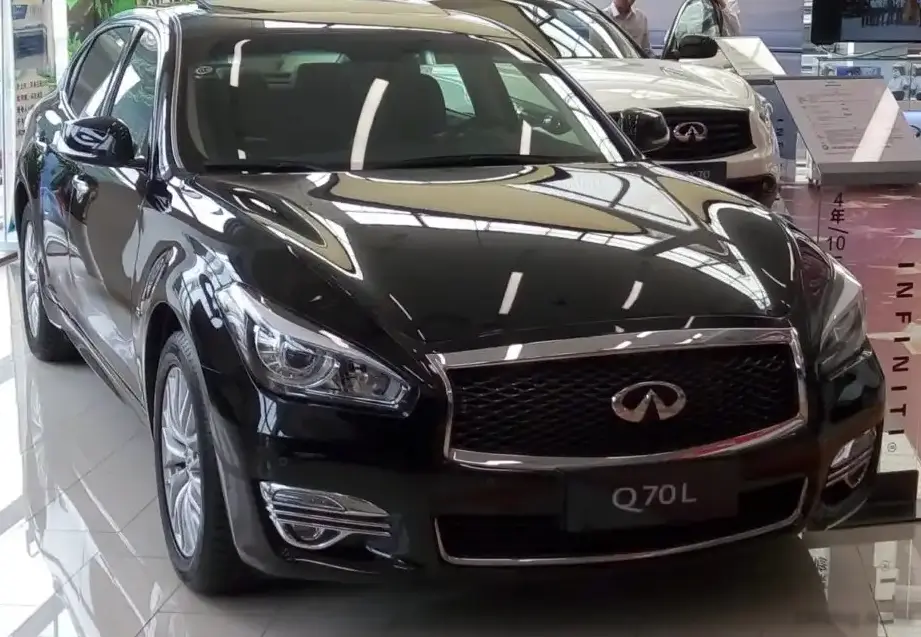
The Infiniti Q70L (facelift, introduced in 2014) with the 3.7-liter V6 engine producing 330 horsepower and paired with an all-wheel-drive system and a seven-speed automatic transmission represents a significant iteration of Infiniti’s full-size luxury sedan. Produced from 2014 through 2018, the Q70L was specifically designed to appeal to buyers in markets, like China, where longer-wheelbase sedans are highly valued for their increased rear passenger space. The “L” designation denotes the extended wheelbase, adding 5.9 inches (150 mm) to the standard Q70, almost all of which benefits rear legroom. This variant occupied the top end of the Q70 lineup in terms of powertrain and features, positioned as a premium offering focused on comfort and performance.
Technical Specifications
| Brand | Infiniti |
| Model | Q70 |
| Generation | Q70L (facelift 2014) |
| Type (Engine) | 3.7 V6 (330 Hp) AWD Automatic |
| Start of production | 2014 |
| End of production | 2018 |
| Powertrain Architecture | Internal Combustion engine |
| Body type | Sedan |
| Seats | 5 |
| Doors | 4 |
| Fuel consumption (urban) | 13.1 l/100 km (18 US mpg, 21.6 UK mpg, 7.6 km/l) |
| Fuel consumption (extra urban) | 9.8 l/100 km (24 US mpg, 28.8 UK mpg, 10.2 km/l) |
| Fuel Type | Petrol (Gasoline) |
| Weight-to-power ratio | 5.7 kg/Hp, 175.1 Hp/tonne |
| Weight-to-torque ratio | 5.2 kg/Nm, 194.2 Nm/tonne |
| Power | 330 Hp @ 7000 rpm |
| Power per litre | 89.3 Hp/l |
| Torque | 366 Nm @ 5200 rpm (269.95 lb.-ft. @ 5200 rpm) |
| Engine layout | Front, Longitudinal |
| Engine Model/Code | VQ37VHR |
| Engine displacement | 3696 cm3 (225.54 cu. in.) |
| Number of cylinders | 6 |
| Engine configuration | V-engine |
| Cylinder Bore | 95.5 mm (3.76 in.) |
| Piston Stroke | 86 mm (3.39 in.) |
| Compression ratio | 11:1 |
| Number of valves per cylinder | 4 |
| Fuel injection system | Multi-port manifold injection |
| Engine aspiration | Naturally aspirated engine |
| Valvetrain | DOHC, VVEL |
| Engine oil capacity | 4.9 l (5.18 US qt | 4.31 UK qt) |
| Coolant | 8.7 l (9.19 US qt | 7.65 UK qt) |
| Kerb Weight | 1885 kg (4155.71 lbs.) |
| Trunk (boot) space (minimum) | 422 l (14.9 cu. ft.) |
| Fuel tank capacity | 76 l (20.08 US gal | 16.72 UK gal) |
| Length | 5131 mm (202.01 in.) |
| Width | 1844 mm (72.6 in.) |
| Height | 1514 mm (59.61 in.) |
| Wheelbase | 3051 mm (120.12 in.) |
| Front track | 1575 mm (62.01 in.) |
| Rear (Back) track | 1570 mm (61.81 in.) |
| Drag coefficient (Cd) | 0.27 |
| Minimum turning circle (turning diameter) | 11.4 m (37.4 ft.) |
| Drive wheel | All wheel drive (4×4) |
| Number of gears and type of gearbox | 7 gears, automatic transmission ASC |
| Front suspension | Double wishbone |
| Rear suspension | Independent multi-link spring suspension with stabilizer |
| Front brakes | Ventilated discs |
| Rear brakes | Ventilated discs |
| Assisting systems | ABS (Anti-lock braking system) |
| Steering type | Steering rack and pinion |
| Power steering | Electric Steering |
| Tires size | 245/50 R18 |
| Wheel rims size | 8J x 18 |
INTRODUCTION
The Q70L facelift, launched in 2014, represented a mid-cycle refresh for Infiniti’s flagship sedan. Building upon the foundation laid by the original Q70 (formerly the M series), the facelift brought revised styling, enhanced technology, and continued refinement of the 3.7-liter V6 engine. The extended wheelbase “L” variant was primarily aimed at markets where rear passenger comfort is paramount, offering a more spacious and luxurious experience. It competed with other luxury sedans such as the Acura RLX, Lexus GS, and Audi A6, though the Q70L differentiated itself with its emphasis on rear-seat space and a more driver-focused experience than some of its competitors.
Powertrain & Engine Architecture
At the heart of the Q70L is the VQ37VHR 3.7-liter V6 engine. This engine, a member of Nissan/Infiniti’s highly regarded VQ family, is a naturally aspirated, 60-degree V6 featuring multi-port fuel injection and a double overhead camshaft (DOHC) valvetrain with Variable Valve Event and Lift (VVEL) technology. VVEL continuously adjusts valve timing and lift based on driving conditions, optimizing both performance and fuel efficiency. The engine produces 330 horsepower at 7,000 rpm and 270 lb-ft of torque at 5,200 rpm. The engine’s longitudinal mounting and all-wheel-drive configuration contribute to balanced handling. The seven-speed automatic transmission, designated ASC, provides smooth and responsive shifts. While not a dual-clutch transmission, it features adaptive shift control, allowing the driver to select different driving modes to tailor the transmission’s behavior to their preferences.
Driving Characteristics
The Q70L 3.7L AWD delivers a comfortable and refined driving experience. The extended wheelbase contributes to a smoother ride, absorbing bumps and imperfections in the road effectively. While the 330 horsepower provides ample power for everyday driving and passing maneuvers, it doesn’t offer the outright acceleration of some turbocharged competitors. The seven-speed automatic transmission is well-tuned, providing smooth gear changes and responsive downshifts. The all-wheel-drive system enhances traction and stability, particularly in inclement weather. Compared to the standard Q70, the Q70L feels slightly less agile due to its increased weight and length, but the trade-off is a significantly more spacious rear cabin. Compared to a potential hybrid or smaller displacement engine option (not offered in the US market for this generation), the 3.7L provides a more traditional, linear power delivery.
Equipment & Trim Levels
The Q70L 3.7L AWD typically came well-equipped with standard features including leather upholstery, heated front seats, a power-adjustable driver’s seat, a Bose premium audio system, a navigation system, and a rearview camera. Available options included semi-aniline leather, ventilated front seats, a power-adjustable passenger seat, a climate-controlled seats, a dual-screen entertainment system for rear passengers, and advanced safety features such as lane departure warning, blind-spot monitoring, and intelligent cruise control. Interior trim options typically included wood or aluminum accents. The overall interior design focused on a blend of luxury and technology, with a user-friendly infotainment system and high-quality materials.
Chassis & Braking
The Q70L utilizes a double wishbone front suspension and an independent multi-link rear suspension, both incorporating stabilizer bars to minimize body roll. The suspension is tuned for comfort, prioritizing a smooth ride over sporty handling. Braking duties are handled by ventilated discs on all four wheels, providing ample stopping power. The anti-lock braking system (ABS) is standard, along with electronic brake-force distribution and brake assist. The steering is electrically assisted, offering a light and precise feel. The Q70L’s chassis is designed to provide a stable and secure driving experience, even at higher speeds.
Market Reception & Comparison
The Q70L was generally well-received by critics, who praised its spacious interior, comfortable ride, and powerful engine. However, some reviewers noted that its styling was becoming dated compared to newer competitors. Fuel economy was considered average for its class. Compared to the standard Q70, the Q70L offered a significant advantage in rear passenger space, making it a more appealing option for buyers who frequently transport passengers. Compared to the Q70 3.7 with rear-wheel drive, the AWD version offered enhanced traction and stability, but at a slight penalty in fuel economy and weight. The Q70L’s reliability was generally considered good, though some owners reported minor issues with the infotainment system.
Legacy
The Infiniti Q70L, while discontinued in 2018, remains a viable option in the used car market. The VQ37VHR engine is known for its durability and relatively low maintenance costs. The seven-speed automatic transmission has also proven to be reliable. However, potential buyers should be aware of the possibility of oil consumption issues with the VQ37VHR engine, particularly in higher-mileage examples. The Q70L’s spacious interior and comfortable ride continue to appeal to buyers seeking a luxurious and refined full-size sedan. Its unique positioning as a long-wheelbase variant sets it apart from many of its competitors, making it a compelling choice for those who prioritize rear passenger comfort.
