
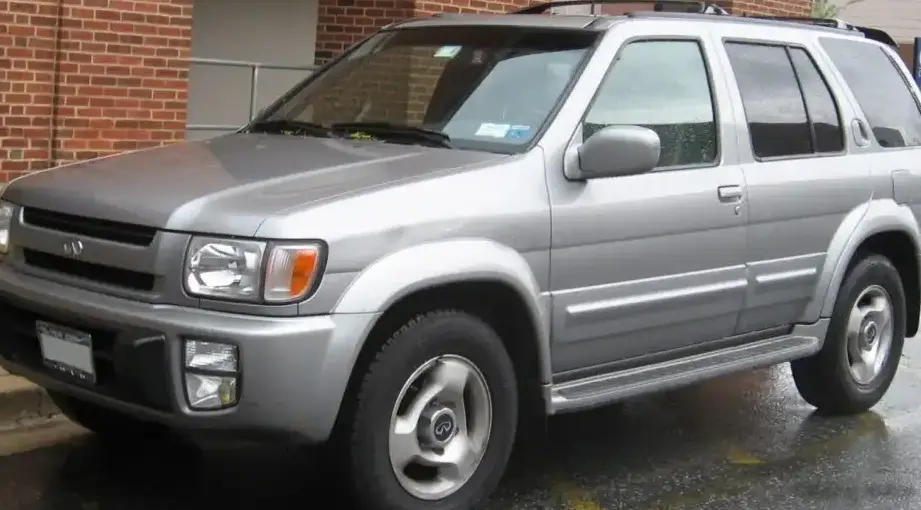
The Infiniti QX4 3.3i, produced from 1996 to 2002, represented Infiniti’s entry into the mid-size luxury SUV segment. Built upon the Nissan Pathfinder chassis (WD21), the QX4 aimed to offer a more refined and luxurious experience than its utilitarian sibling, while still providing robust four-wheel-drive capability. This particular variant, equipped with the 3.3-liter V6 engine producing 170 horsepower and a four-speed automatic transmission, served as the standard powertrain for the QX4 throughout its production run. It positioned itself as a comfortable and capable family vehicle, appealing to buyers seeking a premium SUV experience without the higher price tags of European competitors.
Technical Specifications
| Brand | Infiniti |
| Model | QX4 |
| Generation | QX4 |
| Type (Engine) | 3.3 i V6 24V (170 Hp) |
| Start of production | 1996 year |
| End of production | 2002 year |
| Powertrain Architecture | Internal Combustion engine |
| Body type | SUV |
| Seats | 5 |
| Doors | 5 |
| Fuel consumption (economy) – urban | 15.7 l/100 km (15 US mpg, 18 UK mpg, 6.4 km/l) |
| Fuel consumption (economy) – extra urban | 12.4 l/100 km (19 US mpg, 22.8 UK mpg, 8.1 km/l) |
| Fuel Type | Petrol (Gasoline) |
| Acceleration 0 – 100 km/h | 11.2 sec |
| Acceleration 0 – 62 mph | 11.2 sec |
| Acceleration 0 – 60 mph | 10.6 sec |
| Maximum speed | 177 km/h (109.98 mph) |
| Weight-to-power ratio | 11.4 kg/Hp, 87.6 Hp/tonne |
| Weight-to-torque ratio | 7.3 kg/Nm, 137.1 Nm/tonne |
| Power | 170 Hp @ 4800 rpm |
| Power per litre | 51.9 Hp/l |
| Torque | 266 Nm @ 2800 rpm (196.19 lb.-ft. @ 2800 rpm) |
| Engine layout | Front, Longitudinal |
| Engine displacement | 3275 cm3 (199.85 cu. in.) |
| Number of cylinders | 6 |
| Engine configuration | V-engine |
| Cylinder Bore | 91.5 mm (3.6 in.) |
| Piston Stroke | 83 mm (3.27 in.) |
| Compression ratio | 7.9:1 |
| Number of valves per cylinder | 4 |
| Fuel injection system | Multi-port manifold injection |
| Engine aspiration | Naturally aspirated engine |
| Valvetrain | DOHC |
| Kerb Weight | 1940 kg (4276.97 lbs.) |
| Max. weight | 2335 kg (5147.79 lbs.) |
| Max load | 395 kg (870.83 lbs.) |
| Trunk (boot) space – minimum | 1075 l (37.96 cu. ft.) |
| Trunk (boot) space – maximum | 2405 l (84.93 cu. ft.) |
| Fuel tank capacity | 80 l (21.13 US gal, 17.6 UK gal) |
| Length | 4670 mm (183.86 in.) |
| Width | 1840 mm (72.44 in.) |
| Height | 1800 mm (70.87 in.) |
| Wheelbase | 2700 mm (106.3 in.) |
| Front track | 1520 mm (59.84 in.) |
| Rear (Back) track | 1520 mm (59.84 in.) |
| Drive wheel | All wheel drive (4×4) |
| Number of gears and type of gearbox | 4 gears, automatic transmission |
| Front suspension | Coil spring |
| Rear suspension | Coil spring |
| Front brakes | Ventilated discs |
| Rear brakes | Drum |
| Assisting systems | ABS (Anti-lock braking system) |
| Steering type | Steering rack and pinion |
| Power steering | Hydraulic Steering |
| Tires size | 245/70 R16 |
Powertrain & Engine Architecture
The heart of the QX4 3.3i is the Nissan VG33E engine, a 3.3-liter V6. This engine, part of the VG series known for its durability, utilizes a cast-iron block and aluminum cylinder heads. It features a double overhead camshaft (DOHC) valvetrain with four valves per cylinder, and a multi-port fuel injection system. The VG33E produces 170 horsepower at 4800 rpm and 266 Nm (196 lb-ft) of torque at 2800 rpm. The engine’s relatively low 7.9:1 compression ratio was a design choice to accommodate the use of regular unleaded gasoline. Paired with the engine is a four-speed automatic transmission, providing smooth, if not particularly sporty, shifts. This transmission was chosen for its reliability and ease of use, aligning with the QX4’s focus on comfort and convenience.
Driving Characteristics
The QX4 3.3i’s driving experience is best described as comfortable and composed. The 170 hp engine, while not exceptionally powerful, provides adequate acceleration for everyday driving and highway cruising. The four-speed automatic transmission, while lacking the responsiveness of more modern gearboxes, delivers smooth shifts. Acceleration from 0 to 60 mph takes around 10.6 seconds, and the top speed is approximately 110 mph. Compared to the manual transmission versions (available in the Pathfinder), the automatic QX4 sacrifices some responsiveness for ease of use. The higher-output engine options available in other Nissan/Infiniti models, such as the supercharged V6, offered significantly more performance, but at a higher price point. The QX4’s all-wheel-drive system provides confident traction in various weather conditions, making it a capable vehicle for those living in areas with inclement weather.
Equipment & Trim Levels
The QX4 3.3i came reasonably well-equipped, even in its base form. Standard features included air conditioning, power windows and locks, cruise control, and an AM/FM stereo with a cassette player. Leather upholstery, a sunroof, and upgraded audio systems were available as options. The interior design was generally conservative, focusing on functionality and durability rather than flashy aesthetics. Trim levels were relatively simple, with most QX4s falling into a single, well-equipped configuration with options packages available. The emphasis was on providing a comfortable and refined interior experience, befitting a luxury SUV.
Chassis & Braking
The QX4’s chassis is based on the Nissan Pathfinder’s robust body-on-frame construction. The suspension utilizes coil springs at all four corners, providing a comfortable ride. Front brakes are ventilated discs, while the rear brakes are drums. Anti-lock brakes (ABS) were standard equipment. The QX4’s suspension tuning prioritizes ride comfort over sporty handling. The all-wheel-drive system is a part-time system, allowing the driver to select between 2WD and 4WD modes. The relatively heavy curb weight of around 4,277 lbs contributes to the QX4’s stable and planted feel on the road.
Market Reception & Comparison
The Infiniti QX4 was generally well-received by automotive critics. It was praised for its comfortable ride, spacious interior, and capable all-wheel-drive system. However, some critics noted that the engine lacked the power of some competitors, and the interior design was somewhat dated. Compared to other SUVs in its class, such as the Jeep Grand Cherokee and the Ford Explorer, the QX4 offered a more refined and luxurious experience, but at a slightly higher price point. Fuel economy was average for the class, with EPA estimates of around 15 mpg city and 19 mpg highway. Reliability was generally good, with the VG33E engine proving to be a durable and long-lasting powerplant.
Legacy
The Infiniti QX4 laid the foundation for Infiniti’s successful foray into the luxury SUV market. The VG33E engine, while not a high-performance unit, proved to be remarkably reliable, and many QX4s remain on the road today. In the used car market, the QX4 is often sought after for its affordability, durability, and capable four-wheel-drive system. While it may not offer the latest technology or the most exciting driving experience, the QX4 remains a solid and dependable choice for those seeking a comfortable and practical luxury SUV. Its body-on-frame construction and relatively simple mechanicals make it a relatively easy vehicle to maintain and repair, further contributing to its enduring appeal.
