
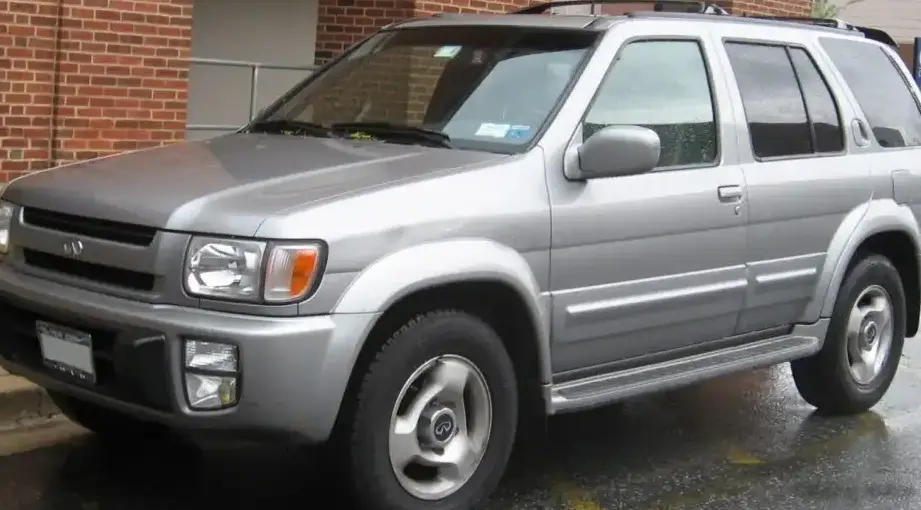
The Infiniti QX4 3.5i, produced from 1996 to 2002, represented Infiniti’s entry into the mid-size luxury SUV segment. Built upon the Nissan Patrol (Y61) chassis, but significantly refined for the luxury market, the QX4 aimed to provide a more upscale alternative to offerings from Ford, Jeep, and Toyota. It was a key model for establishing the Infiniti brand in North America, leveraging Nissan’s robust mechanicals with a focus on comfort and refinement. This specific variant, powered by the 3.5-liter V6 engine paired with a four-speed automatic transmission, occupied the core of the QX4 lineup, offering a balance between performance and accessibility. It was positioned as the standard engine and transmission choice, with no other powertrain options available during its production run.
Technical Specifications
| Brand | Infiniti |
| Model | QX4 |
| Generation | QX4 |
| Type (Engine) | 3.5 i V6 24V (243 Hp) |
| Start of production | 1996 |
| End of production | 2002 |
| Powertrain Architecture | Internal Combustion engine |
| Body type | SUV |
| Seats | 5 |
| Doors | 5 |
| Fuel consumption (urban) | 15.7 l/100 km (15 US mpg, 18 UK mpg) |
| Fuel consumption (extra urban) | 12.4 l/100 km (19 US mpg, 22.8 UK mpg) |
| Fuel Type | Petrol (Gasoline) |
| Acceleration 0 – 100 km/h | 9.1 sec |
| Acceleration 0 – 62 mph | 9.1 sec |
| Acceleration 0 – 60 mph | 8.6 sec |
| Maximum speed | 177 km/h (109.98 mph) |
| Weight-to-power ratio | 7.8 kg/Hp |
| Weight-to-torque ratio | 5.3 kg/Nm |
| Power | 243 Hp @ 6000 rpm |
| Power per litre | 69.5 Hp/l |
| Torque | 359 Nm @ 3200 rpm (264.78 lb.-ft. @ 3200 rpm) |
| Engine layout | Front, Longitudinal |
| Engine displacement | 3498 cm3 (213.46 cu. in.) |
| Number of cylinders | 6 |
| Engine configuration | V-engine |
| Cylinder Bore | 95.5 mm (3.76 in.) |
| Piston Stroke | 81.4 mm (3.2 in.) |
| Compression ratio | 10:1 |
| Number of valves per cylinder | 4 |
| Fuel injection system | Multi-port manifold injection |
| Engine aspiration | Naturally aspirated engine |
| Kerb Weight | 1900 kg (4188.78 lbs.) |
| Trunk (boot) space – minimum | 1076 l (38 cu. ft.) |
| Trunk (boot) space – maximum | 2407 l (85 cu. ft.) |
| Fuel tank capacity | 80 l (21.13 US gal | 17.6 UK gal) |
| Length | 4651 mm (183.11 in.) |
| Width | 1839 mm (72.4 in.) |
| Height | 1796 mm (70.71 in.) |
| Wheelbase | 2700 mm (106.3 in.) |
| Front track | 1539 mm (60.59 in.) |
| Rear (Back) track | 1544 mm (60.79 in.) |
| Drivetrain Architecture | The Internal combustion engine (ICE) drives the rear wheels of the vehicle. |
| Drive wheel | Rear wheel drive |
| Number of gears and type of gearbox | 4 gears, automatic transmission |
| Front suspension | Coil spring |
| Rear suspension | Coil spring |
| Front brakes | Ventilated discs |
| Rear brakes | Drum |
| Assisting systems | ABS (Anti-lock braking system) |
| Steering type | Steering rack and pinion |
| Power steering | Hydraulic Steering |
| Tires size | 245/70 R16 |
Powertrain & Engine Architecture
The heart of the QX4 3.5i is the Nissan VH35DE engine, a 3.5-liter naturally aspirated V6. This engine, part of Nissan’s VQ family, is renowned for its smoothness and reliability. The VH35DE features a cast iron block with aluminum cylinder heads, four valves per cylinder, and a double overhead camshaft (DOHC) design. Fuel delivery is managed by a multi-port fuel injection system, providing precise fuel metering for optimal combustion. The engine produces 243 horsepower at 6000 rpm and 264 lb-ft of torque at 3200 rpm. The four-speed automatic transmission, designated as the RE4R01A, was a standard feature. While not the most advanced transmission available at the time, it was known for its durability and smooth shifting characteristics. The transmission’s gear ratios were tuned for a balance of acceleration and fuel efficiency, prioritizing comfortable cruising over outright performance.
Driving Characteristics
The QX4 3.5i with the automatic transmission delivers a comfortable and refined driving experience. Acceleration from a standstill to 60 mph takes approximately 8.6 seconds, which was competitive for its class at the time. The automatic transmission provides smooth gear changes, but it lacks the responsiveness of a manual transmission. The torque converter can sometimes feel sluggish during quick acceleration. The rear-wheel-drive configuration provides a more engaging driving experience than many contemporary SUVs, offering better handling balance. However, it also means the QX4 lacks the all-weather capability of all-wheel-drive competitors. Compared to a hypothetical manual transmission version (which was not offered), the automatic QX4 sacrifices some performance for ease of use.
Equipment & Trim Levels
The QX4 3.5i came standard with a respectable array of features for a luxury SUV of its era. Standard equipment included leather upholstery, power-adjustable front seats, a premium sound system, automatic climate control, and alloy wheels. Optional extras included a sunroof, upgraded audio systems, and a navigation system. The interior design was generally conservative, focusing on comfort and functionality rather than flashy styling. The dashboard layout was straightforward and easy to use, with clearly labeled controls. The QX4’s interior space was generous, providing ample room for passengers and cargo.
Chassis & Braking
The QX4’s chassis is based on a robust body-on-frame construction, providing a solid and durable platform. The front suspension utilizes coil springs and independent double wishbone setup, while the rear suspension employs coil springs and a solid axle. This configuration provides a comfortable ride, but it can also result in some body roll during cornering. The braking system consists of ventilated discs at the front and drum brakes at the rear. Anti-lock brakes (ABS) were standard, enhancing safety and control during emergency braking situations. The QX4’s steering is hydraulically assisted, providing a responsive and precise feel.
Market Reception & Comparison
The Infiniti QX4 was generally well-received by automotive critics. It was praised for its comfortable ride, spacious interior, and refined powertrain. However, some critics noted its relatively high fuel consumption and lack of all-wheel drive. Compared to competitors like the Ford Explorer and Jeep Grand Cherokee, the QX4 offered a more luxurious and refined experience, but it was also more expensive. The QX4’s fuel economy was typical for a V6-powered SUV of its size, averaging around 15 mpg in the city and 19 mpg on the highway. Reliability was generally good, with the VH35DE engine proving to be a durable and long-lasting powerplant.
Legacy
The Infiniti QX4 3.5i remains a popular choice among used car buyers seeking a reliable and comfortable mid-size SUV. The VH35DE engine is known for its longevity, and the four-speed automatic transmission is generally dependable. While maintenance costs can be higher than for some competitors, the QX4’s overall reliability and build quality make it a worthwhile investment. Today, well-maintained examples of the QX4 3.5i can still provide years of reliable service, offering a taste of early 2000s luxury and a testament to Nissan’s engineering prowess.
