
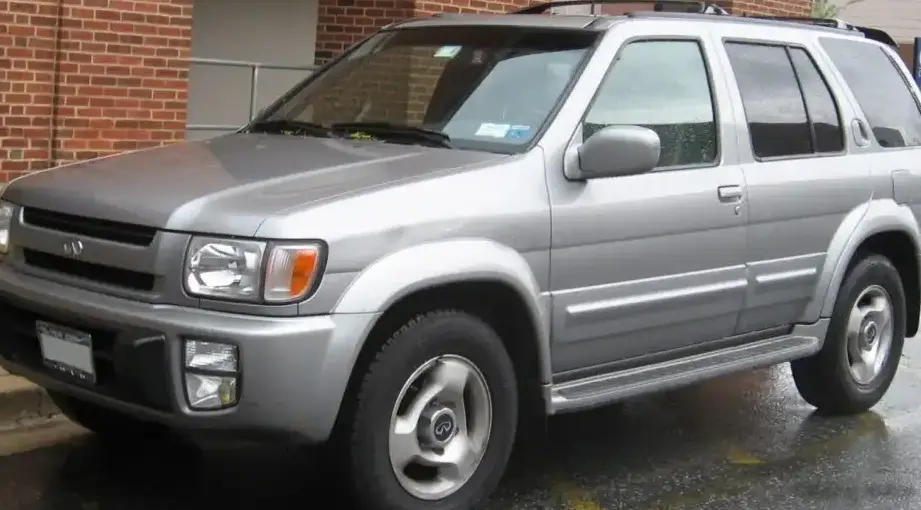
The Infiniti QX4 3.5i, produced from 1996 to 2002, represented Infiniti’s entry into the mid-size luxury SUV segment. Built upon the Nissan Pathfinder chassis (WD21 and later R50), the QX4 aimed to offer a more refined and luxurious experience than its Nissan counterpart, competing with vehicles like the Lexus RX and Acura SLX. This particular variant, equipped with the 3.5-liter V6 engine and a four-speed automatic transmission, was the primary configuration offered throughout its production run, establishing the QX4 as a comfortable and capable all-weather vehicle for American families. It was a key model in establishing the Infiniti brand’s presence in the burgeoning SUV market of the late 1990s and early 2000s.
Technical Specifications
| Brand | Infiniti |
| Model | QX4 |
| Generation | QX4 |
| Type (Engine) | 3.5 i V6 24V AWD (243 Hp) |
| Start of production | 1996 |
| End of production | 2002 |
| Powertrain Architecture | Internal Combustion engine |
| Body type | SUV |
| Seats | 5 |
| Doors | 5 |
| Fuel consumption (urban) | 15.7 l/100 km (15 US mpg, 18 UK mpg, 6.4 km/l) |
| Fuel consumption (extra urban) | 13.1 l/100 km (18 US mpg, 21.6 UK mpg, 7.6 km/l) |
| Fuel Type | Petrol (Gasoline) |
| Acceleration 0 – 100 km/h | 9.3 sec |
| Acceleration 0 – 62 mph | 9.3 sec |
| Acceleration 0 – 60 mph | 8.8 sec |
| Maximum speed | 177 km/h (109.98 mph) |
| Weight-to-power ratio | 8.3 kg/Hp, 120 Hp/tonne |
| Weight-to-torque ratio | 5.6 kg/Nm, 177.3 Nm/tonne |
| Power | 243 Hp @ 6000 rpm |
| Power per litre | 69.5 Hp/l |
| Torque | 359 Nm @ 3200 rpm (264.78 lb.-ft. @ 3200 rpm) |
| Engine layout | Front, Longitudinal |
| Engine displacement | 3498 cm3 (213.46 cu. in.) |
| Number of cylinders | 6 |
| Engine configuration | V-engine |
| Cylinder Bore | 95.5 mm (3.76 in.) |
| Piston Stroke | 81.4 mm (3.2 in.) |
| Compression ratio | 10:1 |
| Number of valves per cylinder | 4 |
| Fuel injection system | Multi-port manifold injection |
| Engine aspiration | Naturally aspirated engine |
| Kerb Weight | 2025 kg (4464.36 lbs.) |
| Trunk (boot) space – minimum | 1076 l (38 cu. ft.) |
| Trunk (boot) space – maximum | 2407 l (85 cu. ft.) |
| Fuel tank capacity | 80 l (21.13 US gal | 17.6 UK gal) |
| Length | 4651 mm (183.11 in.) |
| Width | 1839 mm (72.4 in.) |
| Height | 1796 mm (70.71 in.) |
| Wheelbase | 2700 mm (106.3 in.) |
| Front track | 1539 mm (60.59 in.) |
| Rear (Back) track | 1544 mm (60.79 in.) |
| Drive wheel | All wheel drive (4×4) |
| Number of gears and type of gearbox | 4 gears, automatic transmission |
| Front suspension | Coil spring |
| Rear suspension | Coil spring |
| Front brakes | Ventilated discs |
| Rear brakes | Drum |
| Assisting systems | ABS (Anti-lock braking system) |
| Steering type | Steering rack and pinion |
| Power steering | Hydraulic Steering |
| Tires size | 245/70 R16 |
Powertrain & Engine Architecture
The heart of the QX4 3.5i is the Nissan VK35DE engine, a 3.5-liter naturally aspirated V6. This engine, part of Nissan’s VQ family, is known for its smoothness and reliability. The VK35DE features a cast iron block with aluminum cylinder heads, four valves per cylinder, and a multi-port fuel injection system. The engine produces 243 horsepower at 6000 rpm and 264 lb-ft of torque at 3200 rpm. The engine’s longitudinal mounting and all-wheel-drive system contribute to its balanced handling characteristics. The four-speed automatic transmission, while not as sophisticated as some contemporary transmissions, was chosen for its durability and smooth operation. It provided adequate gear ratios for everyday driving and towing, though it lacked the responsiveness of manual transmissions or more modern automatics.
Driving Characteristics
The QX4 3.5i with the automatic transmission delivers a comfortable and predictable driving experience. Acceleration from 0-60 mph takes approximately 8.8 seconds, which was competitive for its class at the time. The automatic transmission prioritizes smooth shifts over aggressive performance, making it well-suited for cruising and everyday commuting. While the engine provides sufficient power for passing maneuvers, it doesn’t offer the sporty feel of some competitors. The all-wheel-drive system provides excellent traction in various weather conditions, enhancing stability and confidence. The QX4’s relatively soft suspension setup contributes to a comfortable ride, but it can also result in some body roll during cornering.
Equipment & Trim Levels
The QX4 3.5i came reasonably well-equipped, positioning it as a mid-range luxury SUV. Standard features typically included leather upholstery, power-adjustable front seats, a premium sound system, automatic climate control, and alloy wheels. Optional extras included a sunroof, upgraded audio systems, and a navigation system. The interior design was generally conservative and focused on functionality and comfort. The rear seats offered ample legroom, and the folding rear seats expanded cargo capacity significantly. The QX4’s interior materials were of good quality, though they didn’t quite match the refinement of some European competitors.
Chassis & Braking
The QX4’s chassis is based on the Nissan Pathfinder, but with modifications to enhance ride quality and handling. The suspension utilizes coil springs and shock absorbers at all four corners. Front suspension is independent, while the rear suspension is a solid axle configuration. Braking duties are handled by ventilated discs at the front and drum brakes at the rear. Anti-lock brakes (ABS) were standard equipment. The QX4’s braking performance is adequate for its weight class, but it doesn’t offer the stopping power of some more performance-oriented SUVs. The steering is hydraulic power-assisted rack and pinion, providing a reasonably responsive feel.
Market Reception & Comparison
The Infiniti QX4 was generally well-received by automotive critics. It was praised for its comfortable ride, spacious interior, and standard all-wheel-drive system. However, some critics noted that the automatic transmission could feel sluggish at times, and the interior design was somewhat conservative. Compared to the manual transmission version (which was rarely seen in the US market), the automatic QX4 offered less driver engagement but greater convenience. Compared to other trims, the 3.5i automatic was the most popular and balanced option, offering a good combination of performance, comfort, and features. Fuel economy was average for its class, with EPA estimates around 15 mpg city and 18 mpg highway.
Legacy
The Infiniti QX4 established a strong foundation for Infiniti’s SUV lineup. The VK35DE engine proved to be remarkably durable, and many QX4s remain on the road today with relatively high mileage. While the four-speed automatic transmission is not known for its fuel efficiency, it has proven to be reliable. The QX4’s all-wheel-drive system continues to be a valuable asset in regions with inclement weather. In the used car market, the QX4 3.5i is often sought after for its affordability, reliability, and spacious interior. It represents a solid value for buyers looking for a capable and comfortable mid-size SUV.
