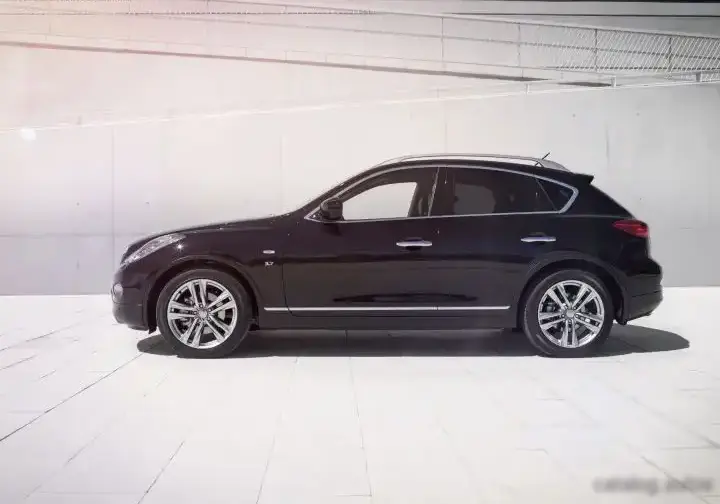
The Infiniti QX50 I, specifically the 2.5 V6 variant with all-wheel drive and an automatic transmission, represents Infiniti’s entry into the mid-size luxury crossover SUV segment. Produced from 2013 to 2015, this generation QX50 (internally designated as the L50 series) aimed to provide a blend of comfort, technology, and performance. It served as a key model in Infiniti’s lineup, positioned below the larger QX70 and aimed at buyers seeking a more manageable and fuel-efficient luxury SUV. This particular configuration, with its 222 horsepower V6 engine and seven-speed automatic, occupied a middle ground within the QX50 range, offering a balance between performance and economy.
Technical Specifications
| Brand | Infiniti |
| Model | QX50 |
| Generation | QX50 I |
| Type (Engine) | 2.5 V6 (222 Hp) AWD Automatic |
| Start of production | 2013 |
| End of production | 2015 |
| Powertrain Architecture | Internal Combustion engine |
| Body type | SUV |
| Seats | 5 |
| Doors | 5 |
| Fuel consumption (urban) | 14.3 l/100 km (16.4 US mpg, 19.8 UK mpg, 7 km/l) |
| Fuel consumption (extra urban) | 8.4 l/100 km (28 US mpg, 33.6 UK mpg, 11.9 km/l) |
| Fuel consumption (combined) | 10.6 l/100 km (22.2 US mpg, 26.6 UK mpg, 9.4 km/l) |
| CO2 emissions | 265 g/km |
| Fuel Type | Petrol (Gasoline) |
| Acceleration 0 – 100 km/h | 9.4 sec |
| Acceleration 0 – 62 mph | 9.4 sec |
| Acceleration 0 – 60 mph | 8.9 sec |
| Maximum speed | 210 km/h (130.49 mph) |
| Emission standard | Euro 4 |
| Weight-to-power ratio | 8.3 kg/Hp, 120.5 Hp/tonne |
| Weight-to-torque ratio | 7.3 kg/Nm, 136.8 Nm/tonne |
| Power | 222 Hp @ 6400 rpm |
| Power per litre | 88.9 Hp/l |
| Torque | 252 Nm @ 4800 rpm (185.87 lb.-ft. @ 4800 rpm) |
| Engine layout | Front, Transverse |
| Engine Model/Code | VQ25HR |
| Engine displacement | 2496 cm3 (152.32 cu. in.) |
| Number of cylinders | 6 |
| Engine configuration | V-engine |
| Cylinder Bore | 85 mm (3.35 in.) |
| Piston Stroke | 73.3 mm (2.89 in.) |
| Compression ratio | 10.3:1 |
| Number of valves per cylinder | 4 |
| Fuel injection system | Multi-port manifold injection |
| Engine aspiration | Naturally aspirated engine |
| Valvetrain | DOHC |
| Engine oil capacity | 4.7 l (4.97 US qt | 4.14 UK qt) |
| Coolant | 8.4 l (8.88 US qt | 7.39 UK qt) |
| Kerb Weight | 1842 kg (4060.91 lbs.) |
| Max. weight | 2272 kg (5008.9 lbs.) |
| Max load | 430 kg (947.99 lbs.) |
| Trunk (boot) space – minimum | 309 l (10.91 cu. ft.) |
| Trunk (boot) space – maximum | 1175 l (41.49 cu. ft.) |
| Fuel tank capacity | 80 l (21.13 US gal | 17.6 UK gal) |
| Length | 4635 mm (182.48 in.) |
| Width | 1800 mm (70.87 in.) |
| Width including mirrors | 2043 mm (80.43 in.) |
| Height | 1600 mm (62.99 in.) |
| Wheelbase | 2800 mm (110.24 in.) |
| Front track | 1540 mm (60.63 in.) |
| Rear (Back) track | 1545 mm (60.83 in.) |
| Ride height (ground clearance) | 147 mm (5.79 in.) |
| Drag coefficient (Cd) | 0.32 |
| Minimum turning circle (turning diameter) | 11.4 m (37.4 ft.) |
| Drive wheel | All wheel drive (4×4) |
| Number of gears and type of gearbox | 7 gears, automatic transmission |
| Front suspension | Double wishbone |
| Rear suspension | Independent multi-link spring suspension with stabilizer |
| Front brakes | Ventilated discs |
| Rear brakes | Disc |
| Assisting systems | ABS (Anti-lock braking system) |
| Steering type | Steering rack and pinion |
| Power steering | Electric Steering |
| Tires size | 225/55 R18 |
| Wheel rims size | 18 |
Powertrain & Engine Architecture
The heart of this QX50 variant is Nissan’s VQ25HR 2.5-liter V6 engine. This engine is a naturally aspirated, 24-valve DOHC powerplant known for its smoothness and relatively high output for its displacement. The ‘HR’ designation signifies a high revolution version, incorporating features like variable valve timing and lift control (VVEL) to optimize performance and efficiency across the rev range. Fuel delivery is managed by a multi-port fuel injection system. The engine produces 222 horsepower at 6400 rpm and 252 Nm (185.87 lb-ft) of torque at 4800 rpm. This power is then sent to all four wheels via a seven-speed automatic transmission. This transmission, while offering smooth shifts, wasn’t known for being particularly sporty, prioritizing comfort and fuel efficiency over aggressive downshifts. The all-wheel-drive system is primarily reactive, engaging the rear wheels when front wheel slip is detected, enhancing stability in adverse conditions.
Driving Characteristics
The QX50 2.5 V6 AWD Automatic delivers a comfortable and composed driving experience. Acceleration from 0-60 mph takes approximately 8.9 seconds, which is adequate for everyday driving but doesn’t offer particularly brisk performance. The seven-speed automatic transmission contributes to a relaxed cruising experience, but can feel somewhat hesitant during quick acceleration maneuvers. Compared to the higher-output 3.7-liter V6 offered in other QX50 trims, this 2.5-liter engine feels noticeably less powerful. However, it offers significantly better fuel economy. The all-wheel-drive system provides confident handling in various weather conditions, but doesn’t transform the QX50 into a performance-oriented SUV. The gear ratios are tuned for efficiency, resulting in a relatively high final drive ratio.
Equipment & Trim Levels
The QX50 2.5 V6 AWD Automatic typically came standard with features such as leather upholstery, a power-adjustable driver’s seat, dual-zone automatic climate control, a rearview camera, and a premium audio system. Optional extras included a navigation system, a panoramic sunroof, and advanced safety features like blind-spot monitoring and lane departure warning. Trim levels varied slightly depending on the year, but generally offered packages that added convenience and luxury features. Interior materials were generally of good quality, though not quite at the level of some European competitors.
Chassis & Braking
The QX50 I utilizes a front double wishbone and rear independent multi-link suspension setup, designed to provide a comfortable ride and predictable handling. Stabilizer bars are included at both ends to reduce body roll during cornering. Braking duties are handled by ventilated discs at the front and solid discs at the rear. The anti-lock braking system (ABS) is standard. The suspension tuning prioritizes comfort over sporty handling, resulting in a relatively soft ride quality. The steering is electrically assisted, providing light and easy steering feel.
Market Reception & Comparison
The QX50 2.5 V6 AWD Automatic was generally well-received by critics as a comfortable and practical luxury crossover. However, some reviewers noted that its performance was not as engaging as some of its competitors, such as the Acura RDX or BMW X3. Fuel economy was considered average for the segment. Compared to the QX50 3.7, the 2.5-liter version offered a more affordable entry point and better fuel efficiency, but at the expense of performance. Reliability was generally good, though some owners reported minor issues with the infotainment system.
Legacy
The Infiniti QX50 I 2.5 V6 AWD Automatic remains a relatively common sight on the used car market. The VQ25HR engine is known for its durability and longevity, provided it has been properly maintained. While not a particularly exciting vehicle to drive, it offers a comfortable and reliable transportation option for those seeking a mid-size luxury crossover. Its relatively affordable price point and good fuel economy make it an attractive option for budget-conscious buyers. The QX50 I paved the way for the significantly redesigned second-generation QX50, which introduced a variable compression engine and a more modern design.