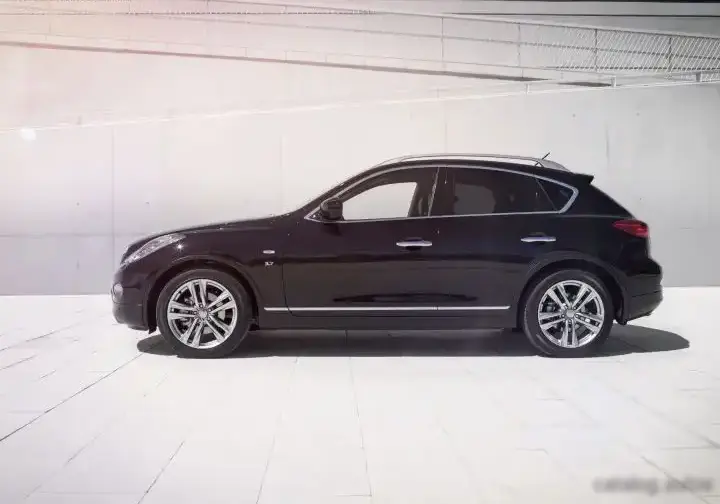
The Infiniti QX50 I 3.0d V6 (238 Hp) AWD Automatic represents a significant entry into the mid-size luxury SUV segment for the Japanese automaker. Produced between 2013 and 2015, this variant occupied a unique position within the first generation (QX50 I) of the QX50, offering a diesel powertrain option not commonly found in its North American competitors. It was built on the shared Nissan/Renault D-platform, also known as the Nissan D platform, and aimed to provide a blend of fuel efficiency, performance, and luxury features. This model was primarily targeted towards European and Asian markets where diesel engines were more prevalent, with limited availability in the United States.
Technical Specifications
| Brand | Infiniti |
| Model | QX50 |
| Generation | QX50 I |
| Type (Engine) | 3.0d V6 (238 Hp) AWD Automatic |
| Start of production | 2013 |
| End of production | 2015 |
| Powertrain Architecture | Internal Combustion engine |
| Body type | SUV |
| Seats | 5 |
| Doors | 5 |
| Fuel consumption (urban) | 10.8 l/100 km (21.8 US mpg) |
| Fuel consumption (extra urban) | 7.2 l/100 km (32.7 US mpg) |
| Fuel consumption (combined) | 8.5 l/100 km (27.7 US mpg) |
| CO2 emissions | 224 g/km |
| Fuel Type | Diesel |
| Acceleration 0 – 100 km/h | 7.9 sec |
| Acceleration 0 – 62 mph | 7.9 sec |
| Acceleration 0 – 60 mph | 7.5 sec |
| Maximum speed | 221 km/h (137.32 mph) |
| Emission standard | Euro 5 |
| Weight-to-power ratio | 8.3 kg/Hp |
| Weight-to-torque ratio | 3.6 kg/Nm |
| Power | 238 Hp @ 3750 rpm |
| Torque | 550 Nm @ 1750 rpm (405.66 lb.-ft. @ 1750 rpm) |
| Engine layout | Front, Longitudinal |
| Engine Model/Code | V9X |
| Engine displacement | 2993 cm3 (182.64 cu. in.) |
| Number of cylinders | 6 |
| Engine configuration | V-engine |
| Cylinder Bore | 84 mm (3.31 in.) |
| Piston Stroke | 90 mm (3.54 in.) |
| Compression ratio | 16:1 |
| Number of valves per cylinder | 4 |
| Fuel injection system | Diesel Commonrail |
| Engine aspiration | Turbocharger, Intercooler |
| Valvetrain | DOHC |
| Engine oil capacity | 5.3 l (5.6 US qt | 4.66 UK qt) |
| Kerb Weight | 1985 kg (4376.18 lbs.) |
| Max. weight | 2470 kg (5445.42 lbs.) |
| Max load | 485 kg (1069.24 lbs.) |
| Trunk (boot) space – minimum | 309 l (10.91 cu. ft.) |
| Trunk (boot) space – maximum | 1175 l (41.49 cu. ft.) |
| Fuel tank capacity | 80 l (21.13 US gal | 17.6 UK gal) |
| Permitted trailer load with brakes (12%) | 2000 kg (4409.25 lbs.) |
| Permitted trailer load without brakes | 750 kg (1653.47 lbs.) |
| Length | 4635 mm (182.48 in.) |
| Width | 1800 mm (70.87 in.) |
| Width including mirrors | 2043 mm (80.43 in.) |
| Height | 1600 mm (62.99 in.) |
| Wheelbase | 2800 mm (110.24 in.) |
| Front track | 1540 mm (60.63 in.) |
| Rear (Back) track | 1545 mm (60.83 in.) |
| Ride height (ground clearance) | 149 mm (5.87 in.) |
| Drag coefficient (Cd) | 0.33 |
| Minimum turning circle (turning diameter) | 11.4 m (37.4 ft.) |
| Drive wheel | All wheel drive (4×4) |
| Number of gears and type of gearbox | 7 gears, automatic transmission |
| Front suspension | Double wishbone |
| Rear suspension | Independent multi-link spring suspension with stabilizer |
| Front brakes | Ventilated discs |
| Rear brakes | Ventilated discs |
| Assisting systems | ABS (Anti-lock braking system) |
| Steering type | Steering rack and pinion |
| Power steering | Electric Steering |
| Tires size | 225/55 R18 |
| Wheel rims size | 18 |
Powertrain & Engine Architecture
The heart of the QX50 I 3.0d is the V9X 3.0-liter V6 turbodiesel engine. This engine, part of the VQ engine family adapted for diesel operation, utilizes a common rail direct injection system, delivering fuel at extremely high pressures for optimized combustion. The engine boasts a robust 16:1 compression ratio and is equipped with a turbocharger and intercooler to enhance power and torque output. The engine code V9X signifies a specific calibration for the European market, prioritizing fuel efficiency and low emissions to meet Euro 5 standards. The engine is longitudinally mounted, contributing to a balanced weight distribution. Paired with this engine is a seven-speed automatic transmission, designed to provide smooth and efficient gear changes. This transmission was chosen for its ability to handle the engine’s substantial torque and provide a comfortable driving experience.
Driving Characteristics
The 3.0d V6 Automatic QX50 delivers a noticeably different driving experience compared to the gasoline-powered variants. The high torque output of 550 Nm (405.66 lb-ft) available from 1750 rpm provides strong acceleration and effortless cruising. While not a sports SUV, the 7.9-second 0-60 mph time is respectable for its class. The seven-speed automatic transmission is well-tuned, offering smooth shifts and contributing to the overall refinement. However, the diesel engine is more audible than the gasoline counterparts, and the added weight of the diesel engine and associated components can be felt in cornering. The all-wheel-drive system provides enhanced traction and stability, particularly in adverse weather conditions.
Equipment & Trim Levels
The QX50 I 3.0d typically came with a generous level of standard equipment, reflecting its luxury positioning. Standard features included leather upholstery, power-adjustable front seats, a premium audio system, dual-zone automatic climate control, and a navigation system. Optional extras included a panoramic sunroof, adaptive cruise control, and a rear-view camera. Trim levels were relatively limited, with the diesel variant often positioned as a mid-range offering, bridging the gap between the base gasoline models and the higher-spec luxury trims.
Chassis & Braking
The QX50 I features a double wishbone front suspension and an independent multi-link rear suspension, providing a comfortable and controlled ride. Stabilizer bars are fitted to both axles to minimize body roll during cornering. Braking duties are handled by ventilated discs on all four wheels, coupled with an Anti-lock Braking System (ABS) for enhanced safety. The suspension tuning was optimized for the added weight of the diesel engine, ensuring a stable and predictable handling experience.
Market Reception & Comparison
The QX50 I 3.0d received mixed reviews. Critics praised its fuel efficiency and strong torque output, but some found the diesel engine to be noisy and less refined than its gasoline counterparts. Compared to the gasoline-powered QX50 variants, the 3.0d offered superior fuel economy, making it an attractive option for drivers covering long distances. However, the diesel version typically commanded a higher price tag. Compared to European rivals like the BMW X3 and Audi Q5, the QX50 3.0d offered a competitive package in terms of features and performance, but lacked the brand prestige of its German competitors.
Legacy
The Infiniti QX50 I 3.0d V6, while not a high-volume seller, represents an interesting chapter in Infiniti’s history. The V9X diesel engine proved to be relatively reliable, with few widespread issues reported. On the used car market, these models are becoming increasingly sought after by enthusiasts who appreciate their unique combination of luxury, fuel efficiency, and torque. Maintenance costs can be slightly higher than gasoline variants due to the complexity of the diesel engine and emissions control systems, but overall, the QX50 I 3.0d remains a viable and appealing option for buyers seeking a distinctive mid-size luxury SUV.