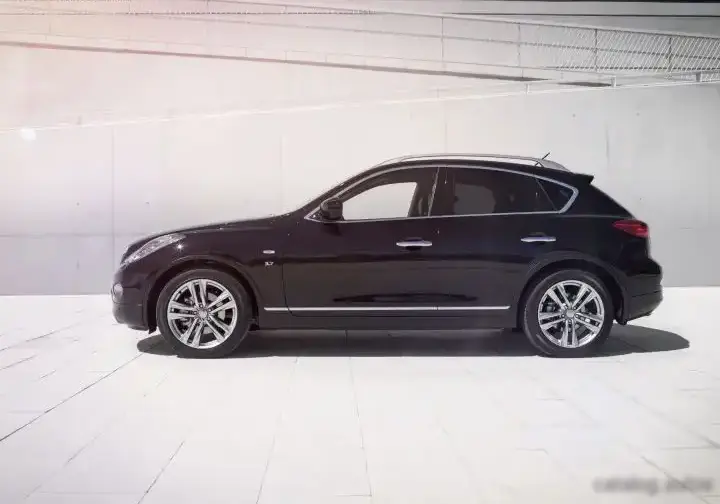
The Infiniti QX50 I, specifically the 3.7 V6 AWD Automatic variant, represents Infiniti’s entry into the mid-size luxury crossover SUV segment. Produced from 2013 to 2015, this generation QX50 (internally designated as the JX50 before a mid-cycle refresh and name change) aimed to provide a more spacious and practical alternative to the G37 sedan and coupe, while still delivering a premium driving experience. This particular configuration, featuring the 3.7-liter V6 engine paired with a seven-speed automatic transmission and all-wheel drive, occupied a central position in the QX50 lineup, offering a balance of performance, luxury, and capability. It was positioned above the base models, which were typically front-wheel drive, and below any potential future high-performance trims.
Technical Specifications
| Brand | Infiniti |
| Model | QX50 |
| Generation | QX50 I |
| Type (Engine) | 3.7 V6 (320 Hp) AWD Automatic |
| Start of production | 2013 |
| End of production | 2015 |
| Powertrain Architecture | Internal Combustion engine |
| Body type | SUV |
| Seats | 5 |
| Doors | 5 |
| Fuel consumption (urban) | 16 l/100 km (14.7 US mpg, 17.7 UK mpg, 6.3 km/l) |
| Fuel consumption (extra urban) | 8.6 l/100 km (27.4 US mpg, 32.8 UK mpg, 11.6 km/l) |
| Fuel consumption (combined) | 11.3 l/100 km (20.8 US mpg, 25 UK mpg, 8.8 km/l) |
| CO2 emissions | 265 g/km |
| Fuel Type | Petrol (Gasoline) |
| Acceleration 0 – 100 km/h | 6.4 sec |
| Acceleration 0 – 62 mph | 6.4 sec |
| Acceleration 0 – 60 mph | 6.1 sec |
| Maximum speed | 240 km/h (149.13 mph) |
| Emission standard | Euro 5 |
| Weight-to-power ratio | 5.9 kg/Hp, 170.6 Hp/tonne |
| Weight-to-torque ratio | 5.2 kg/Nm, 191.9 Nm/tonne |
| Power | 320 Hp @ 7000 rpm |
| Power per litre | 86.6 Hp/l |
| Torque | 360 Nm @ 5200 rpm (265.52 lb.-ft. @ 5200 rpm) |
| Engine layout | Front, Longitudinal |
| Engine Model/Code | VQ37VHR |
| Engine displacement | 3696 cm3 (225.54 cu. in.) |
| Number of cylinders | 6 |
| Engine configuration | V-engine |
| Cylinder Bore | 95.5 mm (3.76 in.) |
| Piston Stroke | 86 mm (3.39 in.) |
| Compression ratio | 11:1 |
| Number of valves per cylinder | 4 |
| Fuel injection system | Multi-port manifold injection |
| Engine aspiration | Naturally aspirated engine |
| Valvetrain | DOHC |
| Engine oil capacity | 4.9 l (5.18 US qt | 4.31 UK qt) |
| Coolant | 9 l (9.51 US qt | 7.92 UK qt) |
| Kerb Weight | 1876 kg (4135.87 lbs.) |
| Max. weight | 2350 kg (5180.86 lbs.) |
| Max load | 474 kg (1044.99 lbs.) |
| Trunk (boot) space – minimum | 309 l (10.91 cu. ft.) |
| Trunk (boot) space – maximum | 1175 l (41.49 cu. ft.) |
| Fuel tank capacity | 80 l (21.13 US gal | 17.6 UK gal) |
| Permitted trailer load with brakes (12%) | 1500 kg (3306.93 lbs.) |
| Permitted trailer load without brakes | 750 kg (1653.47 lbs.) |
| Length | 4635 mm (182.48 in.) |
| Width | 1800 mm (70.87 in.) |
| Width including mirrors | 2043 mm (80.43 in.) |
| Height | 1600 mm (62.99 in.) |
| Wheelbase | 2800 mm (110.24 in.) |
| Front track | 1540 mm (60.63 in.) |
| Rear (Back) track | 1545 mm (60.83 in.) |
| Ride height (ground clearance) | 149 mm (5.87 in.) |
| Drag coefficient (Cd) | 0.32 |
| Minimum turning circle (turning diameter) | 11.4 m (37.4 ft.) |
| Drive wheel | All wheel drive (4×4) |
| Number of gears and type of gearbox | 7 gears, automatic transmission |
| Front suspension | Double wishbone |
| Rear suspension | Independent multi-link spring suspension with stabilizer |
| Front brakes | Ventilated discs |
| Rear brakes | Ventilated discs |
| Assisting systems | ABS (Anti-lock braking system) |
| Steering type | Steering rack and pinion |
| Power steering | Electric Steering |
| Tires size | 225/55 R18 |
| Wheel rims size | 18 |
Powertrain & Engine Architecture
The heart of the QX50 I 3.7 V6 AWD is the VQ37VHR engine, a 3.7-liter naturally aspirated V6. This engine is a member of Nissan’s highly regarded VQ engine family, known for its smoothness, reliability, and strong performance. The “VHR” designation stands for “Variable Valve Timing and lift with high response.” This system allows for precise control of valve timing and lift, optimizing engine performance across the rev range. The engine utilizes multi-port fuel injection and a compression ratio of 11:1. The seven-speed automatic transmission, sourced from Jatco (a Nissan subsidiary), was specifically tuned for the QX50 to provide smooth and responsive shifts. The all-wheel-drive system is primarily front-wheel drive, engaging the rear wheels as needed to enhance traction.
Driving Characteristics
The 3.7-liter V6 delivers a respectable 320 horsepower and 360 lb-ft of torque, providing brisk acceleration. Zero to sixty mph times were consistently reported around 6.1-6.4 seconds. While not a sports car, the QX50 offered ample power for everyday driving and highway passing. The seven-speed automatic transmission, while generally smooth, wasn’t as quick-shifting as some dual-clutch transmissions found in competitors. The AWD system provided confident handling in various weather conditions, but the QX50 wasn’t designed for serious off-roading. Compared to the base 3.5-liter V6 front-wheel drive models, the 3.7-liter AWD version offered a noticeable performance improvement, but at the cost of slightly reduced fuel economy.
Equipment & Trim Levels
The QX50 I 3.7 V6 AWD Automatic typically came standard with features such as leather upholstery, heated front seats, a power-adjustable driver’s seat, a rearview camera, a navigation system, and a premium audio system. Optional extras included a panoramic sunroof, adaptive cruise control, lane departure warning, and blind-spot monitoring. Interior trim levels varied, with higher trims offering more luxurious materials and finishes. The dashboard layout was generally well-designed and user-friendly, although some critics noted the infotainment system could be less intuitive than those offered by some European competitors.
Chassis & Braking
The QX50 I utilized a front double wishbone and rear independent multi-link suspension system, providing a comfortable ride quality. Stabilizer bars were fitted to both the front and rear axles to reduce body roll during cornering. The braking system consisted of ventilated discs on all four wheels, providing adequate stopping power. ABS (Anti-lock Braking System) was standard. The QX50’s weight, around 4136 lbs, contributed to a slightly less agile feel compared to lighter crossovers.
Market Reception & Comparison
The Infiniti QX50 I was generally well-received by critics, who praised its spacious interior, comfortable ride, and strong V6 engine. However, some reviewers noted that its fuel economy was below average for its class, and its handling wasn’t as sporty as some competitors like the Acura RDX or BMW X3. The QX50 offered a compelling value proposition, particularly when compared to more expensive luxury crossovers. The 3.7-liter V6 AWD variant was considered a sweet spot in the lineup, offering a good balance of performance and capability.
Legacy
The Infiniti QX50 I, particularly the 3.7 V6 AWD Automatic, has proven to be a relatively reliable vehicle. The VQ37VHR engine is known for its durability, and the Jatco seven-speed automatic transmission has also demonstrated good longevity. On the used car market, these QX50s represent a good value for buyers seeking a spacious, comfortable, and well-equipped luxury crossover. Common maintenance items include routine oil changes, brake pad replacements, and occasional sensor replacements. While not without its flaws, the QX50 I 3.7 V6 AWD Automatic remains a viable option for those seeking a capable and reliable mid-size luxury SUV.