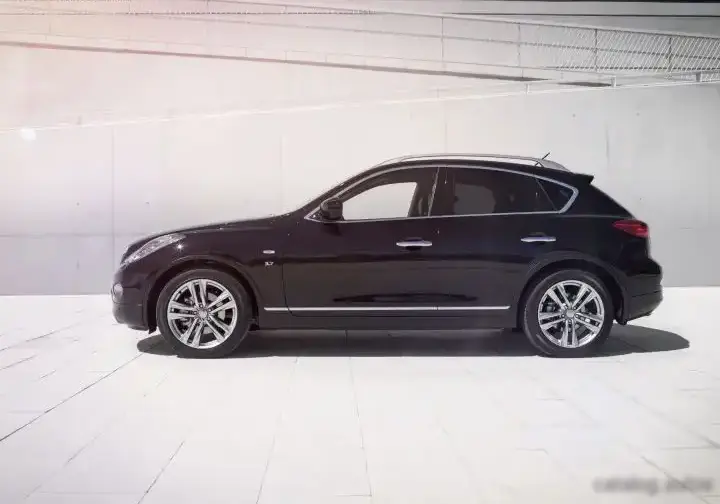
The Infiniti QX50, specifically the facelifted first generation produced from 2015 to 2016, represented Infiniti’s entry into the mid-size luxury crossover SUV segment. This iteration, powered by the 3.7-liter V6 engine paired with an automatic transmission and all-wheel drive, aimed to deliver a blend of performance, luxury, and practicality. Positioned as a premium offering within the Infiniti lineup, it competed with vehicles like the Acura RDX, BMW X3, and Audi Q5. The 2015 facelift brought styling updates and minor equipment revisions to the original QX50, which debuted in 2007, extending its market relevance.
Technical Specifications
| Brand | Infiniti |
| Model | QX50 |
| Generation | QX50 I (facelift 2015) |
| Type (Engine) | 3.7 V6 (325 Hp) AWD Automatic |
| Start of production | 2015 |
| End of production | 2016 |
| Powertrain Architecture | Internal Combustion engine |
| Body type | SUV |
| Seats | 5 |
| Doors | 5 |
| Fuel consumption (urban) | 13.8 l/100 km (17 US mpg) |
| Fuel consumption (extra urban) | 9.8 l/100 km (24 US mpg) |
| Fuel Type | Petrol (Gasoline) |
| Acceleration 0 – 100 km/h | 6.7 sec |
| Acceleration 0 – 62 mph | 6.7 sec |
| Acceleration 0 – 60 mph | 6.4 sec |
| Maximum speed | 225 km/h (139.81 mph) |
| Emission standard | Euro 6 |
| Weight-to-power ratio | 5.6 kg/Hp |
| Weight-to-torque ratio | 6.8 kg/Nm |
| Power | 325 Hp @ 7000 rpm |
| Torque | 267 Nm @ 5200 rpm (196.93 lb.-ft. @ 5200 rpm) |
| Engine layout | Front, Longitudinal |
| Engine Model/Code | VQ37VHR |
| Engine displacement | 3696 cm3 (225.54 cu. in.) |
| Number of cylinders | 6 |
| Engine configuration | V-engine |
| Cylinder Bore | 95.5 mm (3.76 in.) |
| Piston Stroke | 86 mm (3.39 in.) |
| Compression ratio | 11:1 |
| Number of valves per cylinder | 4 |
| Fuel injection system | Multi-port manifold injection |
| Engine aspiration | Naturally aspirated engine |
| Engine oil capacity | 4.9 l (5.18 US qt | 4.31 UK qt) |
| Coolant capacity | 9 l (9.51 US qt | 7.92 UK qt) |
| Kerb Weight | 1823 kg (4019.03 lbs.) |
| Max. weight | 2305 kg (5081.66 lbs.) |
| Max load | 482 kg (1062.63 lbs.) |
| Trunk (boot) space – minimum | 309 l (10.91 cu. ft.) |
| Fuel tank capacity | 80 l (21.13 US gal | 17.6 UK gal) |
| Length | 4745 mm (186.81 in.) |
| Width | 1800 mm (70.87 in.) |
| Height | 1613 mm (63.5 in.) |
| Wheelbase | 2880 mm (113.39 in.) |
| Front track | 1535 mm (60.43 in.) |
| Rear (Back) track | 1550 mm (61.02 in.) |
| Ride height (ground clearance) | 165 mm (6.5 in.) |
| Drag coefficient (Cd) | 0.33 |
| Drive wheel | All wheel drive (4×4) |
| Number of gears and type of gearbox | 7 gears, automatic transmission |
| Front suspension | Double wishbone |
| Rear suspension | Independent multi-link spring suspension with stabilizer |
| Front brakes | Ventilated discs |
| Rear brakes | Ventilated discs |
| Assisting systems | ABS (Anti-lock braking system) |
| Steering type | Steering rack and pinion |
| Power steering | Electric Steering |
| Tires size | 225/55 R18 |
| Wheel rims size | 18 |
Powertrain & Engine Architecture
The heart of the 2015-2016 Infiniti QX50 was the VQ37VHR 3.7-liter V6 engine. This engine, a member of Nissan’s highly regarded VQ family, is known for its smooth power delivery and relatively high output. The “VHR” designation stands for “Variable Valve Timing and lift with high response.” This engine featured continuously variable valve timing and lift on both the intake and exhaust sides, optimizing performance across the rev range. It utilized multi-port fuel injection, delivering fuel directly into the intake ports. The engine produced 325 horsepower at 7000 rpm and 267 lb-ft of torque at 5200 rpm. The engine was mounted longitudinally in the chassis. The QX50 utilized a seven-speed automatic transmission, providing smooth and responsive shifts. This transmission was designed to balance fuel efficiency with performance, offering both automatic and manual shift modes. All-wheel drive was standard, employing an intelligent system that could distribute torque between the front and rear axles as needed for optimal traction.
Driving Characteristics
The 3.7-liter V6 and seven-speed automatic combination in the QX50 delivered brisk acceleration. The 0-60 mph sprint was achieved in approximately 6.4 seconds, making it competitive within its class. The automatic transmission was generally well-tuned, providing smooth gear changes during normal driving. In manual mode, the transmission responded reasonably quickly to driver inputs, though not as sharply as some dual-clutch transmissions found in European competitors. The all-wheel-drive system provided confident handling in various weather conditions. Compared to the base QX50 models (which were not offered in the US market during this facelift), the 3.7L version offered a significant performance advantage. The power delivery was linear and predictable, making it easy to modulate throttle inputs. However, the naturally aspirated engine did require the driver to downshift for quicker acceleration when overtaking or merging onto highways.
Equipment & Trim Levels
The 2015-2016 Infiniti QX50 3.7 AWD Automatic came well-equipped as standard. Standard features included leather upholstery, heated front seats, a power-adjustable driver’s seat, a rearview camera, a navigation system, and a premium audio system. Available options included a panoramic sunroof, ventilated front seats, adaptive cruise control, and a blind-spot monitoring system. Interior trim options typically included wood or aluminum accents. The dashboard layout was generally considered user-friendly, with logically placed controls. The QX50 aimed for a luxurious feel, with attention paid to material quality and fit and finish.
Chassis & Braking
The QX50 featured a double wishbone front suspension and an independent multi-link rear suspension, both incorporating stabilizer bars. This suspension setup aimed to provide a comfortable ride while maintaining good handling characteristics. The steering was electrically assisted, offering a reasonable level of feedback. Braking duties were handled by ventilated discs on all four wheels, providing ample stopping power. The anti-lock braking system (ABS) was standard, along with electronic brake-force distribution and brake assist. The QX50’s ride height of 6.5 inches provided adequate ground clearance for typical road conditions.
Market Reception & Comparison
Critics generally praised the QX50’s powerful engine and comfortable ride. However, some reviewers noted that its fuel economy was below average for its class. The QX50’s interior was considered well-appointed, but some found it to be less modern in design compared to its European rivals. Compared to the Acura RDX, the QX50 offered more horsepower but slightly less cargo space. Against the BMW X3 and Audi Q5, the QX50 was often seen as offering a better value proposition, with more standard features for the price. Reliability ratings for the QX50 were generally average, with some reports of minor electrical issues.
Legacy
The Infiniti QX50 3.7 V6 AWD Automatic remains a relatively affordable option in the used luxury crossover market. The VQ37VHR engine is known for its durability, provided it receives regular maintenance. Common maintenance items include oil changes, spark plug replacements, and coolant flushes. While the QX50’s fuel economy isn’t exceptional, its powerful engine and comfortable ride continue to appeal to buyers seeking a capable and well-equipped SUV. The QX50’s design, while not groundbreaking, has aged reasonably well, and its overall build quality is generally considered to be good. It represents a solid choice for those looking for a luxury crossover with a proven powertrain.