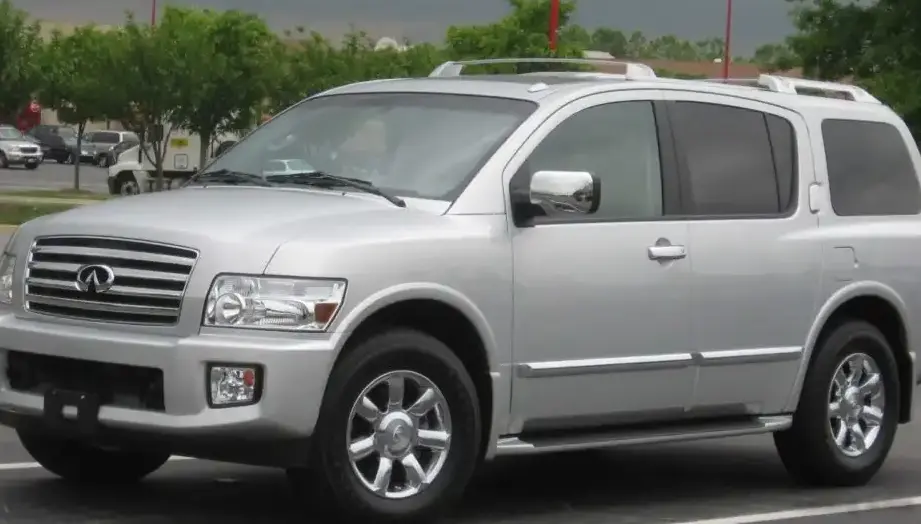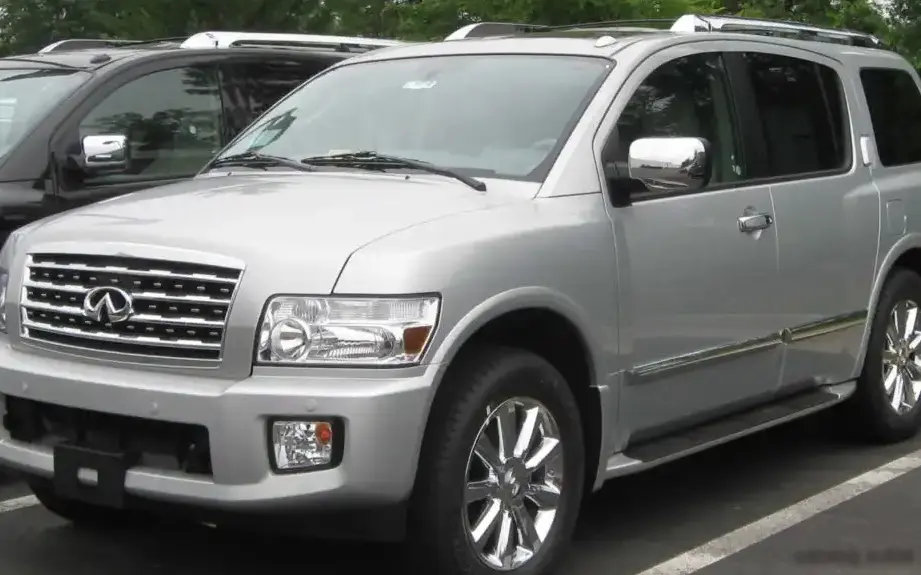
The Infiniti QX56, specifically the facelifted version produced from 2007 to 2010, represented Infiniti’s entry into the full-size luxury SUV segment. Built on the Nissan F-Alpha platform (shared with the Nissan Armada and Titan), the QX56 aimed to provide a blend of American-sized proportions, robust capability, and a more refined driving experience than its Nissan counterparts. The 2007 facelift brought updated styling, interior enhancements, and continued use of the powerful 5.6-liter V8 engine paired with a five-speed automatic transmission. This configuration positioned the QX56 as a strong competitor to vehicles like the Cadillac Escalade, Lincoln Navigator, and Lexus LX. The QX56 was exclusively sold in the North American market.
Technical Specifications
| Brand | Infiniti |
| Model | QX56 |
| Generation | QX56 (facelift 2007) |
| Type (Engine) | 5.6 V8 (325 Hp) Automatic |
| Start of production | 2007 |
| End of production | 2010 |
| Powertrain Architecture | Internal Combustion engine |
| Body type | SUV |
| Seats | 7-8 |
| Doors | 5 |
| Fuel consumption (urban) | 19.6 l/100 km (12 US mpg, 14.4 UK mpg, 5.1 km/l) |
| Fuel consumption (extra urban) | 13.1 l/100 km (18 US mpg, 21.6 UK mpg, 7.6 km/l) |
| Fuel consumption (combined) | 15.3 l/100 km (15.4 US mpg, 18.5 UK mpg, 6.5 km/l) |
| Fuel Type | Petrol (Gasoline) |
| Acceleration 0 – 100 km/h | 7.2 sec |
| Acceleration 0 – 62 mph | 7.2 sec |
| Acceleration 0 – 60 mph | 6.8 sec |
| Maximum speed | 180 km/h (111.85 mph) |
| Emission standard | Euro 4 |
| Weight-to-power ratio | 7.8 kg/Hp, 128 Hp/tonne |
| Weight-to-torque ratio | 4.8 kg/Nm, 209.8 Nm/tonne |
| Power | 325 Hp @ 5200 rpm |
| Power per litre | 58.5 Hp/l |
| Torque | 533 Nm @ 3400 rpm (393.12 lb.-ft. @ 3400 rpm) |
| Engine layout | Front, Longitudinal |
| Engine Model/Code | VK56DE |
| Engine displacement | 5552 cm3 (338.8 cu. in.) |
| Number of cylinders | 8 |
| Engine configuration | V-engine |
| Cylinder Bore | 98 mm (3.86 in.) |
| Piston Stroke | 92 mm (3.62 in.) |
| Compression ratio | 9.8:1 |
| Number of valves per cylinder | 4 |
| Fuel injection system | Multi-port manifold injection |
| Engine aspiration | Naturally aspirated engine |
| Valvetrain | DOHC |
| Engine oil capacity | 6.5 l (6.87 US qt | 5.72 UK qt) |
| Coolant capacity | 14.4 l (15.22 US qt | 12.67 UK qt) |
| Kerb Weight | 2540 kg (5599.74 lbs.) |
| Max. weight | 3243 kg (7149.59 lbs.) |
| Max load | 703 kg (1549.85 lbs.) |
| Trunk (boot) space – minimum | 1733 l (61.2 cu. ft.) |
| Fuel tank capacity | 106 l (28 US gal | 23.32 UK gal) |
| Length | 5255 mm (206.89 in.) |
| Width | 2019 mm (79.49 in.) |
| Height | 1956 mm (77.01 in.) |
| Wheelbase | 3130 mm (123.23 in.) |
| Front track | 1715 mm (67.52 in.) |
| Rear (Back) track | 1715 mm (67.52 in.) |
| Ride height (ground clearance) | 270 mm (10.63 in.) |
| Drivetrain Architecture | Rear wheel drive |
| Number of gears and type of gearbox | 5 gears, automatic transmission |
| Front suspension | Independent, type McPherson with coil spring and anti-roll bar |
| Rear suspension | Independent multi-link spring suspension with stabilizer |
| Front brakes | Ventilated discs |
| Rear brakes | Disc |
| Assisting systems | ABS (Anti-lock braking system) |
| Steering type | Steering rack and pinion |
| Tires size | 275/60 R20 |
| Wheel rims size | 20 |
Powertrain & Engine Architecture
The heart of the 2007-2010 Infiniti QX56 was the VK56DE 5.6-liter V8 engine. This engine, a member of Nissan’s VK engine family, featured a cast-iron block and aluminum cylinder heads. It utilized a dual overhead camshaft (DOHC) valvetrain with four valves per cylinder, and a multi-port fuel injection system. The VK56DE was known for its smooth power delivery and robust construction. The engine produced 325 horsepower at 5200 rpm and 533 Nm (393 lb-ft) of torque at 3400 rpm. This output was channeled through a five-speed automatic transmission, which was chosen for its durability and ability to handle the engine’s substantial torque. While not the most technologically advanced transmission at the time, it was well-suited to the QX56’s intended use as a towing vehicle and comfortable cruiser. The engine was longitudinally mounted, driving the rear wheels.
Driving Characteristics
The QX56 with the 5.6L V8 and automatic transmission offered a comfortable and capable driving experience. Acceleration was brisk, with 0-60 mph times around 6.8 seconds. However, the focus wasn’t on sporty handling. The QX56 prioritized ride comfort, and the suspension absorbed bumps effectively. The five-speed automatic transmission provided smooth shifts, but lacked the responsiveness of more modern transmissions with a greater number of gears. Compared to other QX56 trims (none were offered with different powertrains in the US market), this configuration represented the sole offering, making it the standard for the model. The automatic transmission, while convenient, did slightly diminish the engine’s potential for outright performance compared to a hypothetical manual transmission version.
Equipment & Trim Levels
The 2007-2010 QX56 came well-equipped as standard. Base models included leather upholstery, tri-zone automatic climate control, a Bose premium audio system, power-adjustable front seats, and a rear-seat entertainment system with dual screens. Optional extras included a navigation system, power-folding rear seats, and a rear air suspension system that could adjust ride height for improved off-road capability or easier access. The interior design was generally considered luxurious, though perhaps not as cutting-edge as some European competitors. The QX56 was offered in a single, well-appointed trim level, with options packages available to customize the vehicle.
Chassis & Braking
The QX56’s chassis was a body-on-frame construction, providing a robust foundation for towing and off-road use. The front suspension utilized an independent McPherson strut setup with coil springs and an anti-roll bar, while the rear featured an independent multi-link suspension with a stabilizer bar. Braking duties were handled by ventilated discs at all four corners, along with an anti-lock braking system (ABS). The rear brakes were discs, a feature that contributed to the QX56’s respectable stopping power, especially considering its weight. The QX56’s substantial weight (around 5600 lbs) necessitated a robust braking system.
Market Reception & Comparison
The Infiniti QX56 was generally well-received by critics, who praised its spacious interior, comfortable ride, and powerful engine. However, its fuel economy was a common criticism, averaging around 15 mpg combined. Compared to the Cadillac Escalade and Lincoln Navigator, the QX56 offered a more understated luxury experience and a slightly more refined driving feel. The Lexus LX, while more capable off-road, was significantly more expensive. The QX56’s reliability was generally considered good, though some owners reported issues with the cooling system and the rear air suspension (if equipped).
Legacy
The Infiniti QX56, particularly the 2007-2010 facelifted model, has maintained a reasonable level of popularity in the used car market. The VK56DE engine is known for its durability, and with proper maintenance, can provide many years of reliable service. However, potential buyers should be aware of the potential for cooling system issues and the cost of maintaining the air suspension system. The QX56 represents a significant chapter in Infiniti’s history, establishing the brand as a contender in the full-size luxury SUV segment. While superseded by the QX80, the QX56 remains a desirable vehicle for those seeking a spacious, comfortable, and capable SUV with a proven powertrain.