
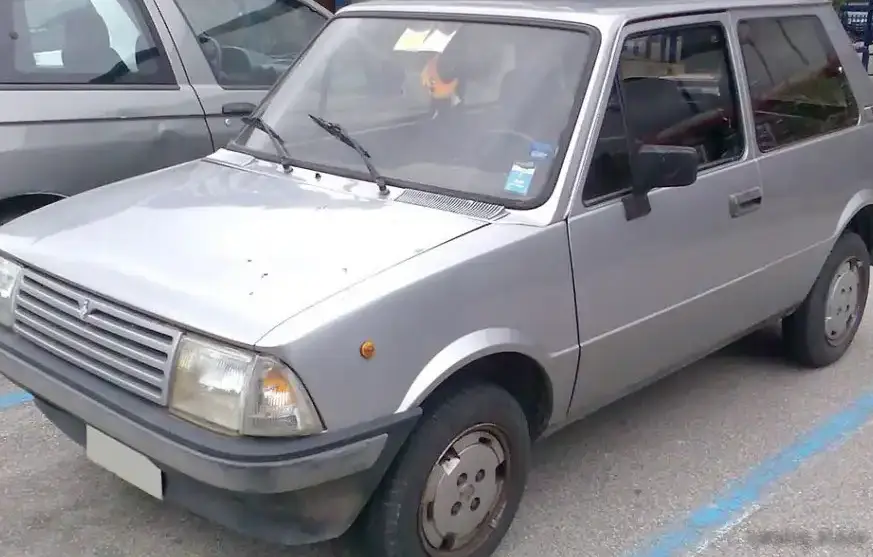
The Innocenti Small 0.7, produced between 1991 and 1994, represents a fascinating, if somewhat obscure, chapter in the history of Italian automotive manufacturing. Born from the remnants of the original Innocenti company, which had a long association with British Motor Corporation (BMC) and the production of licensed Minis, the Small was an attempt to create an affordable and practical city car for the European market. This particular variant, powered by a 659cc engine producing 31 horsepower, served as the entry point into the Small lineup, targeting budget-conscious buyers. It was built during a period of significant change for the Innocenti brand, ultimately acquired by Fiat during its production run.
Technical Specifications
| Brand | Innocenti |
| Model | Small |
| Generation | Small |
| Type (Engine) | 0.7 (31 Hp) |
| Start of production | 1991 |
| End of production | 1994 |
| Powertrain Architecture | Internal Combustion engine |
| Body type | Hatchback |
| Seats | 5 |
| Doors | 3 |
| Fuel consumption (urban) | 6.5 l/100 km (36.2 US mpg) |
| Fuel consumption (extra urban) | 5.8 l/100 km (40.6 US mpg) |
| Fuel Type | Petrol (Gasoline) |
| Maximum speed | 120 km/h (74.56 mph) |
| Weight-to-power ratio | 21.3 kg/Hp |
| Weight-to-torque ratio | 13.5 kg/Nm |
| Power | 31 Hp @ 6400 rpm |
| Power per litre | 47 Hp/l |
| Torque | 49 Nm @ 3400 rpm (36.14 lb.-ft. @ 3400 rpm) |
| Engine displacement | 659 cm3 (40.21 cu. in.) |
| Number of cylinders | 3 |
| Engine configuration | Inline |
| Cylinder Bore | 68 mm (2.68 in.) |
| Piston Stroke | 60.5 mm (2.38 in.) |
| Compression ratio | 9.5:1 |
| Number of valves per cylinder | 2 |
| Fuel injection system | Carburettor |
| Engine aspiration | Naturally aspirated |
| Kerb Weight | 660 kg (1455.05 lbs.) |
| Max. weight | 1060 kg (2336.9 lbs.) |
| Max load | 400 kg (881.85 lbs.) |
| Trunk (boot) space – minimum | 295 l (10.42 cu. ft.) |
| Trunk (boot) space – maximum | 990 l (34.96 cu. ft.) |
| Fuel tank capacity | 40 l (10.57 US gal) |
| Length | 3210 mm (126.38 in.) |
| Width | 1520 mm (59.84 in.) |
| Height | 1380 mm (54.33 in.) |
| Wheelbase | 2045 mm (80.51 in.) |
| Front track | 1245 mm (49.02 in.) |
| Rear track | 1300 mm (51.18 in.) |
| Minimum turning circle | 9.5 m (31.17 ft.) |
| Drivetrain Architecture | Front wheel drive |
| Number of gears | 5 |
| Gearbox type | Manual transmission |
| Front suspension | Coil spring |
| Rear suspension | Coil spring |
| Front brakes | Disc |
| Rear brakes | Drum |
| Assisting systems | ABS (Anti-lock braking system) |
| Steering type | Steering rack and pinion |
| Tires size | 145/70 SR12 |
Powertrain & Engine Architecture
The heart of the Innocenti Small 0.7 was its diminutive 659cc inline three-cylinder engine. This engine, designated as a naturally aspirated unit, relied on a single carburetor for fuel delivery – a relatively simple and cost-effective solution for the time. The engine featured two valves per cylinder and a compression ratio of 9.5:1. While not a powerhouse, the engine was designed for efficiency and ease of maintenance. The 31 horsepower output was delivered at 6400 rpm, with a modest 49 Nm (36.14 lb-ft) of torque available at 3400 rpm. This engine was paired exclusively with a five-speed manual transmission in this configuration, offering a reasonable level of control for the driver. The engine’s architecture was a direct descendant of designs originally developed by BMC, reflecting Innocenti’s historical ties. The carburetor system, while simple, required periodic adjustment to maintain optimal performance and fuel economy.
Driving Characteristics
The Innocenti Small 0.7, with its limited horsepower and lightweight construction, offered a distinctly utilitarian driving experience. Acceleration was slow, and overtaking required careful planning. The five-speed manual transmission helped to keep the engine in its optimal power band, but the car was never intended for spirited driving. The gear ratios were relatively tall, prioritizing fuel economy over outright performance. Compared to potential higher-spec versions (had they been offered with larger engines), the 0.7 prioritized affordability and ease of use. The car felt nimble in city traffic, and its small size made parking a breeze. The suspension, while basic, provided a reasonably comfortable ride on smooth surfaces, though it could become unsettled on rougher roads. The steering was light and responsive, making it easy to maneuver in tight spaces.
Equipment & Trim Levels
The 0.7 variant of the Innocenti Small was positioned as the entry-level model, and as such, it came with a fairly basic level of equipment. Standard features typically included cloth upholstery, a simple dashboard layout, and manual windows and door locks. Power steering was not usually included. Optional extras, depending on the market, could include a radio, upgraded interior trim, and occasionally, alloy wheels. The interior was designed with practicality in mind, offering sufficient space for passengers and a reasonable amount of cargo capacity, especially with the rear seats folded down. The focus was on providing functional transportation at a low cost. The dashboard was constructed from durable plastics, and the overall interior design was minimalist.
Chassis & Braking
The Innocenti Small featured a relatively simple chassis design. Both the front and rear suspension utilized coil springs, providing a basic level of comfort and handling. The front brakes were disc brakes, offering better stopping power than the drum brakes found on the rear wheels. An anti-lock braking system (ABS) was included as a standard safety feature, which was relatively uncommon in this price segment at the time. The steering was a rack and pinion system, providing precise and responsive steering feel. The car’s lightweight construction contributed to its nimble handling characteristics. The suspension geometry was tuned for comfort rather than outright performance, resulting in a slightly softer ride.
Market Reception & Comparison
The Innocenti Small 0.7 received mixed reviews from automotive critics. While praised for its affordability, fuel efficiency, and nimble handling, it was often criticized for its lack of power and basic interior. Compared to other small cars on the market at the time, such as the Fiat Cinquecento or the Renault Twingo, the Small offered a slightly more utilitarian experience. Its fuel economy was competitive, and its reliability was generally considered to be good, although parts availability could be an issue due to the brand’s financial instability. The 0.7 variant was primarily targeted at first-time car buyers and those seeking a cheap and reliable city car. Some reviewers noted that the car’s styling was somewhat dated, even for the early 1990s.
Legacy
The Innocenti Small 0.7, while not a groundbreaking vehicle, represents an interesting footnote in automotive history. Its simple design and focus on affordability made it a popular choice for budget-conscious buyers in Europe. Today, the Small 0.7 is a relatively rare sight on the roads, and well-maintained examples are becoming increasingly collectible. The powertrain, while not particularly powerful, proved to be reasonably reliable, and parts are still available, although sourcing them can be challenging. The car’s legacy lies in its embodiment of a bygone era of affordable and practical motoring, and its connection to the storied history of the Innocenti brand. It serves as a reminder of a time when basic, functional transportation was prioritized over luxury and performance.
