
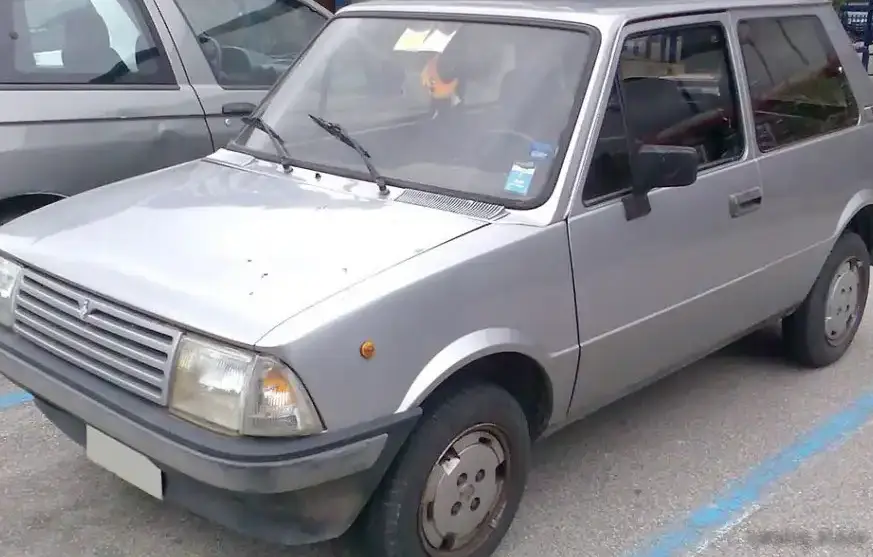
The Innocenti Small 1.0, produced between 1991 and 1994, represents a significant, albeit short-lived, chapter in the history of the Italian automaker Innocenti. Positioned as an entry-level hatchback, the 1.0 variant aimed to provide affordable transportation within the European market, particularly in Italy. It was based on the Mk1 Ford Fiesta platform, a result of a collaboration between Innocenti and Ford following Leyland’s acquisition of Innocenti in the 1970s. The Small 1.0 occupied the base trim level of the Small range, offering a more economical alternative to the slightly more powerful 1.3 and 1.4 liter versions. This model was designed to appeal to budget-conscious buyers and those prioritizing fuel efficiency over outright performance.
Technical Specifications
| Brand | Innocenti |
| Model | Small |
| Generation | Small |
| Type (Engine) | 1.0 (52 Hp) |
| Start of production | 1991 |
| End of production | 1994 |
| Powertrain Architecture | Internal Combustion engine |
| Body type | Hatchback |
| Seats | 5 |
| Doors | 3 |
| Fuel consumption (urban) | 7.4 l/100 km (31.8 US mpg) |
| Fuel consumption (extra urban) | 5.1 l/100 km (46.1 US mpg) |
| Fuel consumption (combined) | 7.2 l/100 km (32.7 US mpg) |
| Fuel Type | Petrol (Gasoline) |
| Acceleration 0 – 100 km/h | 16.2 sec |
| Acceleration 0 – 62 mph | 16.2 sec |
| Acceleration 0 – 60 mph | 15.4 sec |
| Maximum speed | 147 km/h (91.34 mph) |
| Weight-to-power ratio | 13.7 kg/Hp |
| Weight-to-torque ratio | 9.1 kg/Nm |
| Power | 52 Hp @ 5750 rpm |
| Torque | 78 Nm @ 3500 rpm (57.53 lb.-ft. @ 3500 rpm) |
| Engine displacement | 993 cm3 (60.6 cu. in.) |
| Number of cylinders | 3 |
| Engine configuration | Inline |
| Cylinder Bore | 76 mm (2.99 in.) |
| Piston Stroke | 73 mm (2.87 in.) |
| Compression ratio | 9.5:1 |
| Number of valves per cylinder | 2 |
| Fuel injection system | Carburettor |
| Engine aspiration | Naturally aspirated |
| Kerb Weight | 710 kg (1565.28 lbs.) |
| Max. weight | 1100 kg (2425.08 lbs.) |
| Max load | 390 kg (859.8 lbs.) |
| Trunk (boot) space – minimum | 295 l (10.42 cu. ft.) |
| Trunk (boot) space – maximum | 990 l (34.96 cu. ft.) |
| Fuel tank capacity | 40 l (10.57 US gal) |
| Length | 3375 mm (132.87 in.) |
| Width | 1520 mm (59.84 in.) |
| Height | 1375 mm (54.13 in.) |
| Wheelbase | 2205 mm (86.81 in.) |
| Front track | 1245 mm (49.02 in.) |
| Rear track | 1290 mm (50.79 in.) |
| Minimum turning circle | 9.5 m (31.17 ft.) |
| Drivetrain Architecture | Front wheel drive |
| Number of gears | 5 |
| Gearbox type | Manual transmission |
| Front suspension | Coil spring |
| Rear suspension | Coil spring |
| Front brakes | Disc |
| Rear brakes | Drum |
| Assisting systems | ABS (Anti-lock braking system) |
| Steering type | Steering rack and pinion |
| Tires size | 155/70 SR12 |
Powertrain & Engine Architecture
The Innocenti Small 1.0 was powered by a 993cc inline three-cylinder engine. This engine, derived from the Ford CVH (Compound Valve Hemispherical) family, was a relatively simple design utilizing a single overhead camshaft and two valves per cylinder. Crucially, this variant employed a carburetor for fuel delivery, a cost-saving measure compared to the fuel injection systems found in some of its siblings. The carburetor setup contributed to the engine’s modest power output of 52 horsepower at 5750 rpm and 57.53 lb-ft of torque at 3500 rpm. The engine’s compression ratio was 9.5:1. The engine was mated to a five-speed manual transmission, which was the only transmission option available for this trim level. The drivetrain was front-wheel drive, a common configuration for European hatchbacks of this era.
Driving Characteristics
The driving experience in the Innocenti Small 1.0 was characterized by its economy-focused nature. Acceleration was leisurely, taking approximately 16.2 seconds to reach 62 mph (100 km/h). The carburetor-fed engine delivered power in a relatively linear fashion, but lacked the responsiveness of fuel-injected counterparts. The five-speed gearbox helped to keep the engine within its optimal operating range, but frequent downshifts were often necessary for overtaking or climbing hills. Compared to the 1.3 and 1.4 liter versions, the 1.0 felt noticeably underpowered, particularly when fully loaded. However, its lighter weight and simple mechanicals made it relatively nimble in city driving.
Equipment & Trim Levels
The Innocenti Small 1.0 was positioned as the entry-level model, and as such, its standard equipment list was fairly basic. It typically included features such as cloth upholstery, a basic instrument cluster, and manual windows and door locks. Power steering was not standard, and air conditioning was rarely fitted. Optional extras included a sunroof, upgraded audio systems, and metallic paint. The interior was functional and utilitarian, prioritizing practicality over luxury. The dashboard layout was simple and straightforward, with easy-to-read gauges.
Chassis & Braking
The Innocenti Small utilized a relatively simple chassis design. Front suspension consisted of coil springs and MacPherson struts, while the rear suspension employed a coil-sprung twist beam axle. This setup provided a reasonable balance between ride comfort and handling. The braking system featured disc brakes on the front wheels and drum brakes on the rear. Anti-lock braking system (ABS) was available as an option, enhancing safety. The steering was a rack and pinion system, providing precise and responsive steering feel. The tires were typically 155/70 SR12, chosen for their balance of grip and fuel efficiency.
Market Reception & Comparison
The Innocenti Small 1.0 received mixed reviews from automotive critics. While praised for its affordability and fuel efficiency, it was often criticized for its lack of power and basic interior. Compared to rivals such as the Fiat Uno and Peugeot 205, the Small 1.0 offered a similar level of practicality but lacked the refinement and performance of some competitors. The 1.3 and 1.4 liter versions of the Small were generally considered to be more desirable due to their improved performance, but they came at a higher price point. Fuel economy was a strong point for the 1.0, achieving around 32.7 US mpg on combined cycles.
Legacy
The Innocenti Small 1.0, while not a performance icon, holds a place in automotive history as a representative of affordable European motoring in the early 1990s. Its simple mechanicals and robust construction have contributed to a reasonable level of long-term reliability. Today, the Small 1.0 is a relatively rare sight on the roads, but it has gained a following among enthusiasts who appreciate its quirky charm and affordability. Parts availability can be a challenge, but many components are interchangeable with those from the Ford Fiesta. The 1.0 liter engine, while not particularly powerful, is known for its durability and ease of maintenance. The Innocenti Small 1.0 remains a testament to a period of collaboration and innovation in the European automotive industry.
