
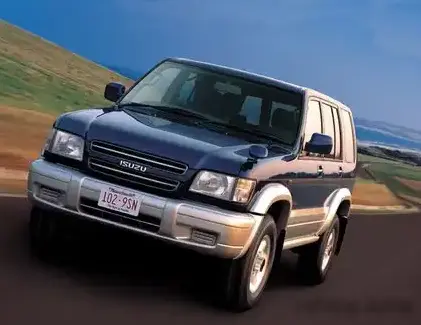
The Isuzu Bighorn 2.6 i S, produced between 1988 and 1991, represents an entry-level offering within the first generation of Isuzu’s popular SUV. Positioned as a more accessible option in the Bighorn lineup, this variant aimed to provide a capable and comfortable four-wheel-drive experience for families and recreational drivers. The Bighorn, known as the Trooper in North American markets, was Isuzu’s attempt to compete in the rapidly growing SUV segment, offering a blend of off-road capability and on-road refinement. This 2.6 i S model served as a crucial stepping stone for establishing the Bighorn’s presence in the market, particularly in regions where larger engines were less common or subject to higher taxation.
Technical Specifications
| Brand | Isuzu |
| Model | Bighorn |
| Generation | Bighorn (SUV) |
| Type (Engine) | 2.6 i S (120 Hp) |
| Start of production | 1988 |
| End of production | 1991 |
| Powertrain Architecture | Internal Combustion engine |
| Body type | SUV |
| Seats | 5 |
| Doors | 5 |
| Fuel Type | Petrol (Gasoline) |
| Weight-to-power ratio | 14.2 kg/Hp, 70.6 Hp/tonne |
| Weight-to-torque ratio | 8.3 kg/Nm, 120 Nm/tonne |
| Power | 120 Hp @ 4600 rpm |
| Power per litre | 46.9 Hp/l |
| Torque | 204 Nm @ 2600 rpm (150.46 lb.-ft. @ 2600 rpm) |
| Engine layout | Front, Longitudinal |
| Engine displacement | 2559 cm3 (156.16 cu. in.) |
| Number of cylinders | 4 |
| Engine configuration | Inline |
| Cylinder Bore | 92.6 mm (3.65 in.) |
| Piston Stroke | 95 mm (3.74 in.) |
| Compression ratio | 8.3:1 |
| Number of valves per cylinder | 2 |
| Fuel injection system | Multi-port manifold injection |
| Engine aspiration | Naturally aspirated engine |
| Valvetrain | OHC |
| Kerb Weight | 1700 kg (3747.86 lbs.) |
| Fuel tank capacity | 83 l (21.93 US gal | 18.26 UK gal) |
| Length | 4470 mm (175.98 in.) |
| Width | 1760 mm (69.29 in.) |
| Height | 1845 mm (72.64 in.) |
| Wheelbase | 2650 mm (104.33 in.) |
| Front track | 1450 mm (57.09 in.) |
| Rear (Back) track | 1460 mm (57.48 in.) |
| Minimum turning circle | 10.8 m (35.43 ft.) |
| Drive wheel | All wheel drive (4×4) |
| Number of gears | 4 |
| Gearbox type | automatic transmission |
| Front brakes | Ventilated discs |
| Rear brakes | Drum |
Powertrain & Engine Architecture
The heart of the Bighorn 2.6 i S is the 4ZE1 2.6-liter inline-four cylinder gasoline engine. This engine, a staple of Isuzu’s offerings during the late 1980s and early 1990s, utilizes a single overhead camshaft (OHC) valvetrain operating two valves per cylinder. The engine employs multi-port fuel injection, a significant advancement over carbureted systems, contributing to improved fuel efficiency and smoother power delivery. The 4ZE1 engine is known for its relatively simple design, making it reasonably reliable and straightforward to maintain. Paired with this engine is a four-speed automatic transmission, designed to provide convenient operation for everyday driving. This transmission, while not particularly sophisticated by modern standards, was chosen for its durability and ease of use, aligning with the Bighorn’s intended role as a practical family vehicle. The engine is longitudinally mounted, a common configuration for four-wheel-drive vehicles, allowing for a more direct connection to the transfer case.
Driving Characteristics
The 120 horsepower output of the 2.6 i S engine, coupled with the four-speed automatic transmission, results in a driving experience focused on practicality rather than outright performance. Acceleration is adequate for everyday driving, but the Bighorn 2.6 i S is not a particularly quick vehicle. The automatic transmission’s gear ratios are tuned for fuel economy and smooth cruising, rather than aggressive shifting. Compared to the more powerful Bighorn variants, such as those equipped with the 3.1-liter V6 engine, the 2.6 i S feels noticeably less responsive. However, the automatic transmission provides a level of convenience that some drivers preferred, especially in urban environments. The four-wheel-drive system provides enhanced traction in slippery conditions, making the Bighorn a capable vehicle for light off-road use. The relatively low power output means that the 2.6 i S is less suited to challenging off-road terrain compared to its more powerful siblings.
Equipment & Trim Levels
The Bighorn 2.6 i S typically came equipped with a modest level of standard features. Interior appointments generally included cloth upholstery, basic instrumentation, and manual windows and door locks. Air conditioning was often included, but could also be an optional extra depending on the market. The dashboard layout is functional and straightforward, prioritizing usability over aesthetic flair. Optional extras available for the 2.6 i S trim could include power windows, upgraded audio systems, and a sunroof. The overall interior ambiance is geared towards practicality and durability, rather than luxury.
Chassis & Braking
The Bighorn 2.6 i S utilizes a body-on-frame construction, a common design for SUVs of this era. The suspension system consists of independent front suspension with coil springs and a live rear axle with leaf springs. This setup provides a reasonable balance between ride comfort and off-road capability. Braking duties are handled by ventilated discs on the front wheels and drum brakes on the rear. While adequate for normal driving conditions, the drum brakes on the rear can lack the stopping power of disc brakes, particularly when the vehicle is heavily loaded. The Bighorn 2.6 i S typically features a stabilizer bar on the front axle to reduce body roll during cornering.
Market Reception & Comparison
The Isuzu Bighorn 2.6 i S was generally well-received as an affordable and capable entry-level SUV. Critics praised its four-wheel-drive system and relatively spacious interior. However, the 2.6-liter engine was often criticized for its lack of power, particularly when compared to the larger-displacement engines offered in competing SUVs. In terms of fuel economy, the 2.6 i S offered a slight advantage over the more powerful variants, but was still not particularly fuel-efficient by modern standards. Compared to the V6-powered Bighorn models, the 2.6 i S appealed to buyers who prioritized affordability and fuel economy over performance. The 2.6 i S also offered a more accessible price point, making it a popular choice for first-time SUV buyers.
Legacy
The Isuzu Bighorn 2.6 i S, while not the most powerful or technologically advanced SUV of its time, has proven to be a reasonably reliable vehicle. The 4ZE1 engine, despite its relatively simple design, is known for its durability when properly maintained. The automatic transmission, while not particularly refined, is also generally reliable. Today, the Bighorn 2.6 i S can be found in the used car market, often at very affordable prices. These vehicles are often sought after by enthusiasts looking for a classic four-wheel-drive SUV that is relatively easy to maintain and repair. Parts availability can be a challenge in some regions, but many parts are still available through aftermarket suppliers. The Bighorn 2.6 i S represents a significant chapter in Isuzu’s history, demonstrating the company’s commitment to providing capable and affordable SUVs to a global market.

