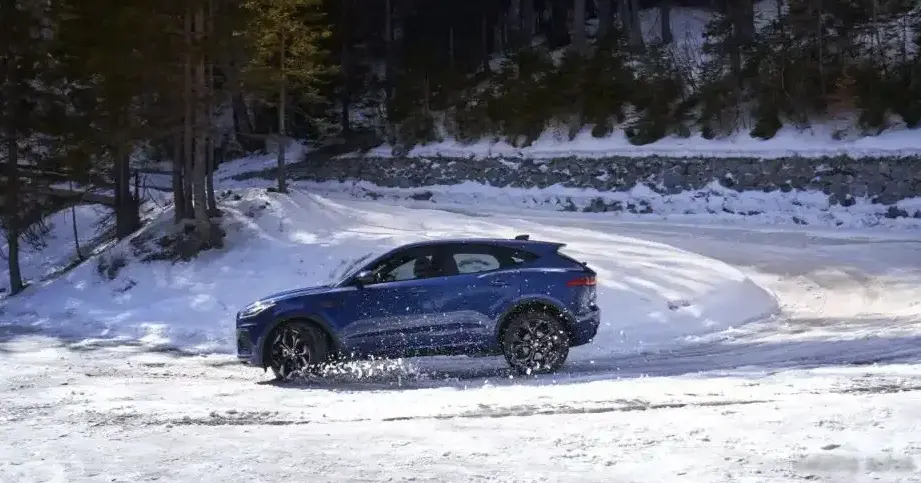
The Jaguar E-Pace (facelift, introduced in October 2020) 2.0d (163 hp) Mild Hybrid AWD Automatic represents a key variant within the E-Pace range, Jaguar’s compact luxury SUV. Positioned as a more efficient and accessible entry point into the E-Pace lineup, this model combined a diesel engine with mild hybrid technology and all-wheel drive. It aimed to balance performance, fuel economy, and practicality for buyers seeking a premium SUV experience. Production of this specific configuration continued through 2024, reflecting its sustained popularity within the E-Pace family.
Technical Specifications
| Brand | Jaguar |
| Model | E-Pace |
| Generation | E-Pace (facelift 2020) |
| Type (Engine) | 2.0d (163 Hp) Mild Hybrid AWD Automatic |
| Start of production | October, 2020 |
| End of production | 2024 |
| Powertrain Architecture | MHEV (Mild Hybrid Electric Vehicle) |
| Body type | SUV |
| Seats | 5 |
| Doors | 5 |
| Combined fuel consumption (WLTP) | 6.4-6.9 l/100 km (36.8 – 34.1 US mpg, 44.1 – 40.9 UK mpg, 15.6 – 14.5 km/l) |
| CO2 emissions (WLTP) | 167-182 g/km |
| Fuel Type | Diesel |
| Acceleration 0 – 100 km/h | 9.8 sec |
| Acceleration 0 – 62 mph | 9.8 sec |
| Acceleration 0 – 60 mph | 9.2 sec |
| Maximum speed | 200 km/h (124.27 mph) |
| Emission standard | Euro 6d |
| Weight-to-power ratio | 11.3 kg/Hp, 88.5 Hp/tonne |
| Weight-to-torque ratio | 4.8 kg/Nm, 206.4 Nm/tonne |
| Power | 163 Hp @ 3750 rpm |
| Power per litre | 81.6 Hp/l |
| Torque | 380 Nm @ 1500-2500 rpm (280.27 lb.-ft. @ 1500-2500 rpm) |
| Engine layout | Front, Transverse |
| Engine Model/Code | Ingenium / AJ20D4 |
| Engine displacement | 1997 cm3 (121.86 cu. in.) |
| Number of cylinders | 4 |
| Engine configuration | Inline |
| Cylinder Bore | 83 mm (3.27 in.) |
| Piston Stroke | 92.31 mm (3.63 in.) |
| Compression ratio | 16.5:1 |
| Number of valves per cylinder | 4 |
| Fuel injection system | Diesel Commonrail |
| Engine aspiration | Turbocharger, Intercooler |
| Engine oil capacity | 6.5 l (6.87 US qt | 5.72 UK qt) |
| Coolant | 11.2 l (11.83 US qt | 9.85 UK qt) |
| Kerb Weight | 1841 kg (4058.71 lbs.) |
| Trunk (boot) space – minimum | 601 l (21.22 cu. ft.) |
| Trunk (boot) space – maximum | 1386 l (48.95 cu. ft.) |
| Fuel tank capacity | 65 l (17.17 US gal | 14.3 UK gal) |
| AdBlue tank | 17 l (4.49 US gal | 3.74 UK gal) |
| Permitted trailer load with brakes (12%) | 1800 kg (3968.32 lbs.) |
| Permitted trailer load without brakes | 750 kg (1653.47 lbs.) |
| Length | 4395 mm (173.03 in.) |
| Width with mirrors folded | 1984 mm (78.11 in.) |
| Height | 1648 mm (64.88 in.) |
| Wheelbase | 2681 mm (105.55 in.) |
| Front track | 1625 mm (63.98 in.) |
| Rear (Back) track | 1624 mm (63.94 in.) |
| Front overhang | 882 mm (34.72 in.) |
| Rear overhang | 832 mm (32.76 in.) |
| Ride height (ground clearance) | 212 mm (8.35 in.) |
| Drag coefficient (Cd) | 0.32 |
| Minimum turning circle (turning diameter) | 11.63 m (38.16 ft.) |
| Approach angle | 22° |
| Departure angle | 28° |
| Ramp-over (brakeover) angle | 20.7° |
| Wading depth | 500 mm (19.69 in.) |
| Drivetrain Architecture | ICE and electric motor drive rear wheels, with front wheel engagement via clutch. |
| Drive wheel | All wheel drive (4×4) |
| Number of gears and type of gearbox | 9 gears, automatic transmission |
| Front suspension | Independent, McPherson with coil spring and anti-roll bar |
| Rear suspension | Independent multi-link spring suspension with stabilizer |
| Front brakes | Ventilated discs, 325-349 mm |
| Rear brakes | Disc, 300 mm |
| Assisting systems | ABS (Anti-lock braking system) |
| Steering type | Steering rack and pinion |
| Power steering | Electric Steering |
| Wheel rims size | 17; 18 |
Powertrain & Engine Architecture
The heart of this E-Pace variant is Jaguar’s Ingenium 2.0d engine, specifically the AJ20D4 code. This is a four-cylinder, inline diesel engine displacing 1997cc. The engine utilizes a turbocharger and intercooler to boost power and efficiency. Crucially, this version incorporates mild hybrid technology. A Belt-integrated Starter Generator (BSG) provides a small amount of electrical assistance during acceleration, enabling smoother starts and improved fuel economy. The BSG also facilitates a more refined stop/start system. Fuel is delivered via a common rail direct injection system, optimized for clean combustion and reduced emissions. The engine boasts a relatively high compression ratio of 16.5:1, contributing to its thermal efficiency. The 9-speed automatic transmission, sourced from ZF, is a key component, offering smooth and efficient gear changes. It’s designed to work seamlessly with the engine’s torque curve, providing responsive acceleration.
Driving Characteristics
The 163 hp output and 380 Nm of torque, coupled with the 9-speed automatic, deliver a comfortable and capable driving experience. While not overtly sporty, the E-Pace 2.0d offers sufficient power for everyday driving and highway cruising. Acceleration from 0-60 mph takes around 9.2 seconds. The automatic transmission is well-tuned, providing smooth shifts and intelligent gear selection. Compared to higher-powered E-Pace variants (like the 300 hp petrol models), this version prioritizes fuel economy and relaxed cruising. The all-wheel-drive system provides excellent traction in various conditions, enhancing stability and confidence. The gear ratios are optimized for fuel efficiency, meaning the engine doesn’t always feel overtly powerful when needing to accelerate quickly.
Equipment & Trim Levels
The 2.0d (163 hp) Automatic typically came as a standard trim level, offering a good balance of features. Standard equipment generally included leather upholstery, a touchscreen infotainment system with Apple CarPlay and Android Auto compatibility, automatic climate control, and a suite of safety features like autonomous emergency braking and lane keep assist. Optional extras included a panoramic sunroof, premium audio system, heated seats, and adaptive cruise control. Interior trim options varied, allowing buyers to personalize the cabin to their preferences. The dashboard layout was consistent across the E-Pace range, featuring a modern and driver-focused design.
Chassis & Braking
The E-Pace utilizes an independent suspension system all around – McPherson struts at the front and a multi-link setup at the rear. This provides a comfortable ride quality while maintaining good handling characteristics. Stabilizer bars are fitted front and rear to reduce body roll during cornering. Braking duties are handled by ventilated discs at the front (ranging from 325-349mm depending on specification) and solid discs at the rear (300mm). The ABS system ensures effective braking performance in emergency situations. The chassis was tuned to accommodate the weight distribution of the engine and drivetrain, providing a balanced and predictable driving experience.
Market Reception & Comparison
The E-Pace 2.0d (163 hp) Automatic was generally well-received by critics as a practical and efficient option within the luxury compact SUV segment. It was praised for its comfortable ride, refined interior, and decent fuel economy (6.4-6.9 l/100km). Compared to the more powerful petrol variants, it offered a lower price point and better fuel efficiency, making it appealing to buyers prioritizing value and running costs. However, some reviewers noted that the engine could feel slightly underpowered when fully loaded or during spirited driving. Against competitors like the BMW X1 and Audi Q3, the E-Pace offered a distinctive design and a more engaging driving experience.
Legacy
The Ingenium engine family, including the AJ20D4, has proven to be relatively reliable, although regular maintenance is crucial. The 9-speed automatic transmission, while generally robust, has been known to exhibit occasional software glitches. In the used car market, the E-Pace 2.0d (163 hp) Automatic represents a good value proposition, offering a premium SUV experience at a more affordable price point. Its fuel efficiency and relatively low running costs make it an attractive option for buyers seeking a practical and stylish vehicle. The mild hybrid system contributes to improved fuel economy and reduced emissions, enhancing its appeal in an increasingly environmentally conscious market.