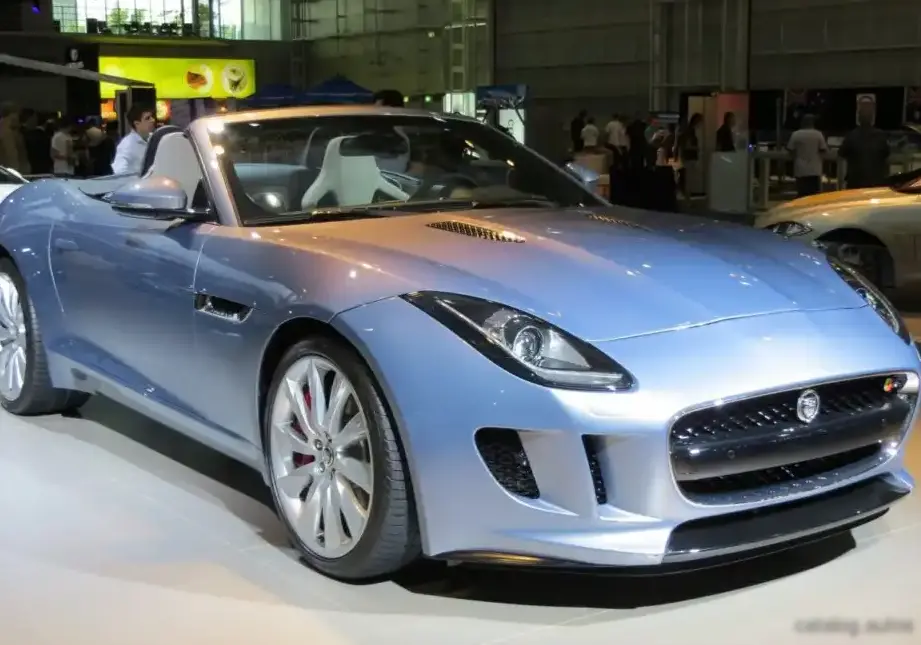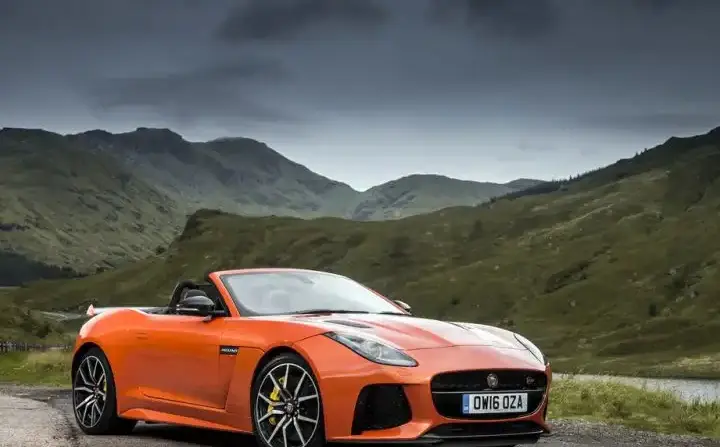
The Jaguar F-Type Convertible, specifically the 2.0-liter (300 hp) automatic variant introduced with the 2017 facelift, represents a significant entry point into the F-Type range. Produced through 2018, this model aimed to broaden the appeal of the F-Type by offering a more accessible price point and improved fuel efficiency without entirely sacrificing the model’s core sporting character. It slots into the lineup below the supercharged V6 and V8 models, targeting buyers who prioritize style and a refined driving experience over outright performance. This variant is based on the Jaguar’s aluminum-intensive architecture, first seen in the original F-Type launched in 2013.
Technical Specifications
| Brand | Jaguar |
| Model | F-type |
| Generation | F-type Convertible (facelift 2017) |
| Type (Engine) | 2.0 (300 Hp) Automatic |
| Start of production | 2017 |
| End of production | 2018 |
| Powertrain Architecture | Internal Combustion engine |
| Body type | Cabriolet |
| Seats | 2 |
| Doors | 2 |
| Fuel consumption (combined) | 7.2 l/100 km |
| Fuel consumption (US mpg) | 32.7 |
| Fuel consumption (UK mpg) | 39.2 |
| Fuel consumption (km/l) | 13.9 |
| CO2 emissions | 163 g/km |
| Fuel Type | Petrol (Gasoline) |
| Acceleration 0 – 100 km/h | 5.7 sec |
| Acceleration 0 – 62 mph | 5.7 sec |
| Acceleration 0 – 60 mph | 5.4 sec |
| Maximum speed | 250 km/h (155.34 mph) |
| Emission standard | Euro 6 |
| Weight-to-power ratio | 5.2 kg/Hp |
| Weight-to-torque ratio | 3.9 kg/Nm |
| Power | 300 Hp @ 5500 rpm |
| Power per litre | 150.2 Hp/l |
| Torque | 400 Nm @ 1500-4500 rpm (295.02 lb.-ft. @ 1500-4500 rpm) |
| Engine layout | Front, Longitudinal |
| Engine Model/Code | Ingenium / PT204 |
| Engine displacement | 1997 cm3 (121.86 cu. in.) |
| Number of cylinders | 4 |
| Engine configuration | Inline |
| Cylinder Bore | 83 mm (3.27 in.) |
| Piston Stroke | 92.3 mm (3.63 in.) |
| Compression ratio | 9.5:1 |
| Number of valves per cylinder | 4 |
| Fuel injection system | Direct injection |
| Engine aspiration | Turbocharger, Intercooler |
| Valvetrain | DOHC |
| Engine oil capacity | 6.5 l (6.87 US qt | 5.72 UK qt) |
| Kerb Weight | 1545 kg (3406.14 lbs.) |
| Trunk (boot) space – minimum | 207 l (7.31 cu. ft.) |
| Fuel tank capacity | 63 l (16.64 US gal | 13.86 UK gal) |
| Length | 4482 mm (176.46 in.) |
| Width | 1923 mm (75.71 in.) |
| Width with mirrors folded | 2042 mm (80.39 in.) |
| Height | 1307 mm (51.46 in.) |
| Wheelbase | 2622 mm (103.23 in.) |
| Front track | 1597 mm (62.87 in.) |
| Rear (Back) track | 1649 mm (64.92 in.) |
| Drivetrain Architecture | Rear wheel drive |
| Number of gears and type of gearbox | 8 gears, automatic transmission |
| Front suspension | Double wishbone |
| Rear suspension | Double wishbone |
| Front brakes | Ventilated discs |
| Rear brakes | Ventilated discs |
| Assisting systems | ABS (Anti-lock braking system) |
| Steering type | Steering rack and pinion |
| Power steering | Electric Steering |
Introduction
The 2017 facelift of the Jaguar F-Type Convertible brought with it the Ingenium 2.0-liter turbocharged four-cylinder engine, a departure from the traditionally larger engines offered in the F-Type. This engine, designated PT204, was designed to provide a more fuel-efficient and accessible option for buyers drawn to the F-Type’s styling and driving dynamics. The introduction of this engine coincided with visual updates to the F-Type range, including revised headlights and a bolder front grille. This variant is built on the same aluminum chassis as its siblings, contributing to a relatively lightweight body for a grand tourer.
Powertrain & Engine Architecture
The heart of this F-Type variant is Jaguar Land Rover’s Ingenium engine family. The PT204 is a 1997cc inline-four cylinder engine utilizing direct injection and a single twin-scroll turbocharger. This configuration allows for quick spool-up and a broad torque curve. The engine produces 300 horsepower at 5500 rpm and 400 Nm (295 lb-ft) of torque between 1500 and 4500 rpm. The Ingenium engine features a sophisticated valvetrain with dual overhead camshafts (DOHC) and variable valve timing. The engine is paired with an eight-speed automatic transmission, sourced from ZF. This transmission is known for its smooth shifts and quick response, and it’s programmed with specific calibrations for the 2.0-liter engine to optimize performance and efficiency. The transmission features steering wheel-mounted paddle shifters for manual control.
Driving Characteristics
The 2.0-liter F-Type Convertible offers a distinct driving experience compared to the V6 and V8 models. While it doesn’t deliver the same raw acceleration, it provides a surprisingly engaging and enjoyable drive. The turbocharger provides ample low-end torque, making it responsive in everyday driving situations. The 0-60 mph sprint takes approximately 5.4 seconds, and the car has a top speed of 155 mph. The eight-speed automatic transmission is well-matched to the engine, providing smooth and timely gear changes. The gear ratios are tuned to maximize acceleration and fuel efficiency. Compared to the manual transmission options available on other F-Type models, the automatic prioritizes ease of use and refinement. The lighter weight of the four-cylinder engine, compared to the V6 and V8, contributes to a more balanced feel in corners.
Equipment & Trim Levels
The 2.0-liter F-Type Convertible typically came well-equipped, though it sat as the entry-level model. Standard features included leather upholstery, automatic climate control, a touchscreen infotainment system with navigation, and a premium sound system. Optional extras included heated seats, a panoramic sunroof, and various cosmetic enhancements. Interior trim options ranged from standard leather to more luxurious leather packages with contrast stitching. The dashboard layout is driver-focused, with a clear and concise instrument cluster. Exterior options included a variety of wheel designs and paint colors.
Chassis & Braking
The F-Type Convertible utilizes an aluminum chassis, contributing to its relatively low weight. The suspension consists of double wishbones at both the front and rear, providing a comfortable yet controlled ride. The suspension is tuned to balance handling and comfort, making it suitable for both spirited driving and long-distance cruising. Braking duties are handled by ventilated discs at all four corners. The braking system is equipped with ABS (Anti-lock Braking System) and electronic brake-force distribution. The standard wheels are typically 18 or 19 inches in diameter, with performance tires available as an option.
Market Reception & Comparison
The introduction of the 2.0-liter F-Type Convertible was generally well-received by automotive critics. It was praised for its stylish design, engaging driving dynamics, and improved fuel efficiency compared to the higher-powered models. However, some critics noted that the four-cylinder engine lacked the aural excitement of the V6 and V8 engines. Compared to the V6 F-Type, the 2.0-liter model offered a lower price point and better fuel economy, but it sacrificed some performance. Against competitors like the Porsche 718 Boxster, the F-Type 2.0 offered a more luxurious interior and a more comfortable ride, but the Porsche typically provided sharper handling.
Legacy
The Jaguar F-Type Convertible 2.0-liter automatic has proven to be a relatively reliable vehicle, with the Ingenium engine demonstrating good durability. The engine’s direct injection system and turbocharger require regular maintenance, but major issues are relatively uncommon. On the used car market, these models represent a good value for buyers seeking a stylish and engaging convertible. The 2.0-liter F-Type helped to broaden the appeal of the F-Type range, attracting a wider range of buyers to the Jaguar brand. While it may not have the same collector appeal as the V8 models, it remains a desirable and well-regarded sports car.