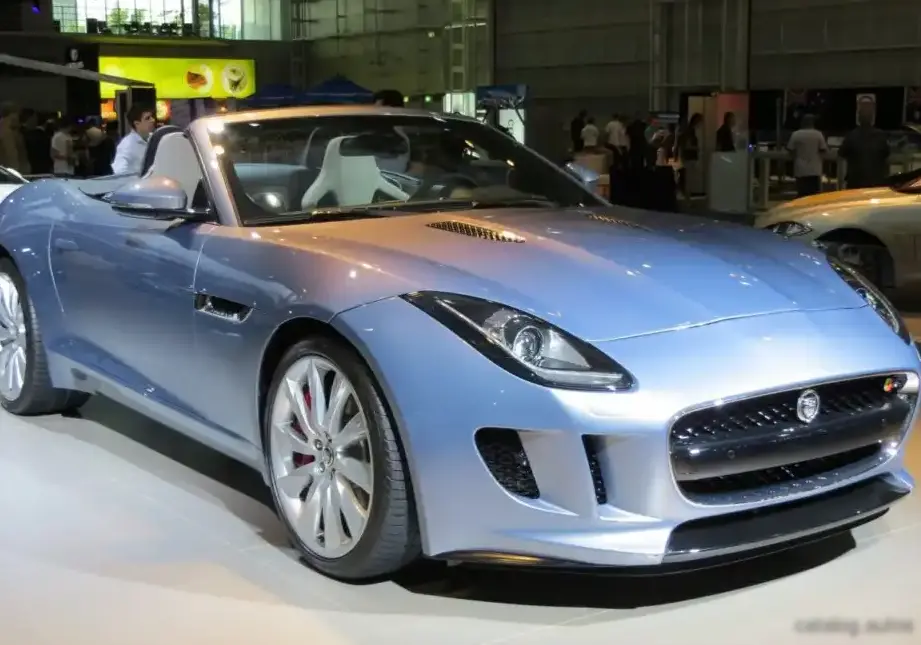
The Jaguar F-Type Convertible P300, introduced as part of the 2017 facelift and produced through 2020, represents an entry point into the F-Type range. Positioned as the most accessible variant, it offered the iconic F-Type styling and driving experience with a more fuel-efficient and affordable powertrain. This model year saw significant updates to the F-Type line, including revised styling, updated technology, and the introduction of the Ingenium engine family. The P300 aimed to broaden the F-Type’s appeal, attracting buyers who desired a sporty convertible without the higher price tag and performance focus of the V6 or V8 models.
Technical Specifications
| Brand | Jaguar |
| Model | F-type |
| Generation | F-type Convertible (facelift 2017) |
| Type (Engine) | P300 (300 Hp) Automatic |
| Start of production | 2019 year |
| End of production | 2020 year |
| Powertrain Architecture | Internal Combustion engine |
| Body type | Cabriolet |
| Seats | 2 |
| Doors | 2 |
| Fuel consumption (economy) – urban | 10 l/100 km (23.5 US mpg, 28.2 UK mpg, 10 km/l) |
| Fuel consumption (economy) – extra urban | 6.6 l/100 km (35.6 US mpg, 42.8 UK mpg, 15.2 km/l) |
| Fuel consumption (economy) – combined | 7.9 l/100 km (29.8 US mpg, 35.8 UK mpg, 12.7 km/l) |
| CO2 emissions | 179 g/km |
| Fuel Type | Petrol (Gasoline) |
| Acceleration 0 – 100 km/h | 5.7 sec |
| Acceleration 0 – 62 mph | 5.7 sec |
| Acceleration 0 – 60 mph | 5.4 sec |
| Maximum speed | 250 km/h (155.34 mph) |
| Emission standard | Euro 6d-Temp |
| Weight-to-power ratio | 4.9 kg/Hp, 204.1 Hp/tonne |
| Weight-to-torque ratio | 3.7 kg/Nm, 272.1 Nm/tonne |
| Power | 300 Hp @ 5500 rpm |
| Power per litre | 150.2 Hp/l |
| Torque | 400 Nm @ 1500-4500 rpm (295.02 lb.-ft. @ 1500-4500 rpm) |
| Engine layout | Front, Longitudinal |
| Engine Model/Code | Ingenium / PT204 |
| Engine displacement | 1997 cm3 (121.86 cu. in.) |
| Number of cylinders | 4 |
| Engine configuration | Inline |
| Cylinder Bore | 83 mm (3.27 in.) |
| Piston Stroke | 92.3 mm (3.63 in.) |
| Compression ratio | 9.5:1 |
| Number of valves per cylinder | 4 |
| Fuel injection system | Direct injection |
| Engine aspiration | Turbocharger, Intercooler |
| Engine oil capacity | 6.5 l (6.87 US qt | 5.72 UK qt) |
| Kerb Weight | 1470 kg (3240.8 lbs.) |
| Max. weight | 1925 kg (4243.9 lbs.) |
| Max load | 455 kg (1003.1 lbs.) |
| Trunk (boot) space – minimum | 207 l (7.31 cu. ft.) |
| Fuel tank capacity | 63 l (16.64 US gal | 13.86 UK gal) |
| Length | 4482 mm (176.46 in.) |
| Width | 1923 mm (75.71 in.) |
| Width including mirrors | 2042 mm (80.39 in.) |
| Height | 1308 mm (51.5 in.) |
| Wheelbase | 2622 mm (103.23 in.) |
| Front track | 1597 mm (62.87 in.) |
| Rear (Back) track | 1649 mm (64.92 in.) |
| Ride height (ground clearance) | 100 mm (3.94 in.) |
| Minimum turning circle (turning diameter) | 11.2 m (36.75 ft.) |
| Drivetrain Architecture | Rear wheel drive |
| Number of gears and type of gearbox | 8 gears, automatic transmission |
| Front brakes | Disc, 355 mm |
| Rear brakes | Disc, 325 mm |
| Assisting systems | ABS (Anti-lock braking system) |
| Tires size | 245/45 R18; 275/40 R18 |
| Wheel rims size | 8.5J x 18; 9.5J x 18 |
Powertrain & Engine Architecture
The P300 utilizes Jaguar Land Rover’s Ingenium engine family, specifically the PT204 2.0-liter turbocharged inline-four cylinder engine. This engine represents a departure from the earlier supercharged six-cylinder engines traditionally associated with the F-Type. The Ingenium engine features direct injection, a single twin-scroll turbocharger, and variable valve timing. It produces 300 horsepower at 5500 rpm and 400 Nm (295 lb-ft) of torque between 1500 and 4500 rpm. The engine is longitudinally mounted at the front of the vehicle. The P300 is exclusively paired with an 8-speed automatic transmission, developed in-house by Jaguar. This transmission offers smooth shifts and contributes to the car’s improved fuel efficiency. The transmission is calibrated for a balance of performance and comfort, prioritizing smooth operation over aggressive gear changes.
Driving Characteristics
The F-Type P300 Automatic delivers a distinct driving experience compared to its more powerful siblings. While it doesn’t possess the raw acceleration of the V6 or V8 models, it offers a surprisingly engaging drive. The 0-60 mph sprint takes approximately 5.4 seconds. The 8-speed automatic transmission is well-tuned, providing quick and seamless gear changes. However, some reviewers noted that the transmission can occasionally feel hesitant during downshifts. The relatively lower weight compared to the higher-spec models contributes to nimble handling. The suspension setup, while sporty, is tuned for comfort, making it a more suitable daily driver than the more track-focused variants. The power delivery is linear and predictable, making it easy to modulate the throttle.
Equipment & Trim Levels
The P300 typically came standard with leather upholstery, a touchscreen infotainment system, automatic climate control, and a suite of safety features including emergency braking and lane departure warning. Optional extras included a premium sound system, heated seats, and various cosmetic enhancements. The interior design mirrored that of other F-Type models, with a driver-focused cockpit and high-quality materials. Trim levels were relatively streamlined, with most customization options available as individual add-ons. The standard wheels were typically 18-inch alloys, with larger sizes available as options.
Chassis & Braking
The F-Type Convertible P300 utilizes a lightweight aluminum chassis, contributing to its relatively low curb weight of 1470 kg (3240.8 lbs). The suspension consists of double wishbones at the front and a multi-link setup at the rear. The braking system features disc brakes on all four wheels, with 355mm discs at the front and 325mm discs at the rear. ABS (Anti-lock Braking System) is standard. The P300 typically did not feature the larger brakes or adaptive dampers found on the higher-performance models.
Market Reception & Comparison
The F-Type P300 was generally well-received by automotive critics as an accessible entry point into the F-Type lineup. It was praised for its stylish design, comfortable ride, and improved fuel economy compared to the V6 and V8 models. However, some reviewers felt that the 2.0-liter engine lacked the character and excitement of the larger engines. Compared to the F-Type 3.0L, the P300 offered significantly better fuel economy (around 29.8 US mpg combined vs. 25-26 mpg for the 3.0L) but considerably less performance. Against competitors like the Porsche 718 Boxster, the F-Type P300 offered a more luxurious interior and a more comfortable ride, but the Boxster generally provided sharper handling.
Legacy
The Ingenium engine proved to be a reliable unit, and the P300 powertrain has generally held up well over time. On the used car market, the P300 represents a relatively affordable way to experience F-Type ownership. Maintenance costs are generally lower than those associated with the V6 and V8 models, due to the simpler engine design and lower running costs. While it may not offer the same level of performance as its more powerful siblings, the F-Type P300 remains a desirable and stylish convertible that provides a compelling blend of performance, comfort, and fuel efficiency.