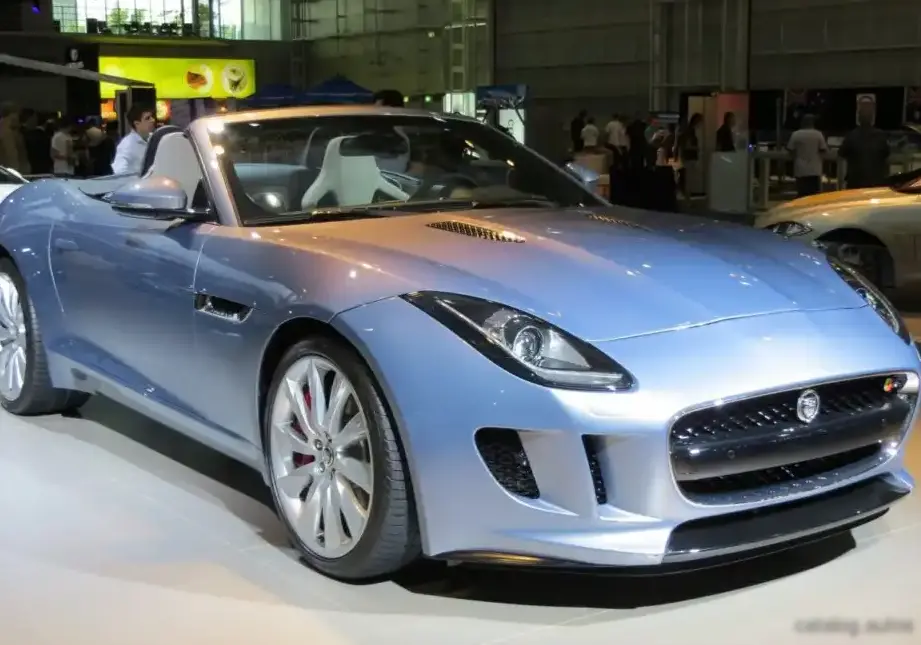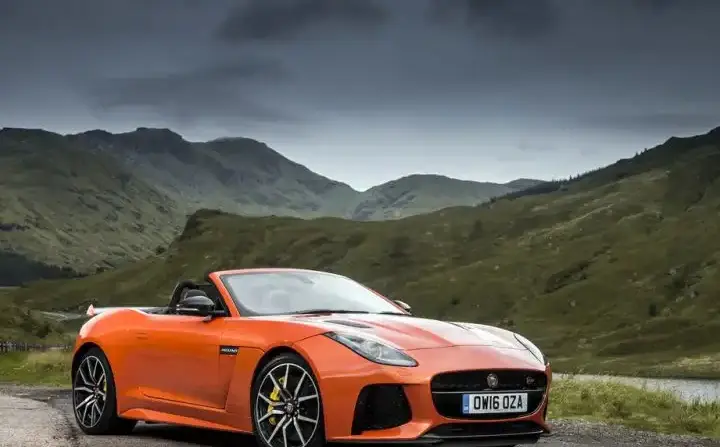
The Jaguar F-Type Convertible, specifically the P380 V6 variant produced from 2019 to 2020, represents a significant iteration of Jaguar’s successful sports car lineage. This model falls within the facelifted first-generation (X152) F-Type range, introduced in 2017, and aimed to refine the original’s design and enhance its driving experience. The P380 occupied a middle ground in the F-Type lineup, offering a compelling balance between performance and everyday usability, positioned above the entry-level 2.0L four-cylinder models and below the more potent V8-powered versions. It was primarily marketed towards enthusiasts seeking a sophisticated and engaging open-top sports car experience.
Technical Specifications
| Brand | Jaguar |
| Model | F-type |
| Generation | F-type Convertible (facelift 2017) |
| Type (Engine) | P380 V6 (380 Hp) |
| Start of production | 2019 |
| End of production | 2020 |
| Powertrain Architecture | Internal Combustion engine |
| Body type | Cabriolet |
| Seats | 2 |
| Doors | 2 |
| Fuel consumption (urban) | 14.5 l/100 km (16.2 US mpg, 19.5 UK mpg, 6.9 km/l) |
| Fuel consumption (extra urban) | 8.2 l/100 km (28.7 US mpg, 34.4 UK mpg, 12.2 km/l) |
| Fuel consumption (combined) | 10.6 l/100 km (22.2 US mpg, 26.6 UK mpg, 9.4 km/l) |
| CO2 emissions | 242 g/km |
| Fuel Type | Petrol (Gasoline) |
| Acceleration 0 – 100 km/h | 5.5 sec |
| Acceleration 0 – 62 mph | 5.5 sec |
| Acceleration 0 – 60 mph | 5.2 sec |
| Maximum speed | 275 km/h (170.88 mph) |
| Emission standard | Euro 6d-Temp |
| Weight-to-power ratio | 4 kg/Hp, 248.5 Hp/tonne |
| Weight-to-torque ratio | 3.3 kg/Nm, 300.9 Nm/tonne |
| Power | 380 Hp @ 6500 rpm |
| Torque | 460 Nm @ 3500-5500 rpm (339.28 lb.-ft. @ 3500-5500 rpm) |
| Engine layout | Front, Longitudinal |
| Engine Model/Code | 306PS |
| Engine displacement | 2995 cm3 (182.77 cu. in.) |
| Number of cylinders | 6 |
| Engine configuration | V-engine |
| Cylinder Bore | 84.5 mm (3.33 in.) |
| Piston Stroke | 89 mm (3.5 in.) |
| Compression ratio | 10.5:1 |
| Number of valves per cylinder | 4 |
| Fuel injection system | Direct injection |
| Engine aspiration | Supercharger, Intercooler |
| Engine oil capacity | 7.25 l (7.66 US qt | 6.38 UK qt) |
| Coolant | 9.6 l (10.14 US qt | 8.45 UK qt) |
| Kerb Weight | 1529 kg (3370.87 lbs.) |
| Max. weight | 2050 kg (4519.48 lbs.) |
| Max load | 521 kg (1148.61 lbs.) |
| Fuel tank capacity | 70 l (18.49 US gal | 15.4 UK gal) |
| Length | 4482 mm (176.46 in.) |
| Width | 1923 mm (75.71 in.) |
| Width including mirrors | 2042 mm (80.39 in.) |
| Height | 1308 mm (51.5 in.) |
| Wheelbase | 2622 mm (103.23 in.) |
| Front track | 1585 mm (62.4 in.) |
| Rear track | 1627 mm (64.06 in.) |
| Minimum turning circle | 11.2 m (36.75 ft.) |
| Drivetrain | Rear wheel drive |
| Number of gears | 6 |
| Front brakes | Disc, 380 mm |
| Rear brakes | Disc, 325 mm |
| Tires size | 255/35 R20; 295/30 R20 |
| Wheel rims size | 9.0J x 20; 10.5J x 20 |
Powertrain & Engine Architecture
The heart of the F-Type P380 is Jaguar Land Rover’s AJ306 engine, a 2.9-liter supercharged V6. This engine utilizes a roots-type supercharger, providing immediate throttle response and a broad torque curve. Direct fuel injection is employed for precise fuel delivery and improved efficiency. The engine produces 380 horsepower at 6,500 rpm and 460 Nm (339 lb-ft) of torque between 3,500 and 5,500 rpm. The engine code is often referred to as 306PS. The P380 exclusively came with an eight-speed automatic transmission, developed in-house by Jaguar. This transmission features quick shifts and a sophisticated control system designed to optimize performance and fuel economy. The drivetrain is rear-wheel drive, contributing to the car’s sporty handling characteristics.
Driving Characteristics
The F-Type P380 offers a compelling driving experience, balancing performance with everyday usability. The supercharged V6 delivers strong acceleration, with a 0-60 mph time of around 5.2 seconds. The eight-speed automatic transmission provides smooth and responsive shifts, although some enthusiasts prefer the engagement of a manual gearbox. The car’s weight distribution and well-tuned suspension contribute to its agile handling. Compared to the four-cylinder F-Type, the P380 offers significantly more power and torque, resulting in a more exhilarating driving experience. However, it doesn’t quite match the raw performance of the V8-powered models. The gear ratios are tuned for a blend of acceleration and cruising efficiency, making it suitable for both spirited driving and long-distance journeys.
Equipment & Trim Levels
The P380 Convertible came well-equipped as standard, including leather upholstery, heated seats, a premium sound system, and a touchscreen infotainment system. Optional extras included a panoramic sunroof, adaptive cruise control, and upgraded interior trim materials. The interior design featured a driver-focused cockpit with a sporty steering wheel and supportive seats. The dashboard layout was clean and modern, with intuitive controls. Trim levels were relatively streamlined, with most customization options available through individual selections rather than distinct packages.
Chassis & Braking
The F-Type Convertible utilizes an aluminum chassis, contributing to its relatively low weight. The suspension system features double wishbones at the front and a multi-link setup at the rear. The P380 variant typically came with performance-tuned dampers and springs. Braking duties are handled by ventilated disc brakes on all four wheels, with larger front discs (380mm) compared to the base models. Anti-lock braking system (ABS) is standard, along with electronic stability control. The rear brakes are 325mm discs.
Market Reception & Comparison
The F-Type P380 was generally well-received by automotive critics, who praised its performance, handling, and stylish design. It was often seen as a sweet spot in the F-Type range, offering a good balance between price and performance. Fuel economy was considered reasonable for a sports car of its caliber, although it wasn’t a primary strength. Compared to the four-cylinder F-Type, the P380 offered a more satisfying engine note and a more engaging driving experience. However, the V8 models provided even greater performance for those willing to pay the premium. Reliability reports have been mixed, with some owners reporting minor electrical issues, but overall the F-Type has proven to be a relatively durable sports car.
Legacy
The Jaguar F-Type P380 Convertible represents a high point in Jaguar’s modern sports car history. Its combination of performance, style, and technology has made it a desirable used car. The 2.9L supercharged V6 engine has proven to be a robust and reliable unit when properly maintained. As the F-Type moves towards an all-electric future, the P380 variant will likely be remembered as a classic example of Jaguar’s commitment to building exciting and engaging sports cars. The used market values for well-maintained examples remain strong, reflecting the car’s enduring appeal.