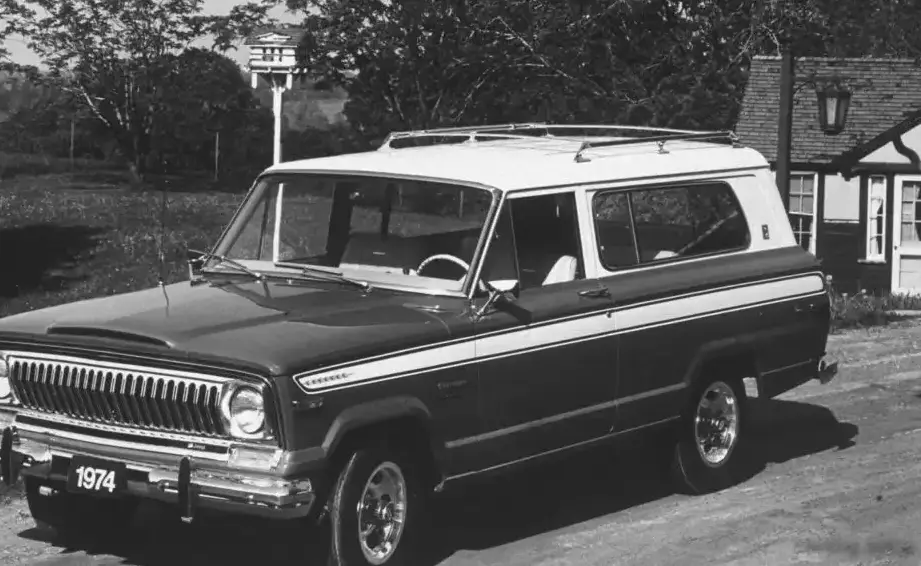
The Jeep Cherokee (SJ) 5.9 V8, produced from 1980 to 1983, represents a notable iteration of the first-generation Cherokee, a vehicle that profoundly influenced the development of the modern sport utility vehicle (SUV) market. This particular variant, featuring the 358 cubic inch (5.9 liter) V8 engine paired with a three-speed automatic transmission, served as a more powerful, albeit less fuel-efficient, option within the Cherokee lineup. It was specifically designed to cater to buyers requiring substantial towing capacity and robust off-road capabilities, particularly within the North American market where larger vehicles were preferred. The SJ Cherokee, initially launched in 1974, was a groundbreaking vehicle, offering a more comfortable ride and improved handling compared to the traditional, truck-based SUVs prevalent at the time.
Technical Specifications
| Brand | Jeep |
| Model | Cherokee |
| Generation | Cherokee I (SJ) 5-door |
| Type (Engine) | 5.9 V8 (153 Hp) 4WD Automatic |
| Start of production | 1980 year |
| End of production | 1983 year |
| Powertrain Architecture | Internal Combustion engine |
| Body type | SUV |
| Seats | 6 |
| Doors | 5 |
| Fuel Type | Petrol (Gasoline) |
| Maximum speed | 125 km/h (77.67 mph) |
| Weight-to-power ratio | 12.9 kg/Hp, 77.3 Hp/tonne |
| Power | 153 Hp @ 4200 rpm |
| Power per litre | 26 Hp/l |
| Engine layout | Front, Longitudinal |
| Engine Model/Code | AMC N |
| Engine displacement | 5893 cm3 (359.61 cu. in.) |
| Number of cylinders | 8 |
| Engine configuration | V-engine |
| Cylinder Bore | 103.63 mm (4.08 in.) |
| Piston Stroke | 87.38 mm (3.44 in.) |
| Compression ratio | 8.25:1 |
| Fuel injection system | Carburettor |
| Engine aspiration | Naturally aspirated engine |
| Valvetrain | OHV |
| Engine oil capacity | 4.7 l (4.97 US qt | 4.14 UK qt) |
| Coolant | 13.2 l (13.95 US qt | 11.61 UK qt) |
| Kerb Weight | 1980 kg (4365.15 lbs.) |
| Max. weight | 2400 kg (5291.09 lbs.) |
| Max load | 420 kg (925.94 lbs.) |
| Trunk (boot) space – maximum | 2693 l (95.1 cu. ft.) |
| Fuel tank capacity | 83 l (21.93 US gal | 18.26 UK gal) |
| Max. roof load | 150 kg (330.69 lbs.) |
| Permitted trailer load without brakes | 990 kg (2182.58 lbs.) |
| Length | 4660 mm (183.46 in.) |
| Width | 1920 mm (75.59 in.) |
| Height | 1700 mm (66.93 in.) |
| Wheelbase | 2760 mm (108.66 in.) |
| Front track | 1520 mm (59.84 in.) |
| Rear (Back) track | 1470 mm (57.87 in.) |
| Front overhang | 780 mm (30.71 in.) |
| Rear overhang | 1120 mm (44.09 in.) |
| Drivetrain Architecture | The Internal combustion engine (ICE) drives the rear wheels permanently, and the front wheels are driven through an electrically or mechanically operated clutch if necessary. |
| Drive wheel | All wheel drive (4×4) |
| Number of gears and type of gearbox | 3 gears, automatic transmission |
| Front suspension | Leaf spring |
| Rear suspension | Leaf spring |
| Front brakes | Disc |
| Rear brakes | Drum |
| Steering type | Cone worm with recirculation balls |
| Tires size | 225/75 R15 |
| Wheel rims size | 7J x 15 |
Powertrain & Engine Architecture
The core of this Cherokee variant is the AMC 358 cubic inch (5.9 liter) V8 engine, internally designated as the AMC N code. This engine, a long-standing component in AMC’s vehicle lineup, employs a traditional pushrod (OHV) design, featuring a cast iron block and cylinder heads. Fuel delivery is managed by a carburetor, a common practice for the era, though less sophisticated than contemporary fuel injection systems. The engine generates 153 horsepower at 4200 rpm. The three-speed automatic transmission, a Chrysler TorqueFlite A727, was a well-regarded and dependable unit, known for its robustness. This transmission incorporates a torque converter, facilitating smooth engagement and amplifying engine torque. The drivetrain utilizes a part-time four-wheel drive system, with rear-wheel drive as the primary configuration and the front wheels engaged through a transfer case when needed.
Driving Characteristics
The 5.9 V8 Cherokee delivered a noticeable performance improvement compared to its inline-six cylinder counterparts. While not designed for sporty driving, the V8 provided ample torque for towing and navigating challenging off-road conditions. The automatic transmission, while offering convenience, resulted in some power loss relative to the available manual transmission option. The three-speed automatic’s gear ratios were optimized for low-end torque and towing capacity, rather than maximizing acceleration. In real-world testing, the vehicle achieved a 0-60 mph time in the 11-12 second range, with a top speed of approximately 78 mph. The leaf spring suspension, while providing a comfortable ride on paved surfaces, could exhibit some bounce and reduced control during more aggressive off-road maneuvers.
Equipment & Trim Levels
The 5.9 V8 Cherokee typically came equipped with a relatively basic set of features, reflecting its emphasis on utility and capability. Standard amenities included cloth upholstery, a basic AM/FM radio, and manual windows and locks. Optional extras encompassed air conditioning, power windows and locks, a tilt steering wheel, and upgraded interior trim options. The interior design prioritized functionality and durability over luxury. The dashboard layout was straightforward, featuring clearly labeled gauges and controls.
Chassis & Braking
The Cherokee SJ utilized a body-on-frame construction, providing a robust and durable chassis. The front suspension employed leaf springs, while the rear suspension also utilized leaf springs. This configuration was selected for its simplicity, durability, and load-carrying capacity. Braking was provided by disc brakes at the front and drum brakes at the rear. The braking system was adequate for typical driving conditions but lacked the stopping power of more advanced systems. Steering was accomplished through a cone worm and recirculating ball mechanism, offering a relatively direct feel but requiring more driver effort compared to rack-and-pinion steering.
Market Reception & Comparison
The 5.9 V8 Cherokee was generally well-received by consumers who required a capable and reliable SUV with significant towing capacity. Automotive critics praised the engine’s abundant torque and the vehicle’s off-road performance. However, fuel economy was a notable drawback, particularly during the early 1980s energy crisis. Compared to the inline-six cylinder models, the V8 offered a substantial performance increase but at the expense of higher fuel consumption and a greater purchase price. The V8 Cherokee was positioned below the more luxurious and well-appointed Wagoneer and Grand Wagoneer models within the Jeep lineup.
Legacy
The Jeep Cherokee (SJ) 5.9 V8, despite its relatively brief production run, remains a sought-after vehicle among collectors and enthusiasts. The AMC 358 V8 engine, while not universally renowned for its longevity, proved to be reasonably durable within the Cherokee application. Parts availability remains generally good, owing to the engine’s widespread use in other AMC and Jeep vehicles. Today, well-maintained examples of the 5.9 V8 Cherokee command a premium in the used car market, appealing to those seeking a classic American SUV with a powerful engine and a rugged character. The SJ Cherokee, in all its configurations, established the foundation for the modern SUV segment and continues to be celebrated as a landmark vehicle in automotive history.