Technical Specifications
| Brand | Jeep |
| Model | Compass |
| Generation | Compass II (MP, facelift 2021) |
| Type (Engine) | 2.4 MultiAir (177 Hp) 4×4 Automatic |
| Start of production | July, 2021 |
| End of production | November, 2022 |
| Powertrain Architecture | Internal Combustion engine |
| Body type | SUV, Crossover |
| Seats | 5 |
| Doors | 5 |
| Fuel consumption (economy) – urban (EPA) | 10.7 l/100 km (22 US mpg, 26.4 UK mpg, 9.3 km/l) |
| Fuel consumption (economy) – extra urban (EPA) | 7.8 l/100 km (30.2 US mpg, 36.2 UK mpg, 12.8 km/l) |
| Fuel consumption (economy) – combined (EPA) | 9.4 l/100 km (25 US mpg, 30.1 UK mpg, 10.6 km/l) |
| Fuel Type | Petrol (Gasoline) |
| Weight-to-power ratio | 8.5 kg/Hp, 117.3 Hp/tonne |
| Weight-to-torque ratio | 6.5 kg/Nm, 154.4 Nm/tonne |
| Power | 177 Hp @ 6400 rpm |
| Power per litre | 75 Hp/l |
| Torque | 233 Nm @ 3900 rpm (171.85 lb.-ft. @ 3900 rpm) |
| Maximum engine speed | 6400 rpm |
| Engine layout | Front, Transverse |
| Engine Model/Code | Tigershark |
| Engine displacement | 2360 cm3 (144.02 cu. in.) |
| Number of cylinders | 4 |
| Engine configuration | Inline |
| Cylinder Bore | 88 mm (3.46 in.) |
| Piston Stroke | 97 mm (3.82 in.) |
| Compression ratio | 10:1 |
| Number of valves per cylinder | 4 |
| Fuel injection system | Multi-port manifold injection |
| Engine aspiration | Naturally aspirated engine |
| Valvetrain | SOHC |
| Engine oil capacity | 5.2 l (5.49 US qt | 4.58 UK qt) |
| Coolant | 6.5 l (6.87 US qt | 5.72 UK qt) |
| Kerb Weight | 1509 kg (3326.78 lbs.) |
| Trunk (boot) space – minimum | 438 l (15.47 cu. ft.) |
| Trunk (boot) space – maximum | 1387 l (48.98 cu. ft.) |
| Fuel tank capacity | 51 l (13.47 US gal | 11.22 UK gal) |
| Permitted trailer load with brakes (12%) | 907 kg (1999.59 lbs.) |
| Length | 4404 mm (173.39 in.) |
| Width with mirrors folded | 1874 mm (73.78 in.) |
| Width including mirrors | 2033 mm (80.04 in.) |
| Height | 1641 mm (64.61 in.) |
| Wheelbase | 2636 mm (103.78 in.) |
| Front track | 1542 mm (60.71 in.) |
| Rear (Back) track | 1532 mm (60.31 in.) |
| Ride height (ground clearance) | 206 mm (8.11 in.) |
| Minimum turning circle (turning diameter) | 11.07 m (36.32 ft.) |
| Approach angle | 16.1° |
| Departure angle | 31.4° |
| Ramp-over (brakeover) angle | 22.6° |
| Drivetrain Architecture | The Internal combustion engine (ICE) drives the front wheels permanently, and the rear wheels are driven through an electrically or mechanically operated clutch if necessary. |
| Drive wheel | All wheel drive (4×4) |
| Number of gears and type of gearbox | 9 gears, automatic transmission |
| Front suspension | Independent, type McPherson with coil spring and anti-roll bar |
| Rear suspension | Independent coil spring, Transverse stabilizer |
| Front brakes | Ventilated discs, 305×28 mm |
| Rear brakes | Disc, 278×12 mm |
| Assisting systems | ABS (Anti-lock braking system) |
| Steering type | Steering rack and pinion |
| Power steering | Electric Steering |
| Tires size | 215/65 R16; 225/60 R17; 225/55 R18; 235/45 R19 |
| Wheel rims size | 6.5J x 16; 7J x 17; 7J x 18; 7.5J x 19 |
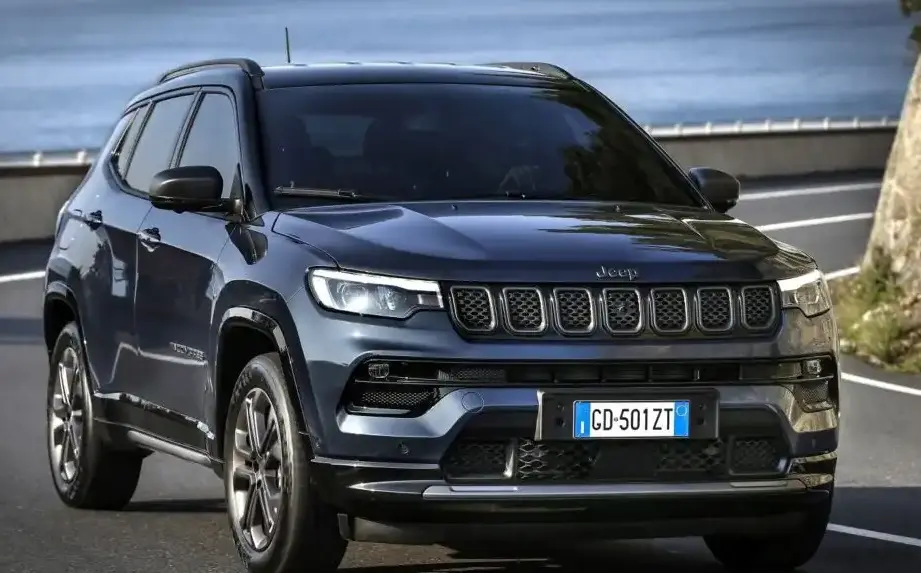
The Jeep Compass II (MP), specifically the 2.4 MultiAir variant with four-wheel drive and an automatic transmission, was produced from July 2021 to November 2022. This version represented a mid-cycle refresh of the second-generation Compass (MP), which initially debuted in 2017 as a substantial improvement over its predecessor. Positioned as a mainstream offering within the Compass lineup, it aimed to strike a balance between fuel efficiency, all-weather capability, and affordability for the North American market, where the Compass competes in the popular compact SUV segment. The facelift incorporated updated styling cues, improved interior materials, and enhanced technology features, reinforcing the Compass’s importance as a key model for the Jeep brand.
Powertrain & Engine Architecture
The 2.4-liter Tigershark inline-four cylinder engine powers this Compass variant. This engine, a common component in several Stellantis vehicles, employs multi-port fuel injection and a single overhead camshaft (SOHC) valvetrain. A defining characteristic is the MultiAir technology, a variable valve timing system that allows for precise control of intake valve operation to optimize combustion efficiency and reduce emissions. The engine generates 177 horsepower at 6400 rpm and 233 Nm (171.85 lb-ft) of torque at 3900 rpm. This power is channeled to all four wheels through a nine-speed automatic transmission sourced from ZF, designed to provide a broad gear ratio spread for both fuel economy and responsive acceleration. The 4×4 system is an active system, automatically distributing torque between the front and rear axles based on driving conditions.
Driving Characteristics
The combination of the 177-hp 2.4-liter engine and the nine-speed automatic transmission delivers adequate performance for everyday driving, though it isn’t particularly sporty. Acceleration is sufficient for typical commutes and errands, but the Compass doesn’t feel especially quick when merging onto highways or overtaking other vehicles. The automatic transmission generally shifts smoothly, although some drivers have reported occasional hesitation or “hunting” for the correct gear, particularly during highway driving. The nine-speed’s wide ratio spread helps maintain lower engine speeds during cruising, contributing to improved fuel economy. Compared to higher-trim Compass models with more powerful engine options, this variant prioritizes fuel efficiency and a more relaxed driving experience. The all-wheel-drive system enhances traction in adverse weather conditions and on moderately challenging terrain, but it’s not designed for serious off-road adventures.
Equipment & Trim Levels
The 2.4 MultiAir 4×4 Automatic trim typically included standard features such as air conditioning, a touchscreen infotainment system with Apple CarPlay and Android Auto compatibility, a rearview camera, and a suite of driver-assistance technologies like lane departure warning and automatic emergency braking. Higher trim levels offered upgrades like leather upholstery, heated front seats, a larger touchscreen display, a premium sound system, and a panoramic sunroof. Optional extras included a navigation system, adaptive cruise control, and blind-spot monitoring.
Chassis & Braking
The Compass II features an independent suspension system at all four corners, utilizing a McPherson strut design in the front and a multi-link setup in the rear. This configuration provides a reasonably comfortable ride, although it can feel somewhat firm on uneven road surfaces. The steering is electrically assisted and offers adequate feedback. Braking is accomplished with ventilated discs at the front and solid discs at the rear. Standard safety features include anti-lock brakes (ABS), electronic stability control, and traction control systems.
Market Reception & Comparison
Automotive critics generally considered the 2.4-liter engine and nine-speed automatic combination to be a competent, if unremarkable, powertrain. Fuel economy was a notable strength, with EPA estimates around 25 mpg combined. However, some reviewers found the engine to be somewhat underpowered, especially when the vehicle was fully loaded or climbing steep hills. Compared to other compact SUVs in its class, the Compass offered a competitive level of features and capability, but it often fell short in terms of overall refinement and driving dynamics.
Legacy
The 2.4 MultiAir engine, while generally reliable, has been known to exhibit some oil consumption issues in certain applications. Owners of this vehicle should regularly check their oil levels. The nine-speed automatic transmission has also received some criticism for occasional rough shifting or hesitation, but these problems are not widespread. As a used vehicle, the 2021-2022 Jeep Compass 2.4 MultiAir 4×4 Automatic represents a relatively affordable and capable option for buyers seeking a compact SUV with all-wheel drive. Its combination of fuel efficiency, practicality, and available features makes it a viable choice in the used car market.