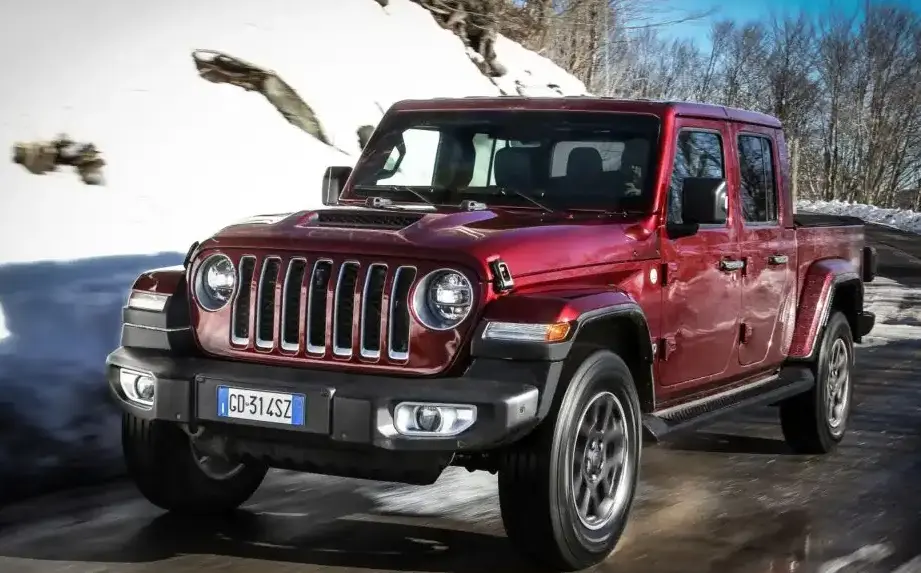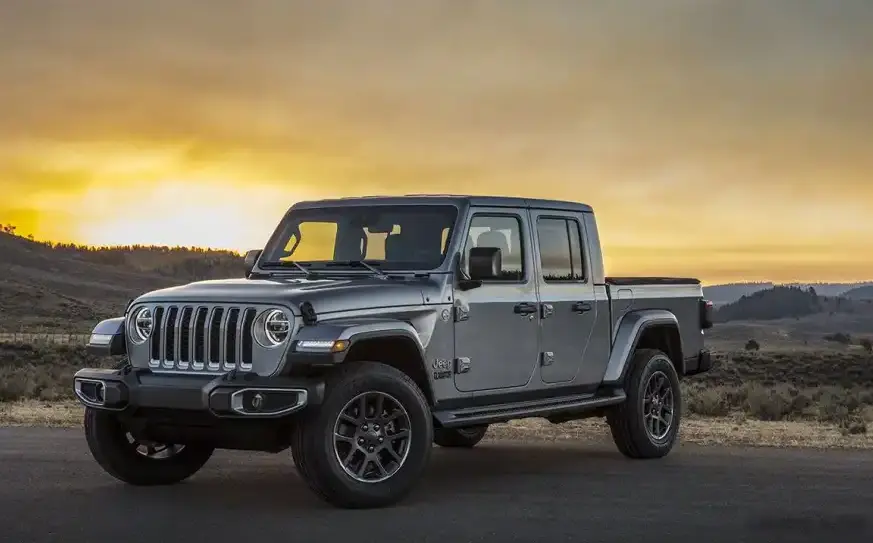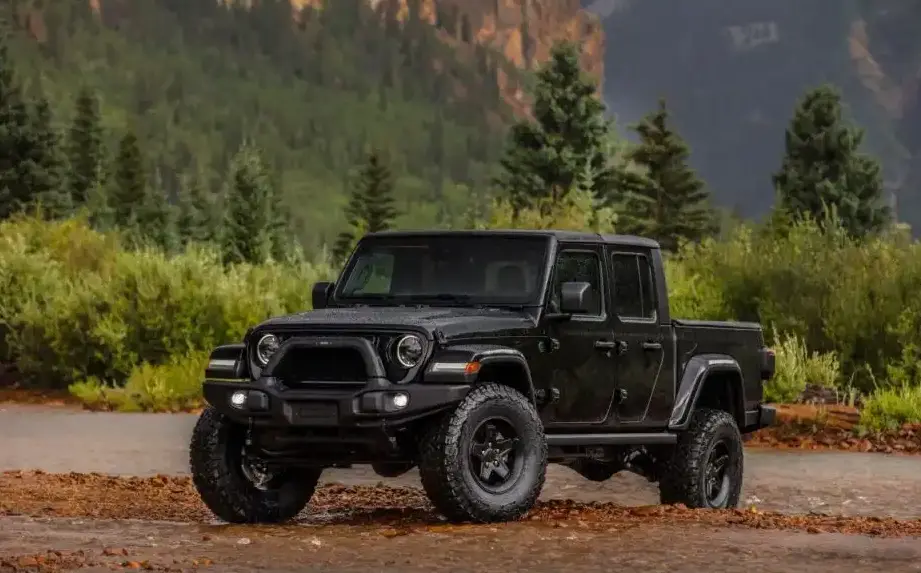
The Jeep Gladiator Sport 3.6 Pentastar V6 4×4 Automatic, introduced for the 2024 model year as part of the JT facelift, represents the entry-level configuration of the revived Gladiator pickup truck. Building upon the initial JT launch in 2019, the 2024 refresh brought updated styling and technology, but the core appeal of the Gladiator – a uniquely capable mid-size truck blending Jeep’s legendary off-road prowess with open-air freedom – remained. The Sport trim, powered by the 3.6-liter Pentastar V6 and paired with an eight-speed automatic transmission, serves as the most accessible gateway into the Gladiator lineup, targeting buyers seeking a versatile and rugged vehicle for both daily driving and recreational adventures.
Technical Specifications
| Brand | Jeep |
| Model | Gladiator |
| Generation | Gladiator (JT, facelift 2024) |
| Type (Engine) | Sport 3.6 Pentastar V6 (285 Hp) 4×4 Automatic |
| Start of production | February, 2024 |
| Powertrain Architecture | Internal Combustion engine |
| Body type | Pick-up |
| Seats | 5 |
| Doors | 4 |
| Fuel consumption (urban) | 13.8 l/100 km (17 US mpg, 20.5 UK mpg, 7.2 km/l) |
| Fuel consumption (extra urban) | 10.7 l/100 km (22 US mpg, 26.4 UK mpg, 9.3 km/l) |
| Fuel consumption (combined) | 12.4 l/100 km (19 US mpg, 22.8 UK mpg, 8.1 km/l) |
| Fuel Type | Petrol (Gasoline) |
| Weight-to-power ratio | 7.4 kg/Hp, 134.8 Hp/tonne |
| Weight-to-torque ratio | 6 kg/Nm, 167 Nm/tonne |
| Power | 285 Hp @ 6400 rpm |
| Power per litre | 79.1 Hp/l |
| Torque | 353 Nm @ 4400 rpm (260.36 lb.-ft. @ 4400 rpm) |
| Maximum engine speed | 6600 rpm |
| Engine layout | Front, Longitudinal |
| Engine Model/Code | Pentastar / ERC |
| Engine displacement | 3604 cm3 (219.93 cu. in.) |
| Number of cylinders | 6 |
| Engine configuration | V-engine |
| Cylinder Bore | 96 mm (3.78 in.) |
| Piston Stroke | 83 mm (3.27 in.) |
| Compression ratio | 11.3:1 |
| Number of valves per cylinder | 4 |
| Fuel injection system | Multi-port manifold injection |
| Engine aspiration | Naturally aspirated engine |
| Valvetrain | DOHC |
| Engine oil capacity | 4.7 l (4.97 US qt | 4.14 UK qt) |
| Coolant capacity | 12.3 l (13 US qt | 10.82 UK qt) |
| Kerb Weight | 2114-2149 kg (4660.57 – 4737.73 lbs.) |
| Max. weight | 2614-2925 kg (5762.88 – 6448.52 lbs.) |
| Max load | 500-776 kg (1102.31 – 1710.79 lbs.) |
| Fuel tank capacity | 83 l (21.93 US gal | 18.26 UK gal) |
| Permitted trailer load with brakes (12%) | 3493 kg (7700.75 lbs.) |
| Length | 5539 mm (218.07 in.) |
| Width | 1875 mm (73.82 in.) |
| Height | 1857-1907 mm (73.11 – 75.08 in.) |
| Wheelbase | 3487 mm (137.28 in.) |
| Front track | 1598 mm (62.91 in.) |
| Rear track | 1598 mm (62.91 in.) |
| Front overhang | 755 mm (29.72 in.) |
| Rear overhang | 1296 mm (51.02 in.) |
| Ride height (ground clearance) | 254 mm (10 in.) |
| Minimum turning circle | 13.56 m (44.49 ft.) |
| Approach angle | 40.8° |
| Departure angle | 25° |
| Ramp-over angle | 18.4° |
| Drivetrain Architecture | The Internal combustion engine (ICE) drives the rear wheels permanently, and the front wheels are driven through an electrically or mechanically operated clutch if necessary. |
| Drive wheel | All wheel drive (4×4) |
| Number of gears | 8 |
| Gearbox type | automatic transmission |
| Front suspension | Coil spring, Rigid axle suspension, Transverse stabilizer |
| Rear suspension | Rigid axle suspension, Transverse stabilizer, Coil spring |
| Front brakes | Ventilated discs, 330×28 mm |
| Rear brakes | Ventilated discs, 345×22 mm |
| Assisting systems | ABS (Anti-lock braking system) |
| Steering type | Cone worm with recirculation balls |
| Power steering | Electric Steering |
| Tires size | 245/75 R17 |
| Wheel rims size | 7.5J x 17 |
Powertrain & Engine Architecture
The heart of the Gladiator Sport is the 3.6-liter Pentastar V6 engine, a mainstay of the FCA (now Stellantis) lineup for many years. This engine, designated as the ERC code, utilizes a naturally aspirated configuration with multi-port fuel injection and a double overhead camshaft (DOHC) valvetrain. The 60-degree V-angle contributes to a relatively smooth running character. The 3.6L Pentastar produces 285 horsepower at 6,400 rpm and 260 lb-ft of torque at 4,400 rpm. Paired with this engine is an eight-speed automatic transmission (8HP75), known for its smooth shifts and wide gear ratio spread. This transmission is designed to balance fuel efficiency with responsive acceleration. The 4×4 system employs a part-time transfer case, allowing the driver to switch between two-wheel drive and four-wheel drive modes as needed, with options for high and low range gearing for enhanced off-road capability.
Driving Characteristics
The 3.6-liter V6 and eight-speed automatic combination in the Gladiator Sport delivers adequate, but not exhilarating, performance. Acceleration is sufficient for everyday driving and highway merging, but the truck’s substantial weight (around 4,700 lbs) is noticeable. Compared to the optional 3.0-liter EcoDiesel or the 6.4-liter HEMI V8, the Pentastar feels less powerful, particularly when towing or carrying heavy loads. The automatic transmission generally shifts smoothly, but can sometimes hunt for the right gear, especially during uphill climbs. The gear ratios are tuned for a balance of fuel economy and usability, prioritizing low-end torque for off-road situations. The 4×4 system provides confident traction in various conditions, making the Gladiator a capable performer on dirt roads, snow, and moderately challenging trails.
Equipment & Trim Levels
The Gladiator Sport trim is positioned as the entry point to the Gladiator range. Standard features typically include air conditioning, a 7-inch touchscreen infotainment system with Apple CarPlay and Android Auto compatibility, a rearview camera, and basic cloth upholstery. Optional extras for the Sport trim can include upgraded audio systems, power windows and locks, keyless entry, and various off-road packages that add features like skid plates and heavy-duty axles. The interior is functional and durable, with a focus on practicality rather than luxury. The dashboard layout is straightforward, with easy-to-use controls.
Chassis & Braking
The Gladiator utilizes a body-on-frame construction, providing a robust and durable platform for off-road use. The front suspension consists of a coil-spring, rigid axle setup with a transverse stabilizer bar, while the rear suspension also employs a coil-spring, rigid axle configuration with a stabilizer bar. Braking duties are handled by ventilated discs at all four corners, with the front discs measuring 330x28mm and the rear discs measuring 345x22mm. An Anti-lock Braking System (ABS) is standard. The Gladiator’s relatively high ride height (10 inches of ground clearance) contributes to its off-road capability, allowing it to navigate obstacles with ease.
Market Reception & Comparison
Critics generally praised the Gladiator for its unique combination of pickup truck functionality and Jeep’s off-road heritage. However, the 3.6-liter V6 and automatic transmission combination received mixed reviews. Some testers found the powertrain adequate for most tasks, while others criticized its lack of power and occasional sluggishness. Fuel economy, averaging around 19 mpg combined, was considered average for the segment. Compared to the diesel and V8 options, the Sport trim offered the most affordable entry point into the Gladiator lineup, making it appealing to budget-conscious buyers.
Legacy
The 3.6-liter Pentastar V6 has proven to be a relatively reliable engine in other FCA vehicles, and the Gladiator is expected to follow suit. While not known for exceptional fuel efficiency, the Pentastar is generally considered a durable and long-lasting powertrain. On the used car market, Gladiator Sport models with the 3.6-liter V6 and automatic transmission represent a good value for buyers seeking a capable and versatile mid-size pickup truck with Jeep’s iconic off-road DNA. Regular maintenance, including oil changes and fluid checks, is crucial for ensuring the long-term reliability of this powertrain.