
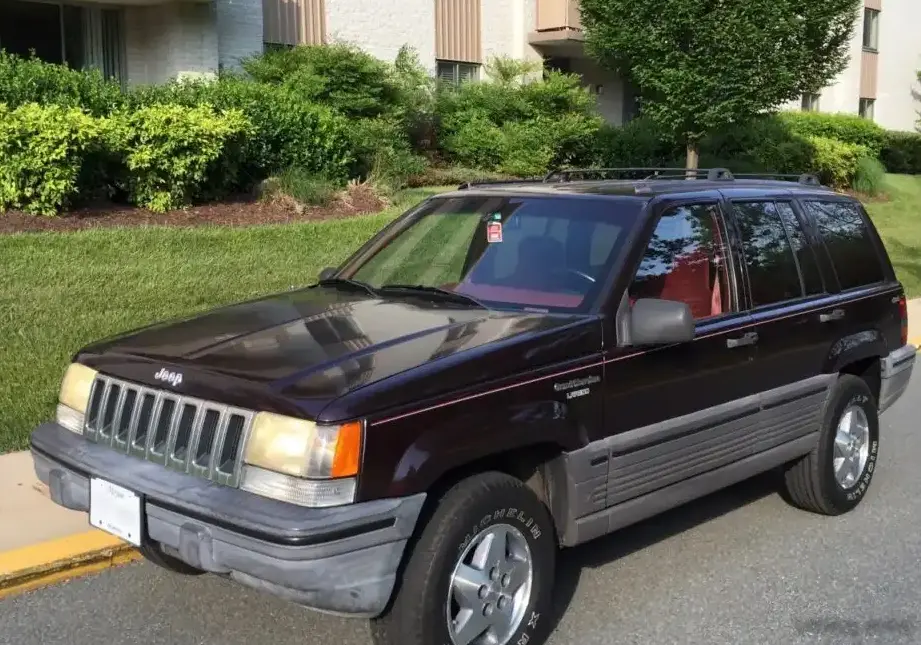
The Jeep Grand Cherokee ZJ, manufactured between 1993 and 1998, marked a significant evolution for the Jeep brand, propelling it into the increasingly popular luxury SUV market. The 5.2i V8 4×4 Automatic variant, primarily produced during the 1996 and 1997 model years, represented the top-tier engine option for buyers prioritizing robust performance and towing capability. It was positioned above the inline-six and 4.0L V6 models, offering a substantial power increase, yet remained below the later, more potent 5.9L V8. This model catered to customers desiring a capable, full-size SUV with a proven V8 engine and the convenience of an automatic transmission.
Technical Specifications
| Brand | Jeep |
| Model | Grand Cherokee |
| Generation | Grand Cherokee I (ZJ) |
| Type (Engine) | 5.2i V8 (212 Hp) 4×4 Automatic |
| Start of production | 1996 |
| End of production | 1997 |
| Powertrain Architecture | Internal Combustion engine |
| Body type | SUV |
| Seats | 5 |
| Doors | 5 |
| Fuel consumption (urban) | 24.1 l/100 km (9.8 US mpg, 11.7 UK mpg, 4.1 km/l) |
| Fuel consumption (extra urban) | 13.1 l/100 km (18 US mpg, 21.6 UK mpg, 7.6 km/l) |
| Fuel consumption (combined) | 17.1 l/100 km (13.8 US mpg, 16.5 UK mpg, 5.8 km/l) |
| Fuel Type | Petrol (Gasoline) |
| Acceleration 0 – 100 km/h | 9.8 sec |
| Acceleration 0 – 62 mph | 9.8 sec |
| Acceleration 0 – 60 mph | 9.3 sec |
| Maximum speed | 200 km/h (124.27 mph) |
| Weight-to-power ratio | 8.7 kg/Hp, 115.2 Hp/tonne |
| Weight-to-torque ratio | 4.7 kg/Nm, 210.9 Nm/tonne |
| Power | 212 Hp @ 4400 rpm |
| Power per litre | 40.7 Hp/l |
| Torque | 388 Nm @ 2950 rpm (286.17 lb.-ft. @ 2950 rpm) |
| Engine layout | Front, Longitudinal |
| Engine displacement | 5210 cm3 (317.93 cu. in.) |
| Number of cylinders | 8 |
| Engine configuration | V-engine |
| Cylinder Bore | 99.31 mm (3.91 in.) |
| Piston Stroke | 84.07 mm (3.31 in.) |
| Compression ratio | 8.92:1 |
| Number of valves per cylinder | 2 |
| Fuel injection system | Multi-port manifold injection |
| Engine aspiration | Naturally aspirated engine |
| Engine oil capacity | 4.7 l (4.97 US qt | 4.14 UK qt) |
| Coolant capacity | 14.1 l (14.9 US qt | 12.41 UK qt) |
| Kerb Weight | 1840 kg (4056.51 lbs.) |
| Max. weight | 2435 kg (5368.26 lbs.) |
| Max load | 595 kg (1311.75 lbs.) |
| Trunk (boot) space – minimum | 1136 l (40.12 cu. ft.) |
| Trunk (boot) space – maximum | 2254 l (79.6 cu. ft.) |
| Fuel tank capacity | 87 l (22.98 US gal | 19.14 UK gal) |
| Permitted trailer load with brakes (12%) | 3500 kg (7716.18 lbs.) |
| Permitted trailer load without brakes | 750 kg (1653.47 lbs.) |
| Length | 4500 mm (177.17 in.) |
| Width | 1800 mm (70.87 in.) |
| Height | 1720 mm (67.72 in.) |
| Wheelbase | 2690 mm (105.91 in.) |
| Front track | 1473 mm (57.99 in.) |
| Rear (Back) track | 1473 mm (57.99 in.) |
| Ride height (ground clearance) | 193 mm (7.6 in.) |
| Drag coefficient (Cd) | 0.44 |
| Minimum turning circle | 11.43 m (37.5 ft.) |
| Approach angle | 36.8° |
| Departure angle | 29.6° |
| Ramp-over (brakeover) angle | 17° |
| Drive wheel | All wheel drive (4×4) |
| Number of gears and type of gearbox | 4 gears, automatic transmission |
| Front brakes | Ventilated discs |
| Rear brakes | Ventilated discs |
| Assisting systems | ABS (Anti-lock braking system) |
| Steering type | Steering rack and pinion |
| Power steering | Hydraulic Steering |
| Tires size | 225/70 R16 |
| Wheel rims size | 16 |
Powertrain & Engine Architecture
The 5.2i Grand Cherokee’s powertrain centers around the LA-series 5.2-liter (318 cubic inch) V8 engine. This engine, a direct descendant of the Chrysler small-block V8 lineage, employs a traditional pushrod design with two valves per cylinder. It features a robust cast iron block and aluminum cylinder heads. Fuel delivery is managed by a multi-port fuel injection system, striking a balance between performance and efficiency for its era. The engine’s 8.92:1 compression ratio contributed to its respectable power output. The 42RE automatic transmission, a durable four-speed unit, was the standard transmission pairing. While lacking the sophistication of more modern automatic gearboxes, the 42RE was known for its reliability and relatively smooth shifting. The transmission featured electronic control, offering adaptive shifting based on driving conditions.
Driving Characteristics
The combination of the 5.2L V8 and the 42RE automatic transmission delivered a noticeable performance improvement over the six-cylinder Grand Cherokee models. Acceleration from 0-60 mph was achieved in approximately 9.3 seconds, making it reasonably quick for a full-size SUV of the period. The automatic transmission, while not providing the driver engagement of a manual gearbox, offered convenient operation, particularly in urban settings. The 5.2L engine’s torque curve was relatively flat, providing ample pulling power for towing and off-road excursions. However, fuel economy was considerably lower than the smaller-engined variants, averaging around 13.8 US mpg in combined driving. The 4×4 system, typically a part-time system with selectable 4-High and 4-Low ranges, provided excellent traction in challenging terrain.
Equipment & Trim Levels
The 5.2i V8 Grand Cherokee generally included a higher level of standard equipment compared to the base models. This typically encompassed features such as air conditioning, power windows and locks, cruise control, and an upgraded sound system. Leather upholstery was often standard or available as an option. Higher trim levels, like the Limited, added features like heated seats, a premium sound system, and alloy wheels. Optional extras included a sunroof, upgraded interior trim packages, and a heavy-duty towing package.
Chassis & Braking
The ZJ Grand Cherokee utilized a body-on-frame construction, providing a robust and durable platform. The suspension system consisted of a traditional setup with coil springs and shock absorbers. The front suspension featured an independent double-wishbone design, while the rear suspension employed a solid axle with coil springs. Braking was handled by ventilated disc brakes on all four wheels, providing adequate stopping power for the vehicle’s weight. An Anti-lock Braking System (ABS) was standard, enhancing safety and control during emergency braking maneuvers.
Market Reception & Comparison
The 5.2i V8 Grand Cherokee was generally well-received by both automotive critics and consumers. It was praised for its powerful engine, comfortable ride quality, and capable 4×4 system. However, its fuel economy was a frequent point of criticism. Compared to the 4.0L inline-six, the 5.2L V8 offered significantly more power but at the expense of increased fuel consumption. The later-introduced 5.9L V8 provided even greater power but came with a higher price tag. The 5.2L model struck a balance between performance and affordability, making it a popular choice for buyers needing a capable and comfortable SUV.
Legacy
The 5.2L V8 engine in the ZJ Grand Cherokee is renowned for its durability and relative simplicity. While not the most fuel-efficient engine available, it has proven remarkably reliable over the long term. Today, well-maintained examples of the 5.2i Grand Cherokee are sought after by enthusiasts and collectors. The engine’s robust construction and readily available parts contribute to its ease of maintenance and repair. The ZJ Grand Cherokee, as a whole, is considered a classic SUV, representing a pivotal moment in Jeep’s history and the evolution of the luxury SUV segment.
