Technical Specifications
| Brand | Jeep |
| Model | Grand Cherokee |
| Generation | Grand Cherokee II (WJ) |
| Type (Engine) | 4.7 V8 (223 Hp) 4×4 Automatic |
| Start of production | 2001 year |
| End of production | 2003 year |
| Powertrain Architecture | Internal Combustion engine |
| Body type | SUV |
| Seats | 5 |
| Doors | 5 |
| Fuel consumption (economy) – urban (NEDC) | 21.5 l/100 km (10.9 US mpg, 13.1 UK mpg, 4.7 km/l) |
| Fuel consumption (economy) – extra urban (NEDC) | 12.5 l/100 km (18.8 US mpg, 22.6 UK mpg, 8 km/l) |
| Fuel consumption (economy) – combined (NEDC) | 15.8 l/100 km (14.9 US mpg, 17.9 UK mpg, 6.3 km/l) |
| CO2 emissions (NEDC) | 378 g/km |
| Fuel Type | Petrol (Gasoline) |
| Acceleration 0 – 100 km/h | 9 sec |
| Acceleration 0 – 62 mph | 9 sec |
| Acceleration 0 – 60 mph | 8.6 sec |
| Maximum speed | 200 km/h (124.27 mph) |
| Emission standard | Euro 3 |
| Weight-to-power ratio | 8.4 kg/Hp, 119.5 Hp/tonne |
| Weight-to-torque ratio | 4.7 kg/Nm, 211.1 Nm/tonne |
| Power | 223 Hp @ 4600 rpm |
| Power per litre | 47.4 Hp/l |
| Torque | 394 Nm @ 3200 rpm (290.6 lb.-ft. @ 3200 rpm) |
| Engine layout | Front, Longitudinal |
| Engine Model/Code | EVA |
| Engine displacement | 4701 cm3 (286.87 cu. in.) |
| Number of cylinders | 8 |
| Engine configuration | V-engine |
| Cylinder Bore | 93 mm (3.66 in.) |
| Piston Stroke | 86.5 mm (3.41 in.) |
| Compression ratio | 9:1 |
| Number of valves per cylinder | 2 |
| Fuel injection system | Multi-port manifold injection |
| Engine aspiration | Naturally aspirated engine |
| Valvetrain | SOHC |
| Engine oil capacity | 5.7 l (6.02 US qt | 5.02 UK qt) |
| Coolant | 13.7 l (14.48 US qt | 12.05 UK qt) |
| Kerb Weight | 1866 kg (4113.83 lbs.) |
| Max. weight | 2495 kg (5500.53 lbs.) |
| Max load | 629 kg (1386.71 lbs.) |
| Trunk (boot) space – minimum | 1110 l (39.2 cu. ft.) |
| Trunk (boot) space – maximum | 2059 l (72.71 cu. ft.) |
| Fuel tank capacity | 78 l (20.61 US gal | 17.16 UK gal) |
| Max. roof load | 68 kg (149.91 lbs.) |
| Permitted trailer load with brakes (12%) | 2948 kg (6499.23 lbs.) |
| Permitted trailer load without brakes | 750 kg (1653.47 lbs.) |
| Permitted towbar download | 140 kg (308.65 lbs.) |
| Length | 4613 mm (181.61 in.) |
| Width | 1836 mm (72.28 in.) |
| Height | 1762 mm (69.37 in.) |
| Wheelbase | 2690 mm (105.91 in.) |
| Front track | 1511 mm (59.49 in.) |
| Rear (Back) track | 1511 mm (59.49 in.) |
| Ride height (ground clearance) | 220 mm (8.66 in.) |
| Drag coefficient (Cd) | 0.45 |
| Minimum turning circle (turning diameter) | 11.1 m (36.42 ft.) |
| Approach angle | 36.7° |
| Departure angle | 28.6° |
| Ramp-over (brakeover) angle | 22.6° |
| Drivetrain Architecture | The Internal combustion engine (ICE) drives the rear wheels permanently, and the front wheels are driven through an electrically or mechanically operated clutch if necessary. |
| Drive wheel | All wheel drive (4×4) |
| Number of gears and type of gearbox | 5 gears, automatic transmission |
| Front suspension | Coil spring, Rigid axle suspension, Transverse stabilizer |
| Rear suspension | Rigid axle suspension, Transverse stabilizer, Trailing arm, Coil spring |
| Front brakes | Ventilated discs, 305 mm |
| Rear brakes | Disc, 305 mm |
| Assisting systems | ABS (Anti-lock braking system) |
| Steering type | Cone worm with recirculation balls |
| Power steering | Hydraulic Steering |
| Tires size | 245/70 R16 |
| Wheel rims size | 7J x 16 |
Introduction
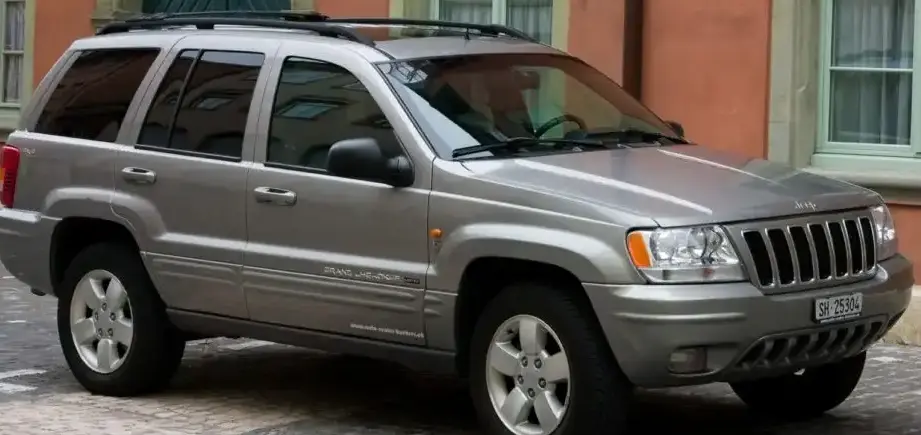
The Jeep Grand Cherokee II (WJ), produced from 1999 to 2004, marked a substantial advancement for the iconic American SUV. The 4.7 V8 4×4 Automatic variant, manufactured between 2001 and 2003, held a significant position within the lineup, offering a compelling blend of power, four-wheel-drive capability, and a degree of luxury. This model year represented a refinement of the WJ platform (WH platform), building upon the substantial redesign from the previous ZJ generation. The focus was on enhancing refinement, improving safety features, and increasing interior space. The WJ aimed to appeal to a broader audience, solidifying the Grand Cherokee’s reputation as both a capable off-roader and a comfortable family vehicle in the American market.
Powertrain & Engine Architecture
The cornerstone of this Grand Cherokee variant is the 4.7-liter V8 engine, designated with the engine code EVA. This engine belongs to Chrysler/Jeep’s OHV (Overhead Valve) engine family. It features a durable cast iron block paired with aluminum cylinder heads, a combination chosen for its balance of strength and cost-effectiveness. Fuel delivery is managed by a multi-point fuel injection system, injecting fuel directly into each intake port for optimized combustion. The valvetrain utilizes a simple yet reliable single overhead camshaft (SOHC) design, operating two valves per cylinder. The 4.7L V8 generates 223 horsepower at 4600 rpm and 290 lb-ft of torque at 3200 rpm. This engine is coupled with a robust 5-speed automatic transmission (typically the 42RE or 45RFE, depending on the specific production date). The transmission is electronically controlled, providing smooth gear changes and adaptive learning to suit driving conditions.
Driving Characteristics
The combination of the 4.7L V8 and the automatic transmission delivers a comfortable and capable driving experience. While not offering the outright acceleration of higher-performance Grand Cherokee trims, it provides sufficient power for everyday driving and towing needs. Acceleration from 0 to 60 mph is achieved in approximately 8.6 seconds. The automatic transmission, while lacking manual shift control, offers smooth and predictable gear changes. The gear ratios are optimized for torque delivery, making it well-suited for navigating off-road terrain and handling heavier loads. Compared to the base 4.0L inline-six engine, the 4.7 V8 provides a noticeable increase in power and torque, though at the expense of fuel economy. In contrast to the higher-output trims equipped with the 4.7 HO engine, this variant prioritizes usability and fuel efficiency, appealing to buyers who valued practicality over sheer speed.
Equipment & Trim Levels
The 4.7 V8 Automatic Grand Cherokee typically came equipped with a standard set of features including air conditioning, power windows and locks, cruise control, and an AM/FM stereo system. Stepping up to higher trim levels, such as the Limited, added features like leather upholstery, heated front seats, a premium sound system, and alloy wheels. A range of optional extras were available, including a sunroof, a navigation system, and upgraded suspension packages designed to further enhance ride comfort or off-road capability. The interior generally featured a dark color scheme accented with woodgrain trim, aiming to create a more upscale and refined atmosphere.
Chassis & Braking
The WJ Grand Cherokee utilizes a traditional body-on-frame construction, providing a robust and durable platform. The front suspension consists of a coil spring and rigid axle setup, incorporating a transverse stabilizer bar to reduce body roll. The rear suspension also employs a rigid axle with coil springs and a transverse stabilizer bar, but utilizes a trailing arm design for improved ride quality. Braking is handled by ventilated discs on the front wheels and solid discs on the rear. An Anti-lock Braking System (ABS) is standard equipment, enhancing safety and control during emergency braking situations. The 4×4 system offers a selection of modes – 2WD, 4-Hi, and 4-Lo – allowing drivers to adapt to a variety of terrain conditions and driving needs.
Market Reception & Comparison
The 4.7 V8 Automatic Grand Cherokee was generally well-received by automotive critics and consumers alike. It was praised for its comfortable ride, spacious interior, and capable four-wheel-drive system. However, fuel economy was a frequent point of criticism, as the 4.7L V8 engine was not particularly fuel-efficient. Compared to the 4.0L inline-six engine, the V8 offered a significant performance upgrade, but came at a higher price point and with reduced fuel economy. When compared to the higher-performance trims equipped with the 4.7 HO engine, this variant offered a more balanced combination of power and efficiency, appealing to buyers who prioritized practicality and everyday usability over outright performance.
Legacy
The 4.7 V8 engine, despite some known issues, proved to be a relatively reliable powertrain. Common concerns included oil leaks and occasional failures of various sensors, but overall, the engine demonstrated good durability. Today, the 2001-2003 Grand Cherokee 4.7 V8 Automatic remains a popular choice in the used car market, particularly among buyers seeking a capable and affordable SUV. Its robust construction and the readily available supply of replacement parts make it a relatively easy vehicle to maintain. However, prospective buyers should be aware of the potential for rust, particularly in areas with harsh winters, and the relatively poor fuel economy compared to more modern SUVs.