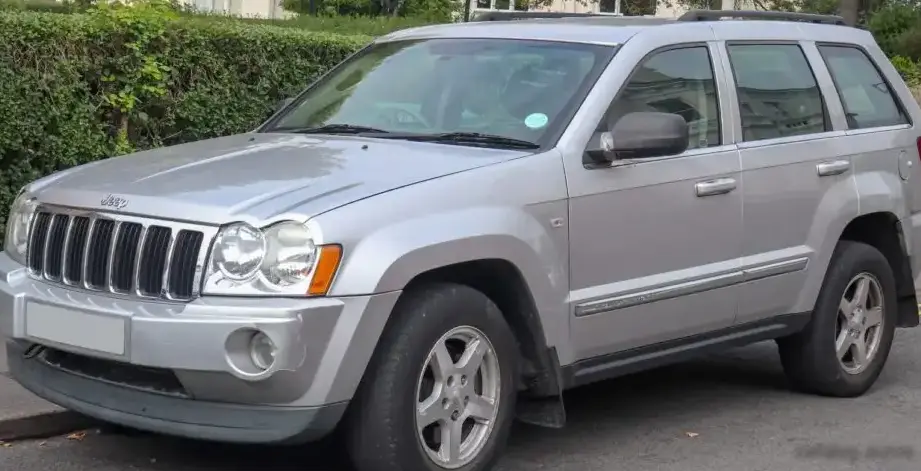
The Jeep Grand Cherokee WK, produced from 2006 to 2008, represented a significant evolution for the iconic American SUV. The 5.7i V8 4×4 Automatic variant, equipped with the EZB engine, was positioned as the premium offering within the WK range, catering to buyers seeking substantial power and capability. This generation marked a move towards a more refined and luxurious Grand Cherokee, while retaining its renowned off-road prowess. The WK series was the third generation of the Grand Cherokee, following the WJ and preceding the WK2.
Technical Specifications
| Brand | Jeep |
| Model | Grand Cherokee |
| Generation | Grand Cherokee III (WK) |
| Type (Engine) | 5.7i V8 (335 Hp) 4×4 Automatic |
| Start of production | 2006 |
| End of production | 2008 |
| Powertrain Architecture | Internal Combustion engine |
| Body type | SUV |
| Seats | 5 |
| Doors | 5 |
| Fuel consumption (urban) | 16.8 l/100 km (14 US mpg, 16.8 UK mpg, 6 km/l) |
| Fuel consumption (extra urban) | 12.4 l/100 km (19 US mpg, 22.8 UK mpg, 8.1 km/l) |
| Fuel consumption (combined) | 14.7 l/100 km (16 US mpg, 19.2 UK mpg, 6.8 km/l) |
| Fuel Type | Petrol (Gasoline) |
| Weight-to-power ratio | 6.4 kg/Hp, 156 Hp/tonne |
| Weight-to-torque ratio | 4.2 kg/Nm, 237.1 Nm/tonne |
| Power | 335 Hp @ 5000 rpm |
| Power per litre | 59.3 Hp/l |
| Torque | 509 Nm @ 4000 rpm (375.42 lb.-ft. @ 4000 rpm) |
| Engine layout | Front, Longitudinal |
| Engine Model/Code | EZB |
| Engine displacement | 5654 cm3 (345.03 cu. in.) |
| Number of cylinders | 8 |
| Engine configuration | V-engine |
| Cylinder Bore | 99.5 mm (3.92 in.) |
| Piston Stroke | 90.9 mm (3.58 in.) |
| Compression ratio | 9.6:1 |
| Number of valves per cylinder | 2 |
| Fuel injection system | Multi-port manifold injection |
| Engine aspiration | Naturally aspirated engine |
| Valvetrain | OHV |
| Engine oil capacity | 6.6 l (6.97 US qt | 5.81 UK qt) |
| Coolant capacity | 14.4 l (15.22 US qt | 12.67 UK qt) |
| Kerb Weight | 2147 kg (4733.32 lbs.) |
| Max. weight | 2790 kg (6150.9 lbs.) |
| Max load | 643 kg (1417.57 lbs.) |
| Fuel tank capacity | 78 l (20.61 US gal | 17.16 UK gal) |
| Length | 4740 mm (186.61 in.) |
| Width | 1862 mm (73.31 in.) |
| Height | 1720 mm (67.72 in.) |
| Wheelbase | 2781 mm (109.49 in.) |
| Front track | 1575 mm (62.01 in.) |
| Rear track | 1575 mm (62.01 in.) |
| Ride height (ground clearance) | 204 mm (8.03 in.) |
| Drag coefficient (Cd) | 0.41 |
| Minimum turning circle | 11.3 m (37.07 ft.) |
| Approach angle | 34.1° |
| Departure angle | 27.1° |
| Ramp-over angle | 20.6° |
| Drive wheel | All wheel drive (4×4) |
| Number of gears | 5 |
| Gearbox type | Automatic transmission |
| Front brakes | Ventilated discs |
| Rear brakes | Ventilated discs |
| Assisting systems | ABS (Anti-lock braking system) |
| Steering type | Steering rack and pinion |
| Tires size | 235/65 R17 |
| Wheel rims size | 17 |
Powertrain & Engine Architecture
The heart of the 5.7i Grand Cherokee is the EZB V8 engine, a 5.7-liter (345 cubic inch) naturally aspirated powerplant. This engine utilizes a cast iron block with aluminum cylinder heads, and features a pushrod valvetrain (OHV). The EZB engine benefits from Chrysler’s Multi-Displacement System (MDS), which allows it to deactivate four cylinders under light load conditions to improve fuel economy. Fuel delivery is managed by a multi-port fuel injection system. The engine produces 335 horsepower at 5000 rpm and 375 lb-ft of torque at 4000 rpm. This output provides substantial acceleration and towing capacity. The engine is mated to a five-speed automatic transmission, specifically the 545RFE, known for its durability and smooth shifting. This transmission is electronically controlled and features a tow/haul mode for optimized performance when towing trailers or navigating challenging terrain.
Driving Characteristics
The 5.7L V8 and five-speed automatic combination delivers a noticeably different driving experience compared to the lower-displacement engines offered in the WK Grand Cherokee. Acceleration is brisk, and the engine provides ample power for merging onto highways and overtaking other vehicles. The automatic transmission is well-tuned, offering smooth gear changes and responsive downshifts. While not as fuel-efficient as the V6 options, the V8 provides a more confident and capable driving experience, particularly when fully loaded or towing. The gear ratios are optimized for both on-road comfort and off-road capability, providing a balance between responsiveness and low-end torque. Compared to a manual transmission equipped Grand Cherokee (though rare), the automatic prioritizes ease of use and convenience over outright driver engagement.
Equipment & Trim Levels
The 5.7i V8 trim typically came standard with a high level of equipment. This included leather upholstery, heated front seats, a premium sound system, automatic climate control, and power-adjustable pedals. Optional extras included a navigation system, rear-seat entertainment system, sunroof, and upgraded wheels. The Limited trim level, often paired with the 5.7L engine, added further refinements such as wood trim and additional chrome accents. The overall interior design focused on providing a comfortable and luxurious experience, with a focus on quality materials and user-friendly controls.
Chassis & Braking
The WK Grand Cherokee features an independent front suspension with coil springs and a multi-link rear suspension. The 5.7i models generally received a slightly stiffer suspension tuning to handle the increased weight and power of the V8 engine. Braking duties are handled by ventilated disc brakes on all four wheels, providing ample stopping power. An Anti-lock Braking System (ABS) is standard. The 5.7i models often featured larger brake rotors and calipers compared to the V6 versions. The chassis is built on a robust frame-on-body construction, providing a solid foundation for both on-road comfort and off-road durability.
Market Reception & Comparison
The 5.7i V8 Grand Cherokee was generally well-received by automotive critics, who praised its powerful engine, comfortable ride, and luxurious interior. However, its fuel economy was a common criticism. Compared to the 3.7L V6 and 4.7L V8 models, the 5.7i offered significantly more power and torque, but at the expense of fuel efficiency. The 5.7i was positioned as the top-of-the-line Grand Cherokee, appealing to buyers who prioritized performance and luxury over fuel economy. Reliability was generally good, although the MDS system could occasionally experience issues. Owners often reported that the MDS system, while intended to save fuel, sometimes felt intrusive or caused minor vibrations.
Legacy
The EZB 5.7L V8 engine proved to be a durable and reliable powerplant, and many examples are still on the road today. The WK Grand Cherokee, particularly the 5.7i variant, has developed a strong following among enthusiasts who appreciate its combination of power, luxury, and off-road capability. In the used car market, the 5.7i models typically command a higher price than the V6 versions, reflecting their desirable performance and features. While fuel economy remains a concern, the 5.7i Grand Cherokee continues to be a popular choice for those seeking a capable and comfortable SUV. Regular maintenance, including oil changes and monitoring the MDS system, is key to ensuring the longevity of these vehicles.