Technical Specifications
| Brand | Jeep |
| Model | Grand Cherokee |
| Generation | Grand Cherokee IV (WK2, facelift 2013) |
| Type (Engine) | 3.6 V6 (299 Hp) Automatic |
| Start of production | 2016 |
| End of production | 2017 |
| Powertrain Architecture | Internal Combustion engine |
| Body type | SUV |
| Seats | 5 |
| Doors | 5 |
| Fuel consumption (urban) | 12.4 l/100 km (19 US mpg, 22.8 UK mpg, 8.1 km/l) |
| Fuel consumption (extra urban) | 9 l/100 km (26.1 US mpg, 31.4 UK mpg, 11.1 km/l) |
| Fuel consumption (combined) | 10.7 l/100 km (22 US mpg, 26.4 UK mpg, 9.3 km/l) |
| Fuel Type | Petrol (Gasoline) |
| Weight-to-power ratio | 6.9 kg/Hp, 145 Hp/tonne |
| Weight-to-torque ratio | 5.8 kg/Nm, 171.2 Nm/tonne |
| Power | 299 Hp @ 6400 rpm |
| Power per litre | 83 Hp/l |
| Torque | 353 Nm @ 4800 rpm (260.36 lb.-ft. @ 4800 rpm) |
| Engine layout | Front, Longitudinal |
| Engine Model/Code | ERB |
| Engine displacement | 3604 cm3 (219.93 cu. in.) |
| Number of cylinders | 6 |
| Engine configuration | V-engine |
| Cylinder Bore | 96 mm (3.78 in.) |
| Piston Stroke | 83 mm (3.27 in.) |
| Compression ratio | 10.2:1 |
| Number of valves per cylinder | 4 |
| Fuel injection system | Multi-port manifold injection |
| Engine aspiration | Naturally aspirated engine |
| Valvetrain | DOHC |
| Engine oil capacity | 5.7 l (6.02 US qt | 5.02 UK qt) |
| Coolant | 9.9 l (10.46 US qt | 8.71 UK qt) |
| Kerb Weight | 2062 kg (4545.93 lbs.) |
| Max. weight | 2948 kg (6499.23 lbs.) |
| Max load | 886 kg (1953.3 lbs.) |
| Fuel tank capacity | 93 l (24.57 US gal | 20.46 UK gal) |
| Permitted trailer load with brakes (12%) | 2812 kg (6199.4 lbs.) |
| Length | 4822 mm (189.84 in.) |
| Width | 1943 mm (76.5 in.) |
| Height | 1761 mm (69.33 in.) |
| Wheelbase | 2915 mm (114.76 in.) |
| Front track | 1623 mm (63.9 in.) |
| Rear (Back) track | 1627 mm (64.06 in.) |
| Ride height (ground clearance) | 218 mm (8.58 in.) |
| Drag coefficient (Cd) | 0.37 |
| Minimum turning circle (turning diameter) | 11.3 m (37.07 ft.) |
| Approach angle | 26.3° |
| Departure angle | 26.5° |
| Ramp-over (brakeover) angle | 18.8° |
| Drivetrain Architecture | The Internal combustion engine (ICE) drives the rear wheels of the vehicle. |
| Drive wheel | Rear wheel drive |
| Number of gears and type of gearbox | 8 gears, automatic transmission |
| Front brakes | Ventilated discs |
| Rear brakes | Disc |
| Assisting systems | ABS (Anti-lock braking system) |
| Steering type | Steering rack and pinion |
| Power steering | Electric Steering |
| Tires size | 245/70 R17 |
| Wheel rims size | 17 |
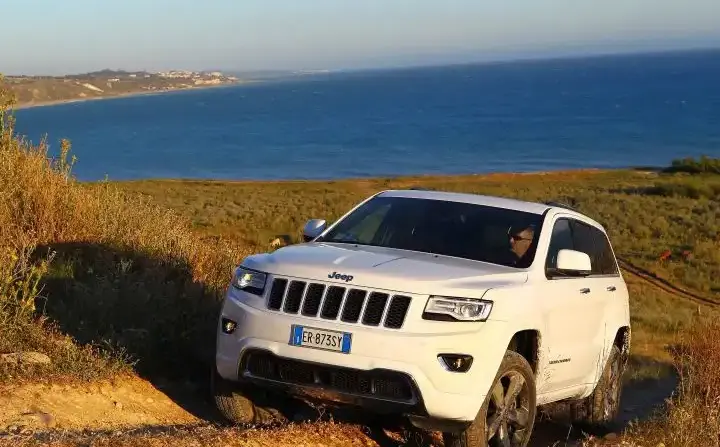
The Jeep Grand Cherokee IV (WK2), specifically the facelifted version produced from 2016 to 2017, offered a 3.6-liter V6 engine producing 299 horsepower paired with an eight-speed automatic transmission. This configuration was a core offering within the WK2 lineup, positioned as a balance between affordability, capability, and refinement. The WK2 generation, launched for the 2011 model year, significantly elevated the Grand Cherokee’s status, moving it firmly into the premium SUV segment. The 2016-2017 facelift brought styling updates, improved interior materials, and enhanced technology, further solidifying its competitive position against rivals like the Ford Explorer, Chevrolet Traverse, and Toyota 4Runner.
Powertrain & Engine Architecture
The heart of this Grand Cherokee variant is the 3.6-liter Pentastar V6 engine, designated as the ERB code. This engine is a naturally aspirated, 60-degree V6 featuring a dual overhead camshaft (DOHC) valvetrain with four valves per cylinder. The Pentastar engine utilizes a multi-port fuel injection system, delivering fuel directly into the intake ports. This design, while not as advanced as direct injection, proved reliable and offered good performance for its time. The 10.2:1 compression ratio contributes to the engine’s efficiency and power output. The eight-speed automatic transmission, sourced from ZF, is a crucial component of this powertrain. Its wide gear ratio spread allows for both strong acceleration and efficient highway cruising. The transmission features a torque converter lock-up clutch to minimize slippage and improve fuel economy.
Driving Characteristics
The 299-horsepower, 3.6-liter V6 with the eight-speed automatic provided a comfortable and capable driving experience. While not as quick as the available 5.7-liter Hemi V8 or the diesel options, it offered sufficient power for everyday driving and towing. The eight-speed transmission helped to keep the engine in its optimal power band, providing smooth and responsive shifts. The rear-wheel-drive configuration contributed to a more engaging driving feel compared to the four-wheel-drive models, although it sacrificed some all-weather capability. The gear ratios were tuned for a balance of acceleration and fuel efficiency, with a relatively tall final drive ratio prioritizing highway economy. Compared to the manual transmission options (available on other Grand Cherokee trims), the automatic offered greater convenience, especially in urban environments.
Equipment & Trim Levels
The 3.6L V6 Automatic Grand Cherokee typically came standard with features like air conditioning, power windows and locks, a touchscreen infotainment system, and a rearview camera. Higher trim levels, such as the Limited and Overland, added features like leather upholstery, heated seats, a premium sound system, and advanced safety technologies like blind-spot monitoring and adaptive cruise control. Optional extras included a panoramic sunroof, navigation system, and a rear-seat entertainment system. Interior upholstery generally consisted of cloth on the base trims, with leather becoming standard on higher-level models. Dashboard configurations were consistent across the range, with a focus on user-friendly controls and a modern aesthetic.
Chassis & Braking
The WK2 Grand Cherokee utilized an independent front suspension with coil springs and stabilizer bar, and a multi-link rear suspension, also with coil springs and a stabilizer bar. The rear brakes on the base models were typically drums, while higher trims received disc brakes all around. The braking system featured ABS (Anti-lock Braking System) as standard. The suspension tuning was geared towards providing a comfortable ride, with a focus on absorbing bumps and minimizing body roll. The stabilizer bars helped to reduce body lean during cornering. The 17-inch wheels and 245/70 R17 tires provided a good balance of ride comfort and handling.
Market Reception & Comparison
Critics generally praised the 3.6-liter V6 Grand Cherokee for its smooth engine, comfortable ride, and well-appointed interior. However, some reviewers noted that the V6 felt underpowered when fully loaded or towing. Fuel economy was considered average for its class, with the combined fuel consumption of 10.7 l/100 km (22 US mpg) being comparable to other mid-size SUVs. Compared to the V8 models, the V6 offered better fuel economy but less performance. The V6 was also more affordable than the V8, making it an attractive option for budget-conscious buyers. Reliability was generally good, with the Pentastar V6 engine proving to be a durable and dependable powerplant.
Legacy
The 3.6-liter Pentastar V6 engine has become a mainstay in the Chrysler/Jeep lineup, known for its reliability and relatively low maintenance costs. The eight-speed automatic transmission has also proven to be a robust and dependable unit. In the used car market, the 2016-2017 Grand Cherokee 3.6L V6 Automatic represents a good value proposition, offering a comfortable and capable SUV at a reasonable price. Regular maintenance, including oil changes and transmission fluid flushes, is crucial for ensuring the long-term reliability of this powertrain. While some minor issues, such as water pump failures, have been reported, these are generally not widespread and can be addressed with preventative maintenance.