Technical Specifications
| Brand | Jeep |
| Model | Grand Cherokee |
| Generation | Grand Cherokee IV (WK2, facelift 2017) |
| Type (Engine) | Trackhawk 6.2 V8 (707 Hp) 4×4 Automatic |
| Start of production | 2017 |
| End of production | 2021 |
| Powertrain Architecture | Internal Combustion engine |
| Body type | SUV |
| Seats | 5 |
| Doors | 5 |
| Fuel consumption (economy) – urban (EPA) | 21.4 l/100 km (11 US mpg, 13.2 UK mpg, 4.7 km/l) |
| Fuel consumption (economy) – extra urban (EPA) | 13.8 l/100 km (17 US mpg, 20.5 UK mpg, 7.2 km/l) |
| Fuel consumption (economy) – combined (EPA) | 18.1 l/100 km (13 US mpg, 15.6 UK mpg, 5.5 km/l) |
| Fuel Type | Petrol (Gasoline) |
| Acceleration 0 – 60 mph | 3.5 sec |
| Maximum speed | 290 km/h (180.2 mph) |
| Weight-to-power ratio | 3.4 kg/Hp, 291.1 Hp/tonne |
| Weight-to-torque ratio | 2.8 kg/Nm, 360.2 Nm/tonne |
| Power | 707 Hp @ 6000 rpm |
| Power per litre | 114.7 Hp/l |
| Torque | 875 Nm @ 4800 rpm (645.37 lb.-ft. @ 4800 rpm) |
| Maximum engine speed | 6200 rpm |
| Engine layout | Front, Longitudinal |
| Engine Model/Code | HEMI / ESD |
| Engine displacement | 6166 cm3 (376.27 cu. in.) |
| Number of cylinders | 8 |
| Engine configuration | V-engine |
| Cylinder Bore | 103.9 mm (4.09 in.) |
| Piston Stroke | 90.9 mm (3.58 in.) |
| Compression ratio | 9.5:1 |
| Number of valves per cylinder | 2 |
| Fuel injection system | Multi-port manifold injection |
| Engine aspiration | Supercharger, Intercooler |
| Valvetrain | OHV |
| Engine oil capacity | 7.8 l (8.24 US qt | 6.86 UK qt) |
| Coolant | 13.9 l (14.69 US qt | 12.23 UK qt) |
| Kerb Weight | 2429 kg (5355.03 lbs.) |
| Max. weight | 2994 kg (6600.64 lbs.) |
| Max load | 565 kg (1245.61 lbs.) |
| Trunk (boot) space – minimum | 1028 l (36.3 cu. ft.) |
| Trunk (boot) space – maximum | 1934 l (68.3 cu. ft.) |
| Fuel tank capacity | 93.1 l (24.59 US gal | 20.48 UK gal) |
| Permitted trailer load with brakes (12%) | 3266 kg (7200.3 lbs.) |
| Length | 4822 mm (189.84 in.) |
| Width | 1943 mm (76.5 in.) |
| Width including mirrors | 2154 mm (84.8 in.) |
| Height | 1724 mm (67.87 in.) |
| Wheelbase | 2914 mm (114.72 in.) |
| Front track | 1636 mm (64.41 in.) |
| Rear (Back) track | 1645 mm (64.76 in.) |
| Ride height (ground clearance) | 206 mm (8.11 in.) |
| Drag coefficient (Cd) | 0.37 |
| Minimum turning circle (turning diameter) | 11.6 m (38.06 ft.) |
| Approach angle | 18° |
| Departure angle | 23.1° |
| Ramp-over (brakeover) angle | 18.4° |
| Drivetrain Architecture | The Internal combustion engine (ICE) drives permanently the four wheels of the vehicle. |
| Drive wheel | All wheel drive (4×4) |
| Number of gears and type of gearbox | 8 gears, automatic transmission |
| Front suspension | Coil spring, Double wishbone, Transverse stabilizer |
| Rear suspension | Independent multi-link spring suspension with stabilizer |
| Front brakes | Ventilated discs, 400×36 mm |
| Rear brakes | Ventilated discs, 350×28 mm |
| Assisting systems | ABS (Anti-lock braking system) |
| Steering type | Steering rack and pinion |
| Power steering | Electric Steering |
| Tires size | 295/45 R20 |
| Wheel rims size | 10J x 20 |
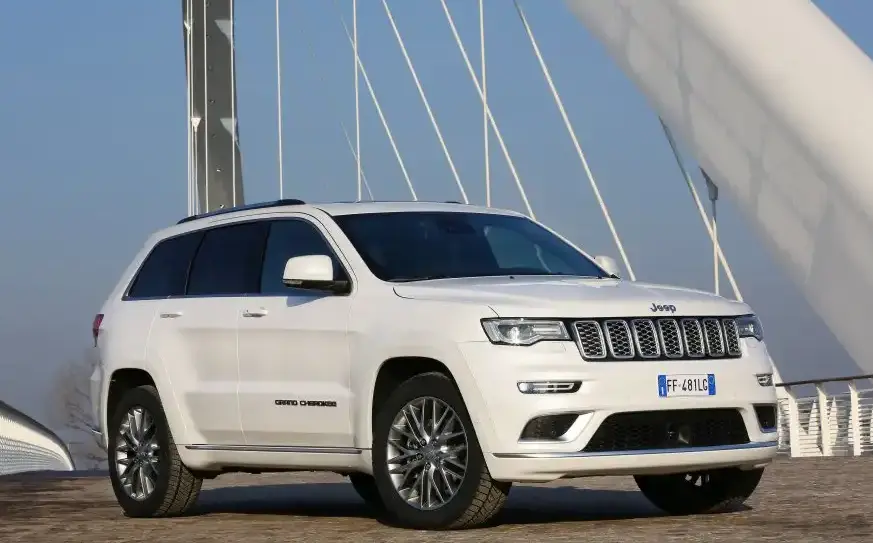
The Jeep Grand Cherokee Trackhawk, introduced for the 2017 model year as part of the WK2 facelift, represents the high-performance pinnacle of the fourth-generation Grand Cherokee lineup. Built from 2017 through 2021, the Trackhawk was designed to be the most powerful SUV in its class, boasting a supercharged 6.2-liter HEMI V8 engine producing 707 horsepower. It quickly gained notoriety for its incredible acceleration and off-road capability, blending luxury with extreme performance. The Trackhawk occupied the top-tier position within the Grand Cherokee range, significantly exceeding the capabilities of trims like the Limited, Overland, and Summit.
Powertrain & Engine Architecture
The heart of the Trackhawk is the 6.2-liter supercharged HEMI V8 engine, internally designated as the ESD code. This engine builds upon the foundation of the 5.7L HEMI, but with significant upgrades to handle the increased power output. A 2.4-liter IHI supercharger, featuring four-lobe rotors, forces air into the engine, boosting output dramatically. The engine utilizes a cast iron block, forged steel crankshaft, and strengthened connecting rods to withstand the stresses of 707 horsepower and 645 lb-ft of torque. Fuel delivery is managed by a high-flow fuel pump and multi-port fuel injection. The engine’s valvetrain employs overhead valves (OHV) with two valves per cylinder. The Trackhawk exclusively used an eight-speed TorqueFlite 8HP70 automatic transmission, reinforced to handle the immense power. This transmission features a wider gear ratio spread than other Grand Cherokee transmissions, optimizing both acceleration and fuel efficiency (relatively speaking).
Driving Characteristics
The Trackhawk’s performance is truly remarkable. Its 3.5-second 0-60 mph acceleration time makes it one of the quickest production SUVs ever created. The supercharger provides instant throttle response and a broad torque curve, delivering relentless acceleration across the entire rev range. The eight-speed automatic transmission shifts quickly and smoothly, although some drivers noted a slight hesitation in certain situations. While capable off-road, the Trackhawk’s weight (over 5,300 pounds) and performance-oriented tuning prioritize on-road performance. The suspension is firmer than other Grand Cherokee models, providing excellent body control but sacrificing some ride comfort. The Quadra-Trac Active On-Demand 4×4 system provides excellent traction in various conditions.
Equipment & Trim Levels
The Trackhawk came standard with a comprehensive list of features, including leather upholstery, performance seats with suede inserts, a premium audio system, and a large touchscreen infotainment system. Standard exterior features included unique styling cues like aggressive front and rear fascias, flared wheel arches, and quad exhaust outlets. Optional extras included a dual-pane panoramic sunroof, adaptive cruise control, and blind-spot monitoring. The interior was largely similar to other high-end Grand Cherokee trims, but with unique Trackhawk badging and trim accents.
Chassis & Braking
The Trackhawk’s chassis was significantly upgraded to handle the increased power. It features a reinforced suspension system with stiffer springs, upgraded dampers, and larger stabilizer bars. The braking system was also substantially improved, featuring massive Brembo six-piston front calipers and four-piston rear calipers, clamping down on ventilated discs measuring 400x36mm front and 350x28mm rear. These brakes provided exceptional stopping power, crucial for controlling the Trackhawk’s immense speed. The Trackhawk also featured an electronic limited-slip rear differential for improved traction.
Market Reception & Comparison
The Jeep Grand Cherokee Trackhawk received overwhelmingly positive reviews from automotive critics. It was praised for its incredible performance, surprisingly capable handling, and luxurious interior. However, its fuel economy (13 mpg combined) was a common criticism. Compared to other high-performance SUVs like the Porsche Cayenne Turbo, the Trackhawk offered a more aggressive and muscular driving experience, but lacked the Cayenne’s refinement. Against other Grand Cherokee trims, the Trackhawk was in a different league, offering a level of performance that was simply unattainable with the V6 or even the 5.7L HEMI V8 engines.
Legacy
The Jeep Grand Cherokee Trackhawk remains a highly sought-after vehicle in the used car market. Its combination of performance, luxury, and off-road capability is unique. While the supercharged 6.2L HEMI engine is generally reliable, it requires regular maintenance, including oil changes and spark plug replacements. The transmission is also robust but should be serviced according to the manufacturer’s recommendations. The Trackhawk’s legacy is as a bold and unapologetically powerful SUV that pushed the boundaries of what was possible in the segment, and it continues to be a benchmark for performance SUVs today.