
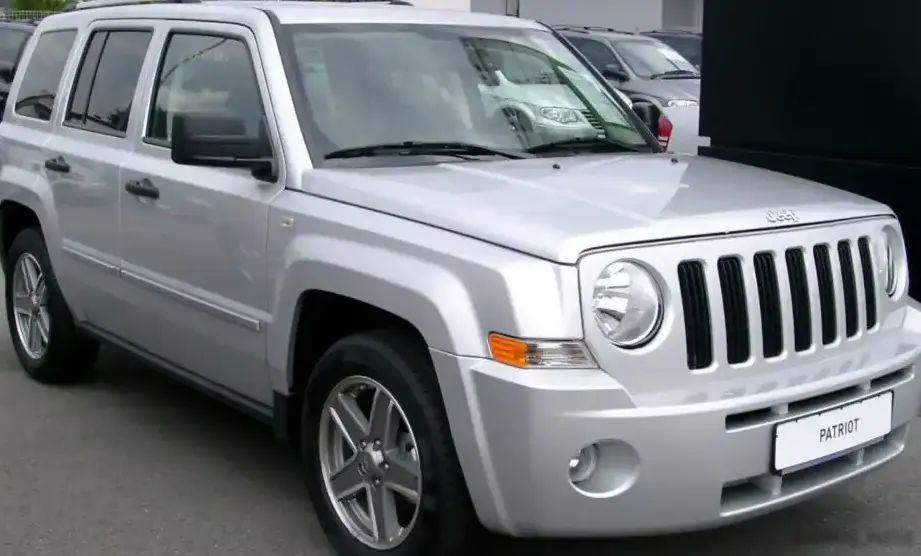
Technical Specifications
| Brand | Jeep |
| Model | Patriot |
| Generation | Patriot |
| Type (Engine) | 2.4 i 16V (174 Hp) |
| Start of production | 2007 year |
| End of production | 2016 year |
| Powertrain Architecture | Internal Combustion engine |
| Body type | SUV |
| Seats | 5 |
| Doors | 5 |
| Fuel consumption (economy) – urban | 9.1 l/100 km (25.8 US mpg, 31 UK mpg, 11 km/l) |
| Fuel consumption (economy) – extra urban | 7.9 l/100 km (29.8 US mpg, 35.8 UK mpg, 12.7 km/l) |
| Fuel Type | Petrol (Gasoline) |
| Power | 174 Hp @ 6000 rpm |
| Power per litre | 73.7 Hp/l |
| Torque | 223 Nm @ 4400 rpm (164.48 lb.-ft. @ 4400 rpm) |
| Engine layout | Front, Transverse |
| Engine Model/Code | ED3 |
| Engine displacement | 2360 cm3 (144.02 cu. in.) |
| Number of cylinders | 4 |
| Engine configuration | Inline |
| Cylinder Bore | 88 mm (3.46 in.) |
| Piston Stroke | 97 mm (3.82 in.) |
| Compression ratio | 10.5:1 |
| Number of valves per cylinder | 4 |
| Fuel injection system | Multi-port manifold injection |
| Engine aspiration | Naturally aspirated engine |
| Valvetrain | DOHC |
| Engine oil capacity | 4.26 l (4.5 US qt | 3.75 UK qt) |
| Coolant | 6.8 l (7.19 US qt | 5.98 UK qt) |
| Trunk (boot) space – minimum | 652 l (23.03 cu. ft.) |
| Trunk (boot) space – maximum | 1777 l (62.75 cu. ft.) |
| Fuel tank capacity | 52 l (13.74 US gal | 11.44 UK gal) |
| Length | 4410 mm (173.62 in.) |
| Width | 1756 mm (69.13 in.) |
| Height | 1637 mm (64.45 in.) |
| Wheelbase | 2635 mm (103.74 in.) |
| Front track | 1520 mm (59.84 in.) |
| Rear (Back) track | 1520 mm (59.84 in.) |
| Drivetrain Architecture | The Internal combustion engine (ICE) drives the front wheels of the vehicle. |
| Drive wheel | Front wheel drive |
| Number of gears and type of gearbox | 5 gears, manual transmission |
| Front suspension | Independent, type McPherson with coil spring and anti-roll bar |
| Rear suspension | Independent multi-link spring suspension with stabilizer |
| Front brakes | Disc |
| Rear brakes | Disc |
| Assisting systems | ABS (Anti-lock braking system) |
| Steering type | Steering rack and pinion |
| Tires size | 215/60R17 |
The Jeep Patriot 2.4i 16V, producing 174 horsepower, was a significant part of the Jeep Patriot lineup from its introduction in 2007 through the end of production in 2016. Positioned as a mainstream offering in the compact SUV segment, the 2.4-liter engine paired with a five-speed manual transmission aimed to deliver a balance of affordability, fuel efficiency, and acceptable performance for daily driving. The Patriot, built on the Chrysler/Dodge/Jeep MK49 platform – shared with the Dodge Caliber and Jeep Compass – represented Jeep’s entry into the growing compact crossover market, offering a more accessible price point than the larger Cherokee. This particular variant proved popular with buyers seeking a practical and capable SUV without the expense of higher trim levels or the more powerful engine options.
Powertrain & Engine Architecture
At the heart of this Patriot variant lies the 2.4-liter inline-four cylinder engine, identified by the engine code ED3. This engine is a naturally aspirated powerplant featuring a dual overhead camshaft (DOHC) valvetrain with four valves per cylinder. Fuel delivery is managed by a multi-port fuel injection system, striking a balance between efficiency and performance. The engine’s 10.5:1 compression ratio contributes to its power output. The standard transmission was a five-speed manual, giving drivers direct control over gear selection. The transmission’s gear ratios were tuned for a blend of acceleration and fuel economy, though it wasn’t designed for particularly sporty driving. The engine’s relatively straightforward design contributed to its overall reliability, although it lacked the sophistication of more modern direct-injection systems.
Driving Characteristics
The 174 horsepower and 164 lb-ft of torque generated by the 2.4-liter engine, combined with the five-speed manual transmission, provided adequate, but not thrilling, performance. Acceleration from 0 to 60 mph typically took around 9-10 seconds. Compared to the base 2.0-liter engine (which offered less power) or the optional continuously variable transmission (CVT), the 2.4-liter manual offered a more engaging driving experience and quicker acceleration. However, it didn’t quite match the responsiveness of the available 2.7-liter V6. The manual transmission allowed for greater control in diverse driving conditions, especially when navigating hills or overtaking. The gear ratios were optimized for fuel efficiency, which sometimes meant the engine felt strained when pushed to its limits.
Equipment & Trim Levels
The 2.4i 16V trim generally came standard with features like air conditioning, power windows and locks, and a basic audio system. Higher trim levels, such as the Limited, added features like alloy wheels, upgraded audio systems, and more premium interior materials. Optional extras included a sunroof, leather upholstery, and a navigation system. The interior typically featured durable, though somewhat basic, plastics. The dashboard layout was functional and straightforward, prioritizing usability over aesthetics. Safety features included standard ABS brakes and front airbags, with side airbags available as an option.
Chassis & Braking
The Jeep Patriot utilized an independent McPherson strut suspension in the front and an independent multi-link suspension in the rear. This setup provided a reasonably comfortable ride, though it wasn’t exceptionally refined. Stabilizer bars were included at both ends to minimize body roll during cornering. The braking system consisted of disc brakes on all four wheels, providing sufficient stopping power for the vehicle’s weight. ABS (Anti-lock Braking System) was standard, enhancing safety during emergency braking. The Patriot’s suspension tuning prioritized comfort and everyday usability over sporty handling.
Market Reception & Comparison
The Jeep Patriot 2.4i 16V was generally well-received as a practical and affordable compact SUV. Critics praised its spacious interior and respectable fuel economy. However, some reviewers noted the engine’s lack of refinement and the somewhat basic interior materials. Compared to competitors like the Honda CR-V and Toyota RAV4, the Patriot offered a lower price point but lacked the same level of polish and driving refinement. The 2.4-liter engine offered a better balance of power and fuel economy than the base 2.0-liter engine, making it a popular choice among buyers. Reliability was generally considered average, with some reports of minor issues with the engine and transmission.
Legacy
The Jeep Patriot, and specifically the 2.4i 16V variant, remains a relatively affordable option in the used car market. The ED3 engine is known for its durability, though consistent maintenance is essential to prevent potential problems. While not a performance leader, the 2.4-liter engine provides adequate power for everyday driving. The availability of a manual transmission is a plus for driving enthusiasts. Overall, the Patriot offered a compelling value proposition for buyers seeking a capable and practical SUV at a reasonable price. Today, well-maintained examples can still provide reliable transportation for years to come, though potential buyers should be aware of the vehicle’s age and potential maintenance requirements.
