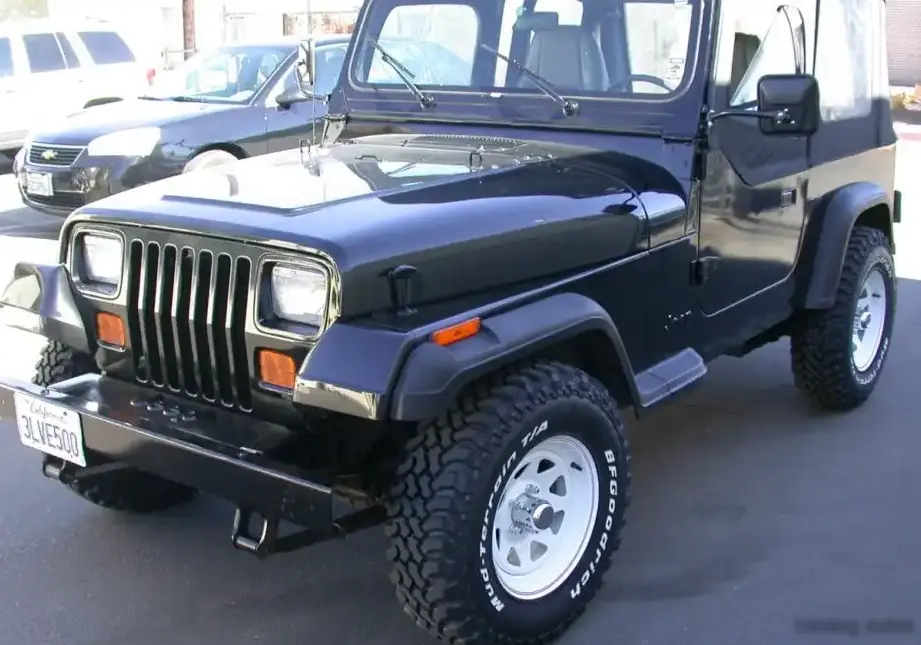
The Jeep Wrangler YJ, produced from 1987 to 1995, represented a significant departure from its predecessor, the CJ series. While retaining the core off-road capability Jeep was known for, the YJ introduced a more modern and rounded design, along with several technological updates. The 2.5-liter inline-four cylinder engine, producing 121 horsepower, was the base engine option throughout the YJ’s production run. This variant occupied the entry-level position in the Wrangler lineup, appealing to buyers prioritizing affordability and basic functionality over outright performance. It served as a popular choice for those seeking a capable and reliable off-road vehicle for recreational use, and a stepping stone into the Jeep brand.
Technical Specifications
| Brand | Jeep |
| Model | Wrangler |
| Generation | Wrangler I (YJ) |
| Type (Engine) | 2.5 i (121 Hp) |
| Start of production | 1987 |
| End of production | 1995 |
| Powertrain Architecture | Internal Combustion engine |
| Body type | Off-road vehicle |
| Seats | 4 |
| Doors | 2 |
| Fuel consumption (combined) | 13.7 l/100 km (17.2 US mpg, 20.6 UK mpg, 7.3 km/l) |
| Fuel Type | Petrol (Gasoline) |
| Acceleration 0 – 100 km/h | 14.8 sec |
| Acceleration 0 – 62 mph | 14.8 sec |
| Acceleration 0 – 60 mph | 14.1 sec |
| Maximum speed | 150 km/h (93.21 mph) |
| Weight-to-power ratio | 12.1 kg/Hp, 82.9 Hp/tonne |
| Weight-to-torque ratio | 7.7 kg/Nm, 130.1 Nm/tonne |
| Power | 121 Hp @ 5400 rpm |
| Power per litre | 49.1 Hp/l |
| Torque | 190 Nm @ 3500 rpm (140.14 lb.-ft. @ 3500 rpm) |
| Engine layout | Front, Longitudinal |
| Engine displacement | 2464 cm3 (150.36 cu. in.) |
| Number of cylinders | 4 |
| Engine configuration | Inline |
| Cylinder Bore | 98.4 mm (3.87 in.) |
| Piston Stroke | 81 mm (3.19 in.) |
| Compression ratio | 9.2:1 |
| Number of valves per cylinder | 2 |
| Fuel injection system | Multi-port manifold injection |
| Engine aspiration | Naturally aspirated engine |
| Engine oil capacity | 3.8 l (4.02 US qt | 3.34 UK qt) |
| Coolant | 8.5 l (8.98 US qt | 7.48 UK qt) |
| Kerb Weight | 1460 kg (3218.75 lbs.) |
| Max. weight | 1950 kg (4299.01 lbs.) |
| Max load | 490 kg (1080.27 lbs.) |
| Trunk (boot) space – minimum | 354 l (12.5 cu. ft.) |
| Trunk (boot) space – maximum | 1223 l (43.19 cu. ft.) |
| Fuel tank capacity | 76 l (20.08 US gal | 16.72 UK gal) |
| Length | 3879 mm (152.72 in.) |
| Width | 1676 mm (65.98 in.) |
| Height | 1735 mm (68.31 in.) |
| Wheelbase | 2373 mm (93.43 in.) |
| Front track | 1473 mm (57.99 in.) |
| Rear (Back) track | 1473 mm (57.99 in.) |
| Drive wheel | All wheel drive (4×4) |
| Number of gears and type of gearbox | 5 gears, manual transmission |
| Front suspension | Leaf spring |
| Rear suspension | Leaf spring |
| Front brakes | Ventilated discs |
| Rear brakes | Drum |
| Power steering | Hydraulic Steering |
| Tires size | 215/75 R15 S |
Powertrain & Engine Architecture
The heart of the YJ 2.5i was the AMC 242 inline-four cylinder engine. This engine, though relatively simple in design, proved to be durable and reliable. It featured a cast iron block and cylinder head, with a two-barrel carburetor initially, transitioning to multi-port fuel injection in later years. The fuel injection system improved efficiency and driveability compared to the earlier carbureted versions. The engine utilized a single overhead camshaft (SOHC) valvetrain with two valves per cylinder. The 5-speed manual transmission was the standard offering, providing adequate gear ratios for both on-road cruising and off-road crawling. The engine’s longitudinal mounting within the chassis contributed to its inherent 4×4 capability, allowing for a direct power transfer to the front and rear axles.
Driving Characteristics
The 121 horsepower and 140 lb-ft of torque produced by the 2.5-liter engine translated to modest performance. Acceleration was leisurely, with a 0-60 mph time hovering around 14 seconds. However, the engine’s torque curve was relatively flat, providing usable power across a broad RPM range. This made it well-suited for low-speed off-road maneuvering, where precise throttle control and consistent power delivery were crucial. Compared to the more powerful 4.0-liter inline-six engine option, the 2.5-liter felt underpowered, especially when fully loaded or tackling steep inclines. The 5-speed manual transmission offered a more engaging driving experience than the optional three-speed automatic, allowing drivers to better control the engine’s power band. The automatic, while providing convenience, resulted in noticeable power loss and slower acceleration.
Equipment & Trim Levels
The base YJ 2.5i typically came with minimal standard equipment. Features included basic steel wheels, vinyl upholstery, and a simple dashboard layout. Power steering was often an optional extra. Higher trim levels, such as the Laredo, added features like aluminum wheels, upgraded upholstery, and additional convenience items. Optional extras included air conditioning, a tilt steering wheel, and upgraded sound systems. The interior was designed with practicality in mind, featuring durable materials and easy-to-clean surfaces. The focus was on functionality rather than luxury.
Chassis & Braking
The YJ chassis was a body-on-frame design, providing excellent durability and off-road capability. The suspension consisted of leaf springs at both the front and rear, offering a comfortable ride on paved roads while maintaining sufficient articulation for off-road use. The front axle featured ventilated disc brakes, while the rear axle utilized drum brakes. This configuration was adequate for the vehicle’s weight and performance, but lacked the stopping power of a four-wheel disc brake system. The steering was hydraulic, providing reasonable maneuverability, although it lacked the precision of more modern steering systems.
Market Reception & Comparison
The YJ 2.5i was generally well-received as an affordable and capable entry-level off-road vehicle. Critics praised its ruggedness and simplicity, but noted its lack of refinement and modest performance. Compared to the 4.0-liter inline-six version, the 2.5-liter offered significantly lower fuel economy, though the difference wasn’t substantial. Reliability was generally good, with the 2.5-liter engine proving to be a durable and long-lasting powerplant. The 2.5L was often favored by those who prioritized cost savings over performance, making it a popular choice for first-time Jeep buyers or those seeking a basic, reliable off-road vehicle.
Legacy
The Jeep Wrangler YJ 2.5i remains a popular choice among enthusiasts and off-roaders today. Its simplicity and durability make it relatively easy to maintain and repair. While not as desirable as the more powerful 4.0-liter models, the 2.5-liter YJ offers a unique blend of affordability and capability. Parts availability is generally good, and a thriving aftermarket supports the YJ platform. The YJ 2.5i represents a significant chapter in the Wrangler’s history, bridging the gap between the classic CJ series and the more modern TJ generation. It continues to be a capable and enjoyable vehicle for those seeking a classic off-road experience.