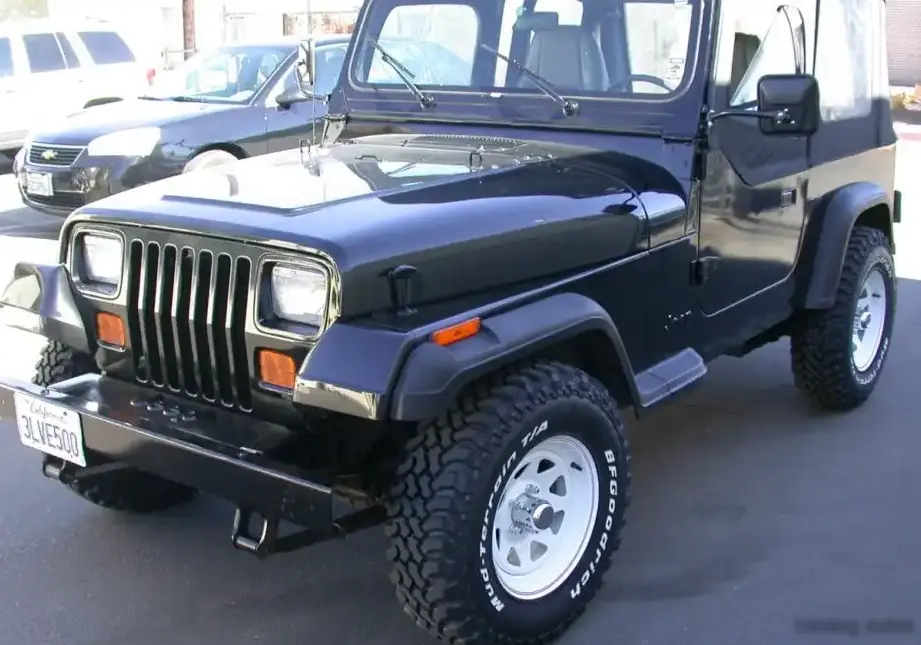
The Jeep Wrangler YJ, produced from 1987 to 1995, represented a significant departure from its predecessor, the CJ series. While retaining the core off-road capability Jeep was known for, the YJ introduced a more modern and rounded design, along with several technological updates. The 4.0-liter inline-six engine variant, producing 184 horsepower, became a popular choice, offering a balance of power and reliability. This configuration positioned itself as a mid-range offering within the YJ lineup, appealing to buyers who desired more performance than the base 2.5-liter four-cylinder, but didn’t require the added cost of potential upgrades or specialized trims. The YJ platform, internally designated as the XJ chassis derivative, was a crucial step in solidifying the Wrangler’s identity as a distinct and capable off-road vehicle.
Technical Specifications
| Brand | Jeep |
| Model | Wrangler |
| Generation | Wrangler I (YJ) |
| Type (Engine) | 4.0 i (184 Hp) |
| Start of production | 1987 |
| End of production | 1995 |
| Powertrain Architecture | Internal Combustion engine |
| Body type | Off-road vehicle |
| Seats | 4 |
| Doors | 2 |
| Fuel consumption (combined) | 15 l/100 km |
| Fuel consumption (US mpg) | 15.7 US mpg |
| Fuel consumption (UK mpg) | 18.8 UK mpg |
| Fuel consumption (km/l) | 6.7 km/l |
| Fuel Type | Petrol (Gasoline) |
| Acceleration 0 – 100 km/h | 9.4 sec |
| Acceleration 0 – 62 mph | 9.4 sec |
| Acceleration 0 – 60 mph | 8.9 sec |
| Maximum speed | 170 km/h |
| Maximum speed (mph) | 105.63 mph |
| Weight-to-power ratio | 8.5 kg/Hp |
| Hp/tonne | 118.3 Hp/tonne |
| Weight-to-torque ratio | 5.4 kg/Nm |
| Nm/tonne | 186.5 Nm/tonne |
| Power | 184 Hp @ 4750 rpm |
| Power per litre | 46.4 Hp/l |
| Torque | 290 Nm @ 3950 rpm |
| Torque (lb.-ft.) | 213.89 lb.-ft. @ 3950 rpm |
| Engine layout | Front, Longitudinal |
| Engine displacement | 3964 cm3 |
| Engine displacement (cu. in.) | 241.9 cu. in. |
| Number of cylinders | 6 |
| Engine configuration | Inline |
| Cylinder Bore | 98.5 mm |
| Cylinder Bore (in.) | 3.88 in. |
| Piston Stroke | 86.7 mm |
| Piston Stroke (in.) | 3.41 in. |
| Compression ratio | 8.8:1 |
| Number of valves per cylinder | 2 |
| Fuel injection system | Multi-port manifold injection |
| Engine aspiration | Naturally aspirated engine |
| Engine oil capacity | 5.7 l |
| Engine oil capacity (US qt) | 6.02 US qt |
| Engine oil capacity (UK qt) | 5.02 UK qt |
| Coolant capacity | 10 l |
| Coolant capacity (US qt) | 10.57 US qt |
| Coolant capacity (UK qt) | 8.8 UK qt |
| Kerb Weight | 1555 kg |
| Kerb Weight (lbs.) | 3428.19 lbs. |
| Max. weight | 1950 kg |
| Max. weight (lbs.) | 4299.01 lbs. |
| Max load | 395 kg |
| Max load (lbs.) | 870.83 lbs. |
| Trunk (boot) space – minimum | 354 l |
| Trunk (boot) space – minimum (cu. ft.) | 12.5 cu. ft. |
| Trunk (boot) space – maximum | 1223 l |
| Trunk (boot) space – maximum (cu. ft.) | 43.19 cu. ft. |
| Fuel tank capacity | 76 l |
| Fuel tank capacity (US gal) | 20.08 US gal |
| Fuel tank capacity (UK gal) | 16.72 UK gal |
| Length | 3859 mm |
| Length (in.) | 151.93 in. |
| Width | 1740 mm |
| Width (in.) | 68.5 in. |
| Height | 1765 mm |
| Height (in.) | 69.49 in. |
| Wheelbase | 2373 mm |
| Wheelbase (in.) | 93.43 in. |
| Front track | 1473 mm |
| Front track (in.) | 57.99 in. |
| Rear (Back) track | 1473 mm |
| Rear (Back) track (in.) | 57.99 in. |
| Drive wheel | All wheel drive (4×4) |
| Number of gears | 5 |
| Gearbox type | manual transmission |
| Front suspension | Leaf spring |
| Rear suspension | Leaf spring |
| Front brakes | Ventilated discs |
| Rear brakes | Drum |
| Power steering | Hydraulic Steering |
| Tires size | 225/75 R15S |
Powertrain & Engine Architecture
The heart of the Wrangler YJ 4.0 i is the 4.0-liter (3964 cc) AMC inline-six cylinder engine. This engine, designated with codes like the 4.0L and later variations, was renowned for its durability and relatively simple design. It featured a cast iron block and cylinder head, a 8.8:1 compression ratio, and a multi-port fuel injection system. The engine’s valvetrain consisted of two valves per cylinder, operated by a single overhead camshaft. The 4.0L engine produced 184 horsepower at 4750 rpm and 290 Nm (213.89 lb-ft) of torque at 3950 rpm. This torque output was particularly beneficial for off-road driving, providing ample low-end grunt. The standard transmission for this variant was a 5-speed manual, although a 3-speed automatic transmission was also available. The automatic transmission, a Chrysler A727 Torqueflite derivative, was known for its robustness but offered less efficient power delivery compared to the manual.
Driving Characteristics
The Wrangler YJ 4.0 i with the 5-speed manual transmission offered a reasonably engaging driving experience. Acceleration to 60 mph took approximately 8.9 seconds, which was respectable for the era and vehicle type. The 4.0L engine provided sufficient power for highway cruising and tackling moderate off-road trails. The automatic transmission version, while offering convenience, noticeably dulled acceleration and reduced fuel economy. The automatic’s gear ratios were optimized for towing and low-speed crawling, but at the expense of responsiveness. The YJ’s solid axles and leaf spring suspension provided a comfortable ride on paved roads, but the handling was not particularly precise. Off-road, the YJ excelled, with its robust drivetrain and ample ground clearance allowing it to navigate challenging terrain with ease.
Equipment & Trim Levels
The 4.0-liter Wrangler YJ typically came standard with features like a tilt steering wheel, full instrumentation, and a basic sound system. Interior upholstery was typically vinyl or cloth, with options for upgraded materials. The base trim level offered minimal frills, while higher trims, such as the Sahara, included features like air conditioning, upgraded wheels, and a more refined interior. Optional extras included a winch, roll bar, and various off-road packages. The dashboard layout was functional and straightforward, prioritizing practicality over aesthetics.
Chassis & Braking
The Wrangler YJ utilized a body-on-frame construction, providing a robust and durable chassis. The suspension consisted of leaf springs at both the front and rear, offering a good balance of ride comfort and off-road capability. The front brakes were ventilated discs, while the rear brakes were drums. This configuration was adequate for the vehicle’s weight and intended use, but lacked the stopping power of more modern braking systems. Power steering was standard, making the YJ relatively easy to maneuver, even with its large tires.
Market Reception & Comparison
The Wrangler YJ 4.0 i was generally well-received by automotive critics and consumers alike. It was praised for its off-road capability, durability, and relatively affordable price. Compared to the base 2.5-liter four-cylinder model, the 4.0-liter offered a significant performance upgrade, making it a more desirable option for those who frequently ventured off the beaten path. Fuel economy was a weak point, averaging around 15.7 US mpg in combined driving. However, this was not a major concern for most Wrangler buyers, who prioritized capability over fuel efficiency. The 4.0L engine proved to be exceptionally reliable, with many examples exceeding 200,000 miles with proper maintenance.
Legacy
The Jeep Wrangler YJ 4.0 i remains a popular choice among off-road enthusiasts and classic Jeep collectors. Its simple design, robust powertrain, and readily available parts make it a relatively easy vehicle to maintain and modify. The 4.0L inline-six engine is particularly well-regarded for its longevity and reliability. Today, well-maintained YJs command a respectable price in the used car market, and they continue to be a common sight on off-road trails across the country. The YJ’s legacy as a capable and iconic off-road vehicle is firmly established, and it remains a testament to Jeep’s enduring commitment to adventure.