
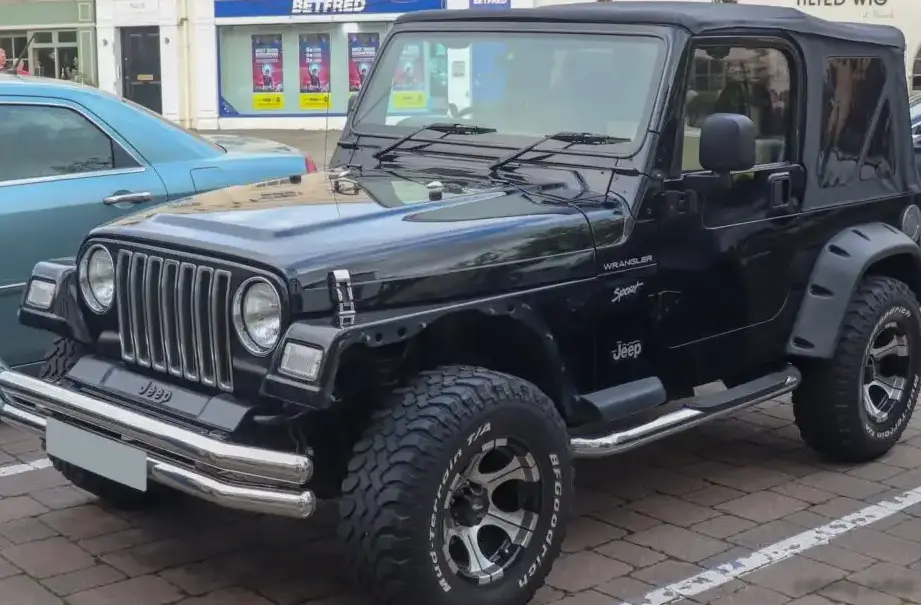
The Jeep Wrangler TJ, produced from 1997 to 2006, represented a significant leap forward for the iconic off-road vehicle. The 4.0i variant, specifically those manufactured between 2000 and 2006, occupied a sweet spot in the lineup, offering a balance of power, capability, and relative affordability. This model year saw the introduction of coil spring suspension across the board, a major improvement over the leaf spring setup of previous generations, enhancing both on-road ride quality and off-road articulation. The 4.0i, with its 192 horsepower inline-six engine, became a popular choice for Wrangler enthusiasts seeking a capable and reliable vehicle for both daily driving and weekend adventures.
Technical Specifications
| Brand | Jeep |
| Model | Wrangler |
| Generation | Wrangler II (TJ) |
| Type (Engine) | 4.0 i (192 Hp) |
| Start of production | 2000 year |
| End of production | 2006 year |
| Powertrain Architecture | Internal Combustion engine |
| Body type | Off-road vehicle |
| Seats | 5 |
| Doors | 2 |
| Fuel consumption (economy) – urban | 14.7 l/100 km (16 US mpg, 19.2 UK mpg, 6.8 km/l) |
| Fuel consumption (economy) – extra urban | 12.4 l/100 km (19 US mpg, 22.8 UK mpg, 8.1 km/l) |
| Fuel Type | Petrol (Gasoline) |
| Acceleration 0 – 100 km/h | 9.1 sec |
| Acceleration 0 – 62 mph | 9.1 sec |
| Acceleration 0 – 60 mph | 8.6 sec |
| Maximum speed | 170 km/h (105.63 mph) |
| Weight-to-power ratio | 7.8 kg/Hp, 128.4 Hp/tonne |
| Weight-to-torque ratio | 4.7 kg/Nm, 212.7 Nm/tonne |
| Power | 192 Hp @ 4600 rpm |
| Power per litre | 48.5 Hp/l |
| Torque | 318 Nm @ 3000 rpm (234.54 lb.-ft. @ 3000 rpm) |
| Engine layout | Front, Longitudinal |
| Engine Model/Code | ERH |
| Engine displacement | 3956 cm3 (241.41 cu. in.) |
| Number of cylinders | 6 |
| Engine configuration | Inline |
| Cylinder Bore | 98.4 mm (3.87 in.) |
| Piston Stroke | 86.7 mm (3.41 in.) |
| Compression ratio | 8.8:1 |
| Number of valves per cylinder | 2 |
| Fuel injection system | Multi-port manifold injection |
| Engine aspiration | Naturally aspirated engine |
| Engine oil capacity | 5.7 l (6.02 US qt | 5.02 UK qt) |
| Coolant | 9.9 l (10.46 US qt | 8.71 UK qt) |
| Kerb Weight | 1495 kg (3295.91 lbs.) |
| Max. weight | 1965 kg (4332.08 lbs.) |
| Max load | 470 kg (1036.17 lbs.) |
| Trunk (boot) space – minimum | 320 l (11.3 cu. ft.) |
| Trunk (boot) space – maximum | 1045 l (36.9 cu. ft.) |
| Fuel tank capacity | 57 l (15.06 US gal | 12.54 UK gal) |
| Length | 3883 mm (152.87 in.) |
| Width | 1694 mm (66.69 in.) |
| Height | 1750 mm (68.9 in.) |
| Wheelbase | 2373 mm (93.43 in.) |
| Front track | 1473 mm (57.99 in.) |
| Rear (Back) track | 1473 mm (57.99 in.) |
| Drive wheel | All wheel drive (4×4) |
| Number of gears and type of gearbox | 5 gears, manual transmission |
| Front suspension | Coil spring |
| Rear suspension | Coil spring |
| Front brakes | Ventilated discs |
| Rear brakes | Drum |
| Power steering | Hydraulic Steering |
| Tires size | 215/75 R15 |
Powertrain & Engine Architecture
The heart of the 2000-2006 Jeep Wrangler TJ 4.0i is the 4.0-liter (3956 cc) inline-six cylinder engine, designated the ERH code. This engine, a descendant of the AMC 199 engine family, had been a mainstay of Jeep vehicles for decades, known for its durability and relatively simple design. It utilizes a cast iron block and cylinder head, contributing to its robustness. The engine employs a multi-port fuel injection system, delivering fuel directly to each intake port for improved efficiency and power delivery. The valvetrain consists of two valves per cylinder, operated by a single overhead camshaft. The 4.0L engine produced 192 horsepower at 4600 rpm and 234 lb-ft of torque at 3000 rpm. The standard transmission for this variant was a five-speed manual, though a four-speed automatic transmission was also available. The automatic transmission, a Chrysler 42RE unit, was known for its reliability but wasn’t as fuel-efficient as the manual option.
Driving Characteristics
The 4.0i Wrangler TJ offered a noticeable step up in performance compared to the earlier 2.5-liter four-cylinder models. While not a sports car, the 4.0L engine provided ample torque for off-road crawling and sufficient power for highway cruising. The five-speed manual transmission allowed for precise control and maximized fuel economy, while the four-speed automatic offered convenience, particularly in stop-and-go traffic. The automatic transmission’s gear ratios were geared more towards torque multiplication than outright acceleration. The 4.0i felt capable and responsive, making it a versatile vehicle for a wide range of driving conditions. Compared to the later 4.7L V8 option, the 4.0L was less powerful but more fuel-efficient and arguably more balanced in terms of overall capability.
Equipment & Trim Levels
The 4.0i Wrangler TJ was available in several trim levels, including Sport, Sahara, and Rubicon. The base Sport model typically included features like air conditioning, a tilt steering wheel, and basic instrumentation. The Sahara trim added upgrades such as alloy wheels, upgraded upholstery, and a premium sound system. The Rubicon, the most off-road focused trim, featured heavy-duty axles, a transfer case with a low range, and rock rails. Optional extras included a power windows and locks, a CD player, and a tow package. Interior upholstery was typically cloth, with leather options available on higher trims. The dashboard layout was functional and straightforward, prioritizing usability over luxury.
Chassis & Braking
The Wrangler TJ chassis was a body-on-frame design, providing excellent durability and off-road capability. The switch to coil spring suspension in 1997 was a significant improvement, offering a more comfortable ride and improved articulation. The front suspension utilized a multi-link design with coil springs, while the rear suspension featured a solid axle with coil springs. Braking duties were handled by ventilated discs in the front and drum brakes in the rear. Power-assisted hydraulic steering provided responsive handling. The standard tire size was 215/75R15, though larger tires were often fitted by owners for improved off-road performance.
Market Reception & Comparison
The 2000-2006 Jeep Wrangler TJ 4.0i was well-received by automotive critics and consumers alike. It was praised for its off-road capability, rugged styling, and relatively affordable price. Compared to the 2.5L four-cylinder models, the 4.0i offered a significant performance boost. Compared to the 4.7L V8, it provided better fuel economy and a more manageable power curve for off-road driving. Reliability was generally good, although some owners reported issues with the cooling system and electrical components. Fuel economy was rated at around 16 mpg city and 19 mpg highway, which was typical for a vehicle of its type and size.
Legacy
The Jeep Wrangler TJ 4.0i has become a highly sought-after vehicle in the used car market. Its combination of capability, reliability, and affordability has made it a popular choice for enthusiasts and weekend warriors. The 4.0L inline-six engine is known for its longevity, and many examples are still running strong with proper maintenance. While some components may require attention due to age, the TJ is generally considered a relatively easy vehicle to maintain and repair. The TJ represents a pivotal moment in Wrangler history, bridging the gap between the classic CJ models and the more modern JK generation. It remains a beloved icon of American off-road culture.
